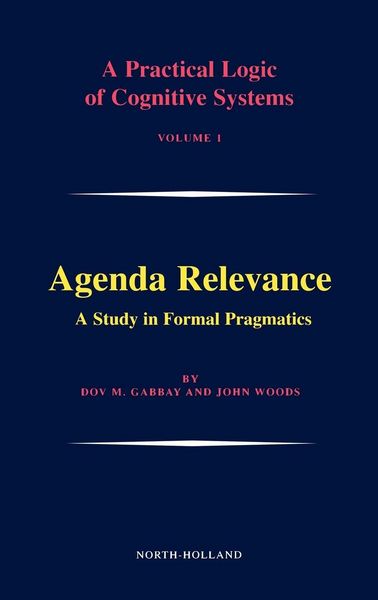
Agenda Relevance A Study in Formal Pragmatics
188,99 €
inkl. gesetzl. MwSt.,
Beschreibung
Produktdetails
Einband
Gebundene Ausgabe
Erscheinungsdatum
01.05.2003
Verlag
Elsevier BvSeitenzahl
528
Maße (L/B/H)
23,4/15,6/2,9 cm
Gewicht
912 g
Sprache
Englisch
ISBN
978-0-444-51385-4
Agenda Relevance is the first volume in the authors' omnibus investigation of
the logic of practical reasoning, under the collective title, A Practical Logic
of Cognitive Systems. In this highly original approach, practical reasoning is
identified as reasoning performed with comparatively few cognitive assets,
including resources such as information, time and computational capacity. Unlike
what is proposed in optimization models of human cognition, a practical reasoner
lacks perfect information, boundless time and unconstrained access to
computational complexity. The practical reasoner is therefore obliged to be a
cognitive economizer and to achieve his cognitive ends with considerable
efficiency. Accordingly, the practical reasoner avails himself of various
scarce-resource compensation strategies. He also possesses neurocognitive
traits that abet him in his reasoning tasks. Prominent among these is the
practical agent's striking (though not perfect) adeptness at evading irrelevant
information and staying on task. On the approach taken here, irrelevancies are
impediments to the attainment of cognitive ends. Thus, in its most basic sense,
relevant information is cognitively helpful information. Information can then be
said to be relevant for a practical reasoner to the extent that it advances or
closes some cognitive agenda of his. The book explores this idea with a
conceptual detail and nuance not seen the standard semantic, probabilistic and
pragmatic approaches to relevance; but wherever possible, the authors seek to
integrate alternative conceptions rather than reject them outright. A further
attraction of the agenda-relevance approach is the extent to which its principal
conceptual findings lend themselves to technically sophisticated re-expression
in formal models that marshal the resources of time and action logics and
label led deductive systems.
Agenda Relevance is necessary reading for researchers in logic, belief
dynamics, computer science, AI, psychology and neuroscience, linguistics,
argumentation theory, and legal reasoning and forensic science, and will repay
study by graduate students and senior undergraduates in these same fields.
Key features:
¿ relevance
¿ action and agendas
¿ practical reasoning
¿ belief dynamics
¿ non-classical logics
¿ labelled deductive systems
Noch keine Bewertungen vorhanden
Verfassen Sie die erste Bewertung zu diesem Artikel
Helfen Sie anderen Kundinnen und Kunden durch Ihre Meinung.
Kurze Frage zu unserer Seite
Vielen Dank für Ihr Feedback
Wir nutzen Ihr Feedback, um unsere Produktseiten zu verbessern. Bitte haben Sie Verständnis, dass wir Ihnen keine Rückmeldung geben können. Falls Sie Kontakt mit uns aufnehmen möchten, können Sie sich aber gerne an unseren Kund*innenservice wenden.
zum Kundenservice