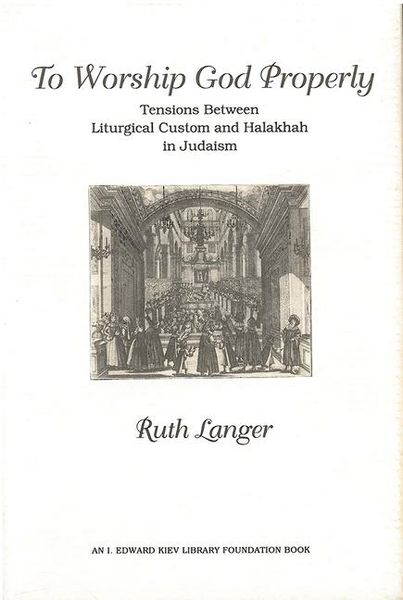
To Worship God Properly Tensions Between Liturgical Custom and Halakhah in Judaism
-
- Taschenbuch ausgewählt
- eBook
-
Sprache:Englisch
36,99 €
inkl. gesetzl. MwSt.,
Beschreibung
Produktdetails
Einband
Taschenbuch
Erscheinungsdatum
29.11.1998
Verlag
ISD International - IPSUKSeitenzahl
287
Maße (L/B/H)
22,3/15,4/2,7 cm
Gewicht
458 g
Sprache
Englisch
ISBN
978-0-87820-458-8
A major influence on the development of rabbinic liturgical custom after the destruction of the Temple was the need to establish that this innovative worship of the heart was as acceptable to God as biblically prescribed sacrificial worship. Later Jewish communities and their leaders continually refined the details of the system they inherited to reflect their changing understandings of acceptable, meaningful, and constructive worship. These understandings have in turn been shaped not only by liturgical halakhah and active custom, but by new intellectual and social currents and by the vicissitudes of Jewish history. Ruth Langer uses the tools of historical scholarship and anthropological study of ritual to analyze some of the dynamics that have shaped Jewish liturgical law and determined the broader outlines of the prayer life of the Jews. After a consideration of the talmudic issues upon which the acceptability of prayer depends, she offers a basic list of legal principles derived by later generations from talmudic literature to ensure that prayer takes the form of blessings composed according to a very specific pattern and invoking God in a very precise way. She then investigates the development and implementation of the corollary that invoking this blessing formula in ways that deviate from the specific directions of the Talmud constitutes precisely inefficacious and even dangerous prayer. Questions about appropriate prayer language go beyond the blessing formula to the contents of the prayers themselves. Langer analyzes the battles fought over the legitimacy of inserting liturgical poetry into the fixed texts of the statutory liturgy and over the requirement of community for the proper recitation of certain prayers, specifically those that include the angelic liturgy. Although in each of these controversies the rabbis compromised by reinterpreting either legal theory or custom-or both-to bring them into harmony, their solutions have never been monolithic or simple. In its lucid illumination of those complexities, To Worship God Properly adds to our understanding of the history of Jewish liturgy and the general history of rabbinic leadership and law.
Noch keine Bewertungen vorhanden
Verfassen Sie die erste Bewertung zu diesem Artikel
Helfen Sie anderen Kundinnen und Kunden durch Ihre Meinung.
Kurze Frage zu unserer Seite
Vielen Dank für Ihr Feedback
Wir nutzen Ihr Feedback, um unsere Produktseiten zu verbessern. Bitte haben Sie Verständnis, dass wir Ihnen keine Rückmeldung geben können. Falls Sie Kontakt mit uns aufnehmen möchten, können Sie sich aber gerne an unseren Kund*innenservice wenden.
zum Kundenservice