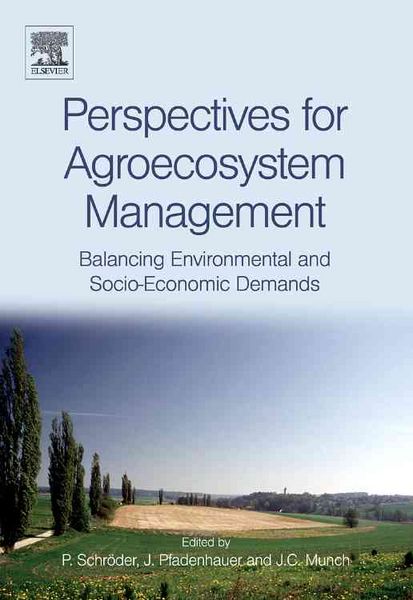
Produktbild: Perspectives for Agroecosystem Management:

Perspectives for Agroecosystem Management: Balancing Environmental and Socio-Economic Demands

89,99 €

inkl. gesetzl. MwSt., Versandkostenfrei


Beschreibung

Produktdetails

Einband

Gebundene Ausgabe

Erscheinungsdatum

01.01.2008

Herausgeber

Peter Schroder + weitere

Verlag

Elsevier Science & Technology

Seitenzahl

456

Maße (L/B/H)

24,2/18/2,4 cm

Gewicht

966 g

Sprache

Englisch

ISBN

978-0-444-51905-4

Beschreibung

Produktdetails

Einband

Gebundene Ausgabe

Erscheinungsdatum

01.01.2008

Herausgeber

Verlag

Elsevier Science & Technology

Seitenzahl

456

Maße (L/B/H)

24,2/18/2,4 cm

Gewicht

966 g

Sprache

Englisch

ISBN

978-0-444-51905-4

Herstelleradresse

Libri GmbH
Europaallee 1
36244 Bad Hersfeld
DE

Email: gpsr@libri.de

Noch keine Bewertungen vorhanden

Verfassen Sie die erste Bewertung zu diesem Artikel

Helfen Sie anderen Kundinnen und Kunden durch Ihre Meinung.

Kundinnen und Kunden meinen

Bewertungen (0)

  • Produktbild: Perspectives for Agroecosystem Management:

  • List of Contributors

    Preface

    Part I: Approaching Sustainable Agriculture

    1.1 Outline of the Scheyern Project

    1.1.1 Background

    1.1.2 Research Station and Project Phases

    1.1.3 Two Farming Systems

    1.2 Sustainable Land Use by Organic and Integrated Farming Systems

    1.2.1 Organic Farming System in Scheyern

    1.2.2 Integrated Farming System in Scheyern

    1.2.3 Discussion

    Part II: Management of Heterogeneous Systems

    2.1 Effects of the Management System on N-, C-, P- and K-Fluxes from FAM Soils

    2.1.1 Introduction

    2.1.2 Materials and Methods

    2.1.3 Results

    2.1.4 Conclusions

    2.2 Main Driving Variables and Effect of Soil Management on Climate or Ecosystem-Relevant Trace Gas Fluxes from Fields of the FAM

    2.2.1 Production and Consumption of the Climaterelevant Trace Gases Nitrous Oxide and Methane in Soils

    2.2.2 Important Controlling Factors for N2O Fluxes at the FAM Sites

    2.2.3 Important Controlling Factors for CH4 Fluxes Mat The FAM Sites

    2.2.4 Ammonia Emissions from Agricultural Land Use

    2.3 Precision Farming - Adaptation of Land Use Management to Small Scale Heterogeneity

    2.3.1 Basics and Objective

    2.3.2 Development of Methods to Characterize Spatial Variability of Soils, Crops, and Yield

    2.3.3 Development of Site-Specific Crop Production Strategies

    2.3.4 Conclusions

    Part III: Influence of Land Use Changes on the Biotic Environment

    3.1 Effects of Land Use Changes on the Plant Species Diversity in Agricultural Ecosystems

    3.1.1 Introduction

    3.1.2 Land Use Systems Practised in the Research Area

    3.1.3 Vegetation Analysis

    3.1.4 Results

    3.1.5 Discussion

    3.1.6 Conclusions

    3.2 Long-Term Effects of Reduced Tillage on the Populations of Arable Weeds

    3.2.1 Introduction

    3.2.2 Research Area and Management

    3.2.3 Materials and Methods

    3.2.4 Results and Discussion

    3.2.5 Conclusions

    3.3 Dispersal Strategies: Are They Responsible for Species Success in Arable Ecosystems?

    3.3.1 Introduction

    3.3.2 Specific Ways of Dispersal in Arable Ecosystems

    3.3.3 Dispersal by Human Activity - a Dispersal Strategy or a Random Process?

    3.3.4 Dispersal Opportunity and Species Success

    3.3.5 Cirsium Arvense and Veronica Triphyllos - a Successful and a Stagnant Species

    3.3.6 Conclusions

    3.4 Soil Microbial Communities and Related Functions

    3.4.1 Introduction

    3.4.2 Materials and Methods

    3.4.3 Singular Environmental and Anthropogenic Effects

    3.4.4 Effect of Land Use and Farming Systems

    3.4.5 Precision Farming: Site-Specific Fertilization

    3.5 Mesofauna

    3.5.1 Introduction

    3.5.2 Occurrence and Distribution of Mesofauna

    3.5.3 Indicator Value

    3.5.4 Collembola and their Influence on Microbial Diversity

    3.5.5 Perspective

    3.6 Spiders (Araneae) in Arable Land: Species Community, Influence of Land Use on Diversity, and Biocontrol Significance

    3.6.1 Introduction

    3.6.2 The Community of Foliage-Dwelling Spiders in Arable Land

    3.6.3 The Influence of Land Use on Foliage-Dwelling Spiders in Field Margins

    3.6.4 Biocontrol Significance of Spiders

    3.6.5 Concluding Remarks

    Part IV: Influence of the Land Use Changes on the Abiotic Environment

    4.1 Development and Application of Agro-Ecosystem Models

    4.1.1 Introduction

    4.1.2 Modular Model Development

    4.1.3 Retrospective Modeling of Soil Water Flow

    4.1.5 Crop Growth Modeling

    4.1.4 Simulation of Organic Matter Turnover and Nitrate Leaching

    4.1.6 assessment of Nitrous Oxide Emissions

    4.1.7 Conclusions

    4.2 Assessment of Soil Landscape Variability

    4.2.1 Introduction

    4.2.2 Terrain Analysis

    4.2.3 Electromagnetic Induction

    4.2.4 Remote Sensing

    4.2.5 Conclusions

    4.3 Changes in Nutrient Status on the Experimental Station Klostergut Scheyern from 1991 to 2001 - Statistical and Geostatistical Analysis

    4.3.1 Introduction

    4.3.2 Material and Methods

    4.3.3 Results

    4.3.4 Discussion

    Outlook

    Index

    Color Plate Section