Beschreibung
Produktdetails
Einband
Taschenbuch
Erscheinungsdatum
01.04.1993
Verlag
University Press Of KansasSeitenzahl
336
Maße (L/B/H)
22,5/18,1/1,8 cm
Gewicht
458 g
Sprache
Englisch
ISBN
978-0-7006-0684-9
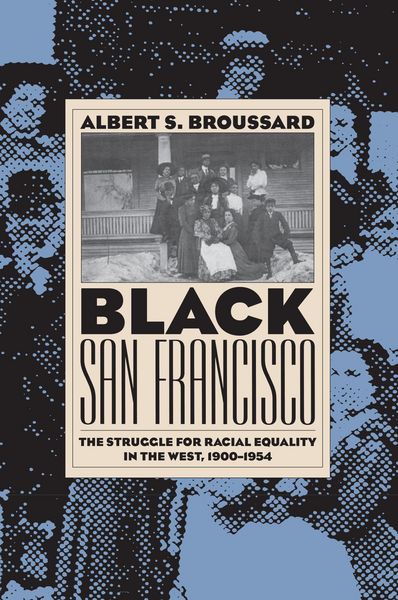
By 1867 black San Franciscans had gained access to public transportation. In 1869 they were granted the right to vote by the state of California. In 1875 they fought for desegregated schools and won. Yet in 1957, Willie Mays was initially denied the opportunity to purchase a home in an exclusive San Francisco neighborhood because he was black.
In Black San Francisco, Albert Broussard explores race relations in a city where whites, for the most part, were outwardly civil to blacks while denying them employment opportunities and political power. Understanding the texture of the racial caste system, he argues, is critical to understanding why blacks made so little progress in employment, housing, and politics despite the absence of segregation laws. When it came to racial equality in the early twentieth century, Broussard argues, the liberal progressive image of San Francisco was largely a facade. Illustrating how black San Franciscans struggled to achieve equality in the same manner as their counterparts in the Midwest and East, he challenges the rhetoric of progress and opportunity with evidence of the reality of inequality for black San Franciscans. Black San Francisco is considerably broader in scope than any previous study of African-Americans in the West. It provides extensive coverage of the city's black community during the Great Depression and the New Deal, details civil rights activities from 1915 to 1954, and provides extensive biographical material on local black leaders. In his reconstruction of the plight of San Francisco's black citizens, Broussard reveals a population that, despite its small size before 1940, did not accept second-class citizenship passively yet remained nonviolent into the 1960s. He also shows how World War II was a watershed for Black San Francisco, bringing thousands of southern migrants to the bay area to work in the war industries. These migrants, in tandem with native black residents, formed coalitions with white liberals to attack racial inequality more vigorously and successfully than at any previous time in San Francisco's history.Noch keine Bewertungen vorhanden
Verfassen Sie die erste Bewertung zu diesem Artikel
Helfen Sie anderen Kundinnen und Kunden durch Ihre Meinung.
Kurze Frage zu unserer Seite
Vielen Dank für Ihr Feedback
Wir nutzen Ihr Feedback, um unsere Produktseiten zu verbessern. Bitte haben Sie Verständnis, dass wir Ihnen keine Rückmeldung geben können. Falls Sie Kontakt mit uns aufnehmen möchten, können Sie sich aber gerne an unseren Kund*innenservice wenden.
zum Kundenservice