
• Produktbild: Globalization and Armed Conflict
  • Produktbild: Globalization and Armed Conflict

Globalization and Armed Conflict

82,99 €

inkl. gesetzl. MwSt., Versandkostenfrei


Beschreibung

Produktdetails

Einband

Taschenbuch

Erscheinungsdatum

11.06.2003

Herausgeber

Schneider Gerald + weitere

Verlag

Rowman & Littlefield

Seitenzahl

384

Maße (L/B/H)

22,9/15,2/2,2 cm

Gewicht

494 g

Sprache

Englisch

ISBN

978-0-7425-1832-2

Beschreibung

Portrait

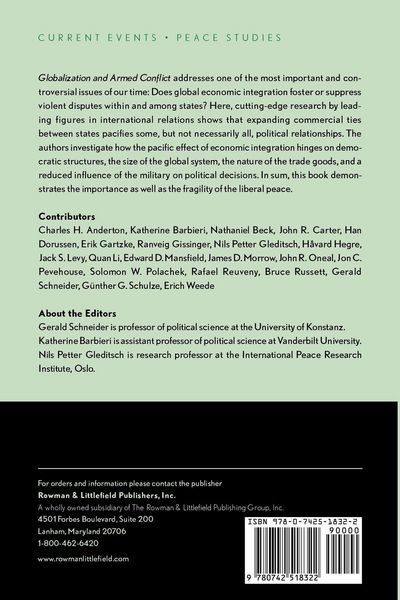
Gerald Schneider is professor of political science at the University of Konstanz. Katherine Barbieri is assistant professor of political science at Vanderbilt University. Nils Petter Gleditsch is senior research fellow at the International Peace Research Institute, Oslo.

Produktdetails

Einband

Taschenbuch

Erscheinungsdatum

11.06.2003

Herausgeber

Verlag

Rowman & Littlefield

Seitenzahl

384

Maße (L/B/H)

22,9/15,2/2,2 cm

Gewicht

494 g

Sprache

Englisch

ISBN

978-0-7425-1832-2

Herstelleradresse

Libri GmbH
Europaallee 1
36244 Bad Hersfeld
DE

Email: gpsr@libri.de

Noch keine Bewertungen vorhanden

Verfassen Sie die erste Bewertung zu diesem Artikel

Helfen Sie anderen Kundinnen und Kunden durch Ihre Meinung.

Kundinnen und Kunden meinen

Bewertungen (0)

Die Leseprobe wird geladen.
  • Produktbild: Globalization and Armed Conflict
  • Produktbild: Globalization and Armed Conflict
  • Part 1 I Competing Models of the Peace-Through-Globalization Hypothesis
    Chapter 2 Does Globalization Contribute to Peace? A Critical Survey of the Literature
    Chapter 3 Multilateral Interactions in the Trade-Conflict Model
    Chapter 4 When Do 'Relative Gains' Impede Trade?
    Chapter 5 Extending the Multi-Country Model of Trade and Conflict
    Chapter 6 The Domestic Roots of Commercial Liberalism: A Sector-Specific Approach
    Chapter 7 How Globalization Can Reduce International Conflict
    Part 8 II Empirical Contributions
    Chapter 9 Assessing the Liberal Peace with Alternative Specifications: Trade Still Reduces Conflict
    Chapter 10 Modeling Dynamics in the Study of Conflict: A Comment on Oneal and Russett
    Chapter 11 Modeling Conflict While Studying Dynamics: A Response to Nathaniel Beck
    Chapter 12 The Trade and Conflict Debate: Exploring the Frontier
    Chapter 13 Development and the Liberal Peace: What Does it Take to be a Trading State?
    Chapter 14 Institutions, Interdependence, and International Conflict
    Chapter 15 Globalization and Internal Conflict
    Chapter 16 The Trade-Disruption Hypothesis and the Liberal Economic Theory of Peace
    Chapter 17 Does War Disrupt Trade?
    Chapter 18 Globalization: Creative Destruction and the Prospect of a Capitalist Peace