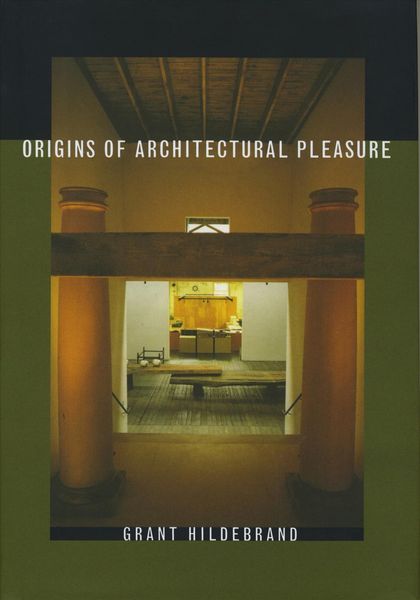
Origins of Architectural Pleasure
-
- Englisch ausgewählt
99,99 €
inkl. gesetzl. MwSt.,
Beschreibung
Produktdetails
Einband
Taschenbuch
Erscheinungsdatum
30.06.1999
Abbildungen
121 black-and-white photos, 8 line figures.
Herausgeber
Grant HildebrandVerlag
De Gruyter OldenbourgSeitenzahl
204
Maße (L/B/H)
26,4/18,5/2,2 cm
Gewicht
736 g
Sprache
Englisch
ISBN
978-0-520-21505-4
Do survival instincts have anything to do with our architectural choices--our liking for a certain room, a special stairway, a plaza in a particular city? In this engaging study Grant Hildebrand discusses ways in which architectural forms emulate some archetypal settings that humans have found appealing--and useful to survival--from ancient times to the present.
Speculating that nature has "designed" us to prefer certain conditions and experiences, Hildebrand is interested in how the characteristics of our most satisfying built environments mesh with Darwinian selection. In examining the appeal of such survival-based characteristics he cites architectural examples spanning five continents and five millennia. Among those included are the Palace of Minos, the Alhambra, Wells cathedral, the Shinto shrine at Ise, the Piazza San Marco, Brunelleschi's Pazzi Chapel, Frank Lloyd Wright's Fallingwater, a Seattle condominium, and recent houses by Eric Owen Moss and Arne Bystrom.
Just what characteristics bestow evolutionary benefits? "Refuge and prospect" offer a protective place of concealment close to a foraging and hunting ground. "Enticement" invites the safe exploration of an information-rich setting where worthwhile discoveries await. "Peril" elicits an emotion of pleasurable fear and so tests and increases our competence in the face of danger: thus the attraction of a skyscraper or a house poised over a vertiginous ravine. "Order and complexity" tease our intuitions for sorting complex information into survival-useful categories.
Gracefully written, with excellent illustrations that complement the text, Origins of Architectural Pleasure will open the reader's eyes to new ways of seeing a home, a workplace, a vacation setting, even a particular table in a restaurant. It also suggests important design considerations for buildings with a more pressing mandate for human appeal, such as hospitals, retirement homes, and hospices.
Noch keine Bewertungen vorhanden
Verfassen Sie die erste Bewertung zu diesem Artikel
Helfen Sie anderen Kundinnen und Kunden durch Ihre Meinung.
Kurze Frage zu unserer Seite
Vielen Dank für Ihr Feedback
Wir nutzen Ihr Feedback, um unsere Produktseiten zu verbessern. Bitte haben Sie Verständnis, dass wir Ihnen keine Rückmeldung geben können. Falls Sie Kontakt mit uns aufnehmen möchten, können Sie sich aber gerne an unseren Kund*innenservice wenden.
zum Kundenservice