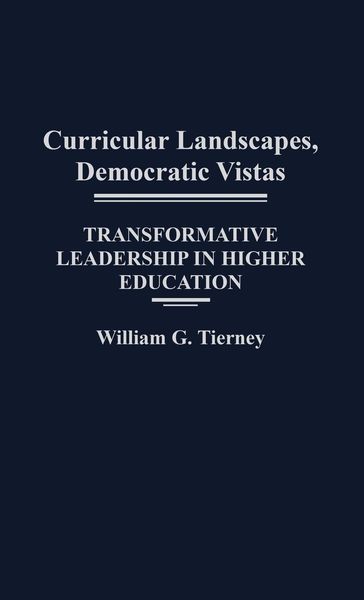

Curricular Landscapes, Democratic Vistas Transformative Leadership in Higher Education
-
- Englisch ausgewählt
89,99 €
inkl. gesetzl. MwSt.,
Beschreibung
Produktdetails
Einband
Gebundene Ausgabe
Erscheinungsdatum
26.09.1989
Verlag
Bloomsbury AcademicSeitenzahl
194
Maße (L/B/H)
22,2/14,5/1,4 cm
Gewicht
382 g
Sprache
Englisch
ISBN
978-0-275-93371-5
William G. Tierney offers a different way of thinking about the curriculum in post-secondary curriculum than is customary. Through an in-depth analysis of seven ethnographic case studies, the author demonstrates how the curriculum itself is a cultural product which institutions of higher education construct socially. The manner in which the individual institution defines its curriculum, Tierney argues, commits it to certain philosophical and ideological choices, whether these are overtly recognized or not. It is the result of a year's research that included over 250 interviews at seven colleges in universities throughout the U.S. The volume concludes with recommendations administrators and faculty may employ in the effort to advance democracy in their colleges and universities.
Organized around the theme of institutional curricula acting as a critical agent for preparing students to participate in the democratic sphere, the book begins by providing a conceptual map for the chapters which follow. Both curricular and cultural theories are reviewed and discussed. The next two sections explore the archaeology of the curriculum at the seven institutions under study. After examining the ways in which participants at the seven colleges and universities view different curricular concepts, the author illustrates how the individuals view one another's actions about the curriculum. As he demonstrates, the curriculum often becomes contested terrain because of the cultural constructions different groups develop about one another and toward the curriculum. Finally, the author offers an interpretation and analysis of the different curricula of the seven institutions, concluding with a discussion of how organizational participants might assume the roles of transformative leaders who create new curricular paths and directions for their organizations.Noch keine Bewertungen vorhanden
Verfassen Sie die erste Bewertung zu diesem Artikel
Helfen Sie anderen Kundinnen und Kunden durch Ihre Meinung.
Kurze Frage zu unserer Seite
Vielen Dank für Ihr Feedback
Wir nutzen Ihr Feedback, um unsere Produktseiten zu verbessern. Bitte haben Sie Verständnis, dass wir Ihnen keine Rückmeldung geben können. Falls Sie Kontakt mit uns aufnehmen möchten, können Sie sich aber gerne an unseren Kund*innenservice wenden.
zum Kundenservice