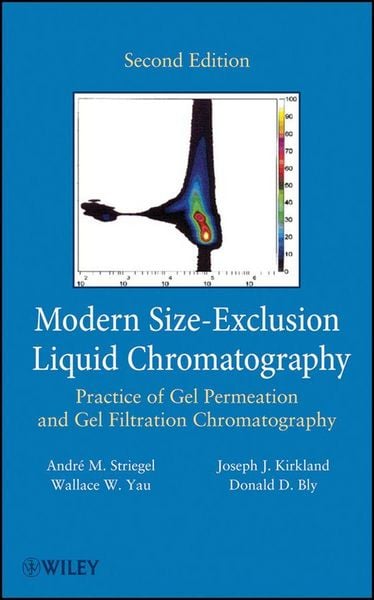
Modern Size-Exclusion Liquid Chromatography Practice of Gel Permeation and Gel Filtration Chromatography
181,99 €
inkl. gesetzl. MwSt.,
Beschreibung
Produktdetails
Einband
Gebundene Ausgabe
Erscheinungsdatum
01.06.2009
Verlag
John Wiley & SonsSeitenzahl
512
Maße (L/B/H)
24,3/16,2/2,9 cm
Gewicht
813 g
Auflage
2nd edition
Sprache
Englisch
ISBN
978-0-471-20172-4
The Second Edition of Modern Size-Exclusion Chromatography offers a complete guide to the theories, methods, and applications of size-exclusion chromatography. It provides an unparalleled, integrated, up-to-date treatment of gel permeation and gel filtration chromatography. With its detailed descriptions of techniques, data handling, compilations of information on columns and column packings, and tables of important solvents and reference materials, the book offers readers everything they need to take full advantage of this popular macromolecular characterization technique.
Since publication of the first edition in 1979, there have been many important advances in the field of size-exclusion chromatography. This Second Edition brings the book thoroughly up to date, with expert coverage of:
* New and emerging industrial and research applications
* Practical aspects of size-exclusion chromatography (SEC) and multidetector and multidimensional SEC technologies for polymer architecture and copolymer analysis
* Updated information on the latest equipment and techniques
* New best practices for the lab
* SEC in relation to polymer characterization techniques such as GPEC, LCCC, and rheology
Throughout the text, detailed examples guide you step by step through all the latest techniques and applications. With its extensive revisions and updates written by leading experts and pioneers in the field, Modern Size-Exclusion Liquid Chromatography remains the definitive resource for the broad range of researchers and scientists who use HPLC and GPC methods.
Since publication of the first edition in 1979, there have been many important advances in the field of size-exclusion chromatography. This Second Edition brings the book thoroughly up to date, with expert coverage of:
* New and emerging industrial and research applications
* Practical aspects of size-exclusion chromatography (SEC) and multidetector and multidimensional SEC technologies for polymer architecture and copolymer analysis
* Updated information on the latest equipment and techniques
* New best practices for the lab
* SEC in relation to polymer characterization techniques such as GPEC, LCCC, and rheology
Throughout the text, detailed examples guide you step by step through all the latest techniques and applications. With its extensive revisions and updates written by leading experts and pioneers in the field, Modern Size-Exclusion Liquid Chromatography remains the definitive resource for the broad range of researchers and scientists who use HPLC and GPC methods.
Kundinnen und Kunden meinen
Verfassen Sie die erste Bewertung zu diesem Artikel
Helfen Sie anderen Kund*innen durch Ihre Meinung
Kurze Frage zu unserer Seite
Vielen Dank für Ihr Feedback
Wir nutzen Ihr Feedback, um unsere Produktseiten zu verbessern. Bitte haben Sie Verständnis, dass wir Ihnen keine Rückmeldung geben können. Falls Sie Kontakt mit uns aufnehmen möchten, können Sie sich aber gerne an unseren Kund*innenservice wenden.
zum Kundenservice