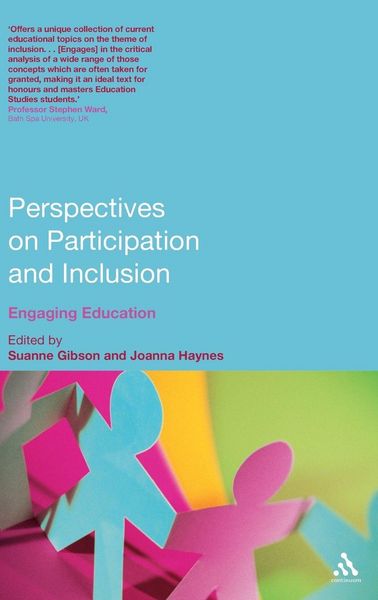
Perspectives on Participation and Inclusion
-
- Hardcover ausgewählt
- Taschenbuch
- eBook
-
Sprache:Englisch
247,99 €
inkl. gesetzl. MwSt.,
Beschreibung
Produktdetails
Einband
Gebundene Ausgabe
Erscheinungsdatum
23.03.2009
Herausgeber
Suanne GibsonVerlag
Bloomsbury 3PLSeitenzahl
184
Maße (L/B/H)
24/16,1/1,5 cm
Gewicht
446 g
Sprache
Englisch
ISBN
978-0-8264-4501-8
Perspectives on Participation and Inclusion draws on the research and scholarship of academics working in the field of Education Studies. The writers are concerned with enduring yet contemporary themes: making education engaging and vital for both learners and educators, and achieving wider participation and more effective and meaningful inclusion for all.
- The book draws on philosophical ideas and educational theories, practical examples and case studies in a wide variety of educational settings and styles.
- Through the medium of brief 'edu-autobiography', each chapter is situated in the context of the author's life as an educator, appealing to readers to consider ways in which the ideas and examples discussed could be pertinent to their own life or work in education.
- Includes sections on voice and empowerment, critical and alternative perspectives on inclusion in education, and practical approaches to widening participation.
- Authors discuss ideas such as 'otherness' and 'voice', freedom, belonging and well-being in education and the relational nature of learning.
Perspectives on Participation and Inclusion is a key text for Education Studies students. In addressing fundamental questions in education, the audience will encompass school practitioners, student teachers and lecturers in further and higher education. This book will also be of interest to students and professionals in fields such as childhood studies and youth and community studies.
Noch keine Bewertungen vorhanden
Verfassen Sie die erste Bewertung zu diesem Artikel
Helfen Sie anderen Kundinnen und Kunden durch Ihre Meinung.
Kurze Frage zu unserer Seite
Vielen Dank für Ihr Feedback
Wir nutzen Ihr Feedback, um unsere Produktseiten zu verbessern. Bitte haben Sie Verständnis, dass wir Ihnen keine Rückmeldung geben können. Falls Sie Kontakt mit uns aufnehmen möchten, können Sie sich aber gerne an unseren Kund*innenservice wenden.
zum Kundenservice