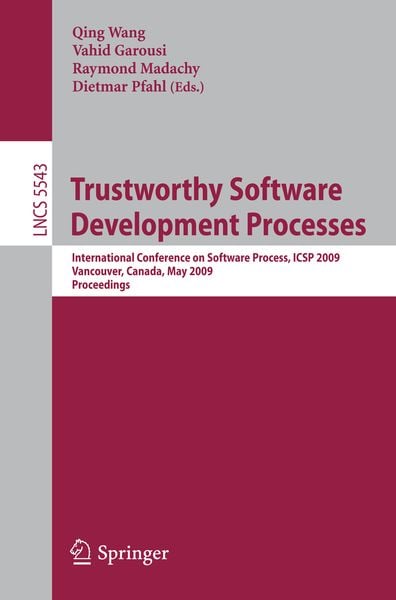
• Produktbild: Trustworthy Software Development Processes
  • Produktbild: Trustworthy Software Development Processes

Trustworthy Software Development Processes International Conference on Software Process, ICSP 2009 Vancouver, Canada, May 16-17, 2009 Proceedings

49,99 €

inkl. gesetzl. MwSt., Versandkostenfrei


Beschreibung

Produktdetails

Einband

Taschenbuch

Erscheinungsdatum

23.04.2009

Herausgeber

Qing Wang + weitere

Verlag

Springer Berlin

Seitenzahl

412

Maße (L/B/H)

23,5/15,5/2,4 cm

Gewicht

652 g

Auflage

2009

Sprache

Englisch

ISBN

978-3-642-01679-0

Beschreibung

Produktdetails

Einband

Taschenbuch

Erscheinungsdatum

23.04.2009

Herausgeber

Verlag

Springer Berlin

Seitenzahl

412

Maße (L/B/H)

23,5/15,5/2,4 cm

Gewicht

652 g

Auflage

2009

Sprache

Englisch

ISBN

978-3-642-01679-0

Herstelleradresse

Springer-Verlag KG
Sachsenplatz 4-6
1201 Wien
AT

Email: GPSR Kontakt

Noch keine Bewertungen vorhanden

Verfassen Sie die erste Bewertung zu diesem Artikel

Helfen Sie anderen Kundinnen und Kunden durch Ihre Meinung.

Kundinnen und Kunden meinen

Bewertungen (0)

  • Produktbild: Trustworthy Software Development Processes
  • Produktbild: Trustworthy Software Development Processes
  • Invited Talks.- System Engineering in the Energy and Maritime Sectors: Towards a Solution Based on Model-Centric Processes.- Decision Processes for Trustworthy Software.- Synthesis, Analysis, and Modeling of Large-Scale Mission-Critical Embedded Software Systems.- Process Management.- Statistically Based Process Monitoring: Lessons from the Trench.- The How? When? and What? for the Process of Re-planning for Product Releases.- Overcoming the First Hurdle: Why Organizations Do Not Adopt CMMI.- Value-Based Multiple Software Projects Scheduling with Genetic Algorithm.- Process Tools.- Meta Model Based Architecture for Software Process Instantiation.- Distributed Orchestration Versus Choreography: The FOCAS Approach.- An Architecture for Modeling and Applying Quality Processes on Evolving Software.- Process Analysis.- Evaluating the Perceived Effect of Software Engineering Practices in the Italian Industry.- Evidence-Based Insights about Issue Management Processes: An Exploratory Study.- Process Aspect: Handling Crosscutting Concerns during Software Process Improvement.- Stochastic Process Algebra Based Software Process Simulation Modeling.- Process Simulation Modeling.- Combining Aspect and Model-Driven Engineering Approaches for Software Process Modeling and Execution.- Dynamic COQUALMO: Defect Profiling over Development Cycles.- A Hybrid Model for Dynamic Simulation of Custom Software Projects in a Multiproject Environment.- On the Relative Merits of Software Reuse.- Investigating the Gap between Quantitative and Qualitative/Semi-quantitative Software Process Simulation Models: An Explorative Study.- Experience Report.- Bridge the Gap between Software Test Process and Business Value: A Case Study.- Subcontracting Processes in Software Service Organisations - An Experience Report.- On Reducing the Pre-release Failures of Web Plug-In on Social Networking Site.- Technical Software Development Process in the XML Domain.- Process Metrics.- Software Product Quality: Ensuring a Common Goal.- Predicting Upgrade Project Defects Based on Enhancement Requirements: An Empirical Study.- Process Modeling and Representation.- Incremental Process Modeling through Stakeholder-Based Hybrid Process Simulation.- A Process-Oriented Approach for the Optimal Satisficing of Non-Functional Requirements.- A Pattern for Modeling Rework in Software Development Processes.- Achieving On-Time Delivery: A Two-Stage Probabilistic Scheduling Strategy for Software Projects.- Incrementally Introducing Process Model Rationale Support in an Organization.- A Process for Driving Process Improvement in VSEs.- Modeling Software Evolution with Game Theory.- Structural Considerations in Defining Executable Process Models.- Analyzing a Software Process Model Repository for Understanding Model Evolution.- Process Trustworthiness as a Capability Indicator for Measuring and Improving Software Trustworthiness.- A System Dynamics Model That Simulates a Significant Late Life Cycle Manpower Increase Phenomenon.