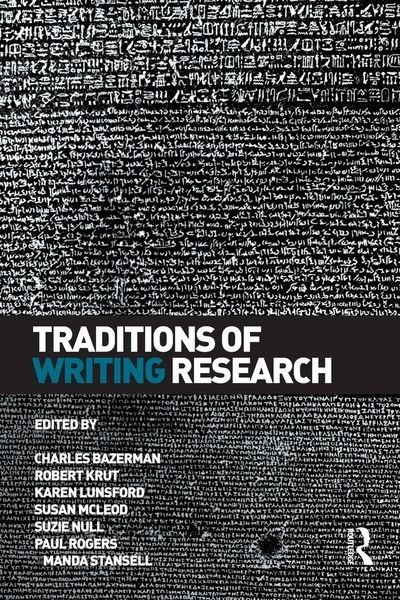
• Produktbild: Traditions of Writing Research
  • Produktbild: Traditions of Writing Research

Traditions of Writing Research

99,99 €

inkl. gesetzl. MwSt., Versandkostenfrei


Beschreibung

Produktdetails

Einband

Taschenbuch

Erscheinungsdatum

06.10.2009

Herausgeber

Bazerman Charles + weitere

Verlag

Taylor and Francis

Seitenzahl

464

Maße (L/B/H)

22,9/15,2/2,5 cm

Gewicht

860 g

Sprache

Englisch

ISBN

978-0-415-99338-8

Beschreibung

Portrait

Charles Bazerman, Robert Krut, Karen Lunsford, Susan McLeod, Suzie Null, Paul Rogers, Amanda Stansell

Produktdetails

Einband

Taschenbuch

Erscheinungsdatum

06.10.2009

Herausgeber

Verlag

Taylor and Francis

Seitenzahl

464

Maße (L/B/H)

22,9/15,2/2,5 cm

Gewicht

860 g

Sprache

Englisch

ISBN

978-0-415-99338-8

Herstelleradresse

Produktsicherheitsverantwortliche/r
Europaallee 1
36244 Bad Hersfeld
DE

Email: gpsr@libri.de

Kundinnen und Kunden meinen

0 Bewertungen

Informationen zu Bewertungen

Zur Abgabe einer Bewertung ist eine Anmeldung im Konto notwendig. Die Authentizität der Bewertungen wird von uns nicht überprüft. Wir behalten uns vor, Bewertungstexte, die unseren Richtlinien widersprechen, entsprechend zu kürzen oder zu löschen.

Die Bewertungen sind nach Format, Anzahl Sterne und Datum sortiert.

Verfassen Sie die erste Bewertung zu diesem Artikel

Helfen Sie anderen Kund*innen durch Ihre Meinung

Kundinnen und Kunden meinen

0 Bewertungen filtern

Die Leseprobe wird geladen.
  • Produktbild: Traditions of Writing Research
  • Produktbild: Traditions of Writing Research
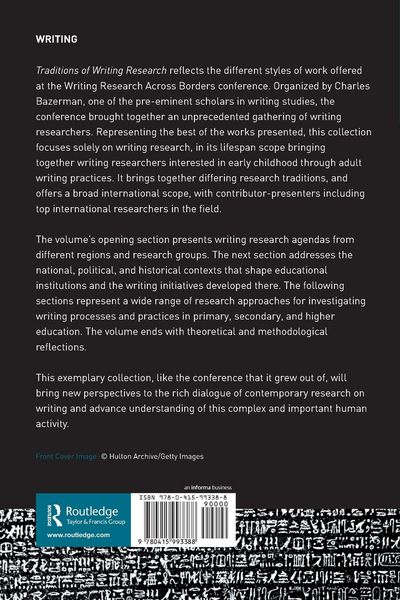
  • I. Approaches in Various Regions

    1. Modern ‘writingology’ in China -- Chen Huijun

    2 The French Didactics approach to writing, from elementary school to university -- I. Delcambre & Y. Reuter

    3. What factors influence the improvement of academic writing practices? A study of reform of undergraduate writing in Norwegian higher education -- Olga Dysthe

    4. Mapping Genre Researches in Brazil: An exploratory study -- Antonia Dilamar Araújo

    5. The teaching and learning of writing in Portugal: the case of a research group -- Luísa Álvares Pereira, Conceição Aleixo, Inês Cardoso, & Luciana Graça

    6. Spanish Research on Writing Instruction For Students with and without Learning Disabilties -- Jesús-Nicasio García, Ana-María de Caso-Fuertes, Raquel Fidalgo-Redondo, Olga Arias-Gundín & Mark Torrance

    II. Writing Education in political and historical contexts

    7. Writing, from Stalinism to Democracy: Language Pedagogy and Politics in Poland, 1945-1999 -- Cezar M. Ornatowski

    8. A Pilot Investigation: A Longitudinal Study of Student Writing in a Post-totalitarian State -- Gil Harootunian

    9. The continuum illiterate-literate and the contrast between different ethnicities

    Maria Sílvia Cintra

    10. Strategies, Policies and Research on Reading and Writing in Colombian Universities

    -- Blanca Yaneth González Pinzón

    III. Research on Primary and Secondary School Practice

    11. Young Children Revising Their Own Texts in School Settings -- Mirta Castedo & Emilia Ferreiro

    12. Written Representations of Nominal Morphology by Chinese and Moroccan Children Learning a Romance Language -- Liliana Tolchinsky & Naymé Salas

    13. Relationships Between Idea Generation and Transcription: How the Act of Writing Shapes What Children Write -- John R. Hayes & Virginia W. Berninger

    14. Academic Writing in Spanish Compulsory Education: Improvements after didactic intervention on sixth graders’ expository texts -- Teodoro Álvarez Angulo & Isabel García Parejo

    15. Caught in the middle years: Improving writing in the middle and upper primary years -- Val Faulkner, Judith Rivalland, & Janet Hunter

    16. Teachers as Mediators of Instructional Texts -- Suzie Y. Null

    17. Pushing the Boundaries of Writing: The Consequentiality of Visualizing Voice in Bilingual Youth Radio -- Deborah Romero & Dana Walker

    18. Classroom Teachers as Authors of the Professional Article: National Writing Project Influence on Teachers Who Publish -- Anne Whitney

    IV. Research on Higher Education Practice

    19. The International WAC/WID Mapping Project: Objectives, Methods, and Early Results -- Chris Thaiss

    20. Rhetorical features of student science writing in introductory university oceanography -- Gregory J. Kelly, Charles Bazerman, Audra Skukauskaite & William Prothero

    21. Reading and writing in the Social Sciences in Argentine universities -- Paula Carlino

    22. Preparing Students to Write: A Case Study of the Role Played by Student Questions in their Quest to Understand How to Write an Assignment in Economics -- Barbara Wake

    23. Can archived TV interviews with Social Sciences scholars enhance the quality of students’ academic writing? -- Terry Inglese

    24. Social Academic Writing: Exploring Academic Literacies in Text-based Computer Conferencing -- Warren M. Liew & Arnetha F. Ball

    25. Between Peer Review and Peer Production: Genre, Wikis, and the Politics of Digital Code in Academe -- Doreen Starke-Meyerring

    V. theories and Methodologies for UNDERSTANDING WRITING AND WRITING PROCESSES

    26.Writing in Multiple Contexts: Vygotskian CHAT Meets the Phenomenology of Genre -- David R. Russell

    27. The Contributions of North American Longitudinal Studies of Writing in Higher Education to our Understanding of Writing Development -- Paul Rogers

    28. Statistical Modeling of Writing Processes -- Daniel Perrin & Marc Wildi

    29. Writers’s Eye Movements -- Mark Torrance & Asa Wengelin

    30. Text Analysis as Theory-Laden Methodology -- Nancy Nelson & Stephanie Grote-Garcia

    31. On Textual Silences, Large and Small -- Tom Huckin