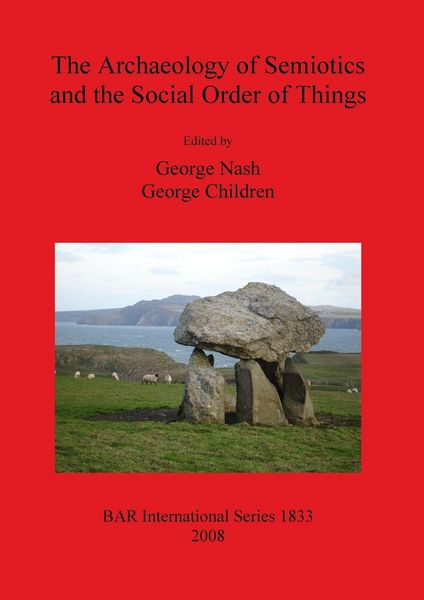
The Archaeology of Semiotics and the Social Order of Things
-
- Englisch ausgewählt
119,99 €
inkl. gesetzl. MwSt.,
Beschreibung
Produktdetails
Einband
Taschenbuch
Erscheinungsdatum
15.09.2008
Herausgeber
George Nash + weitereVerlag
British Archaeological Reports Oxford LtdSeitenzahl
212
Maße (L/B/H)
29,7/21/1,4 cm
Gewicht
829 g
Sprache
Englisch
ISBN
978-1-4073-0317-8
The Archaeology of Semiotics and the social order of things is edited by George Nash and George Children and brings together 15 thought-provoking chapters from contributors around the world. A sequel to an earlier volume published in 1997, it tackles the problem of understanding how complex communities interact with landscape and shows how the rules concerning landscape constitute a recognised and readable grammar. The mechanisms underlying landscape grammar are both physical and mental, being based in part on the mindset of the individual; the same landscape can thus evoke different meanings for different people and at different times. People's perception has greatly influenced the construction of landscapes over millennia but, until recently, the potential of this area has been largely untapped. Apart from chapters focusing solely upon human interaction with landscape, there are several which skilfully integrate artefacts and place with landscape (e.g. Gheorghiu and Sognnes). Other chapters look at the way people have marked the landscape through such mechanisms as rock-art (e.g. Clegg, Devereux, Estévez, Fossati, Kelleher and Skier). Rock-art establishes personal and communal identity in relation to landscape and it is clear that other forms of visual expression were in place which distinctively created special places within the landscape. Landscape constructs can bind cultures together; bringing the old ways of reading the landscape into contemporary life (e.g. Smiseth). Defining early and late prehistoric landscapes and segregating these into, say, mundane domestic and ritualised spaces rely on both clear and subtle archaeologies and in this volume distinct monument clustering and ritualised linearity are considered (e.g. Mason and Nash). A volume such as this cannot escape the influence of New World approaches, such as anthropology, and in many respects chapters by Bender, Muller and Merritt give context to other chapters within the book. Finally, one must consider text as a means of constructing landscape and this is considered by Heyd, who eloquently deconstructs the travel diary of a 17th century Japanese poet. This will be an important volume for archaeologists, landscape scholars and students. The many approaches used are tried and tested, forming an invaluable resource and not just another edited book.
Kundinnen und Kunden meinen
Verfassen Sie die erste Bewertung zu diesem Artikel
Helfen Sie anderen Kund*innen durch Ihre Meinung
Kurze Frage zu unserer Seite
Vielen Dank für Ihr Feedback
Wir nutzen Ihr Feedback, um unsere Produktseiten zu verbessern. Bitte haben Sie Verständnis, dass wir Ihnen keine Rückmeldung geben können. Falls Sie Kontakt mit uns aufnehmen möchten, können Sie sich aber gerne an unseren Kund*innenservice wenden.
zum Kundenservice