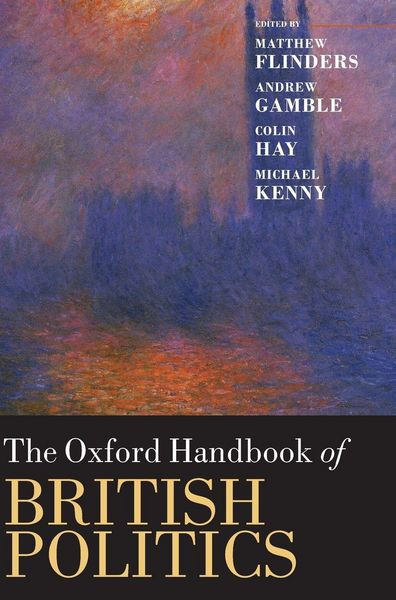
Produktbild: The Oxford Handbook of British Politics

The Oxford Handbook of British Politics

247,99 €

inkl. gesetzl. MwSt., Versandkostenfrei


Beschreibung

Produktdetails

Einband

Gebundene Ausgabe

Erscheinungsdatum

16.07.2009

Herausgeber

Flinders Matthew + weitere

Verlag

Oxford University Press

Seitenzahl

1002

Maße (L/B/H)

25/17,5/5,8 cm

Gewicht

1691 g

Sprache

Englisch

ISBN

978-0-19-923095-2

Beschreibung

Produktdetails

Einband

Gebundene Ausgabe

Erscheinungsdatum

16.07.2009

Herausgeber

Verlag

Oxford University Press

Seitenzahl

1002

Maße (L/B/H)

25/17,5/5,8 cm

Gewicht

1691 g

Sprache

Englisch

ISBN

978-0-19-923095-2

Herstelleradresse

Libri GmbH
Europaallee 1
36244 Bad Hersfeld
DE

Email: gpsr@libri.de

Kundinnen und Kunden meinen

0 Bewertungen

Informationen zu Bewertungen

Zur Abgabe einer Bewertung ist eine Anmeldung im Konto notwendig. Die Authentizität der Bewertungen wird von uns nicht überprüft. Wir behalten uns vor, Bewertungstexte, die unseren Richtlinien widersprechen, entsprechend zu kürzen oder zu löschen.

Die Bewertungen sind nach Format, Anzahl Sterne und Datum sortiert.

Verfassen Sie die erste Bewertung zu diesem Artikel

Helfen Sie anderen Kund*innen durch Ihre Meinung

Kundinnen und Kunden meinen

0 Bewertungen filtern

Weitere Artikel finden Sie in

  • Produktbild: The Oxford Handbook of British Politics
    • I. APPROACHES

    • The British Tradition

    • 1: Michael Kenny: Politics as an Academic Vocation

    • 2: Dennis Kavanagh: Antecedents

    • 3: Robert E. Goodin: The British Study of Politics

    • Political Science

    • 4: B. Guy Peters: Institutionalism

    • 5: Keith Dowding: Rational Choice

    • 6: Robert Johns: Behaviouralism

    • Critical Perspectives

    • 7: Mark Bevir: Anti-Foundationalism

    • 8: Vicky Randall: Feminism

    • 9: Paul Kelly: The Oakeshottians

    • Modes of Political Writing

    • 10: Peter Riddell: Political Journalism

    • 11: David Marquand: Biography

    • 12: Bernard Crick: The Novel

    • II. INSTITUTIONS

    • Democracy

    • 13: Alix Kelso: Parliament

    • 14: Adam Tomkins: Constitutionalism

    • 15: Keith Ewing: Judiciary

    • 16: Peter Mair: Party System

    • Governance

    • 17: Matthew Flinders: Delegation

    • 18: Michael Moran: Regulation

    • 19: Oliver James: Central State

    • 20: Grant Jordan: Lobbying

    • Territory

    • 21: Charlie Jeffrey: Devolution in the UK

    • 22: Jonathan Davies: Localism

    • 23: Michael Keating: European Devolution

    • III. IDENTITIES

    • Identification

    • 24: Richard Heffernan: Political Parties

    • 25: Ron Johnston and Charles Pattie: Voting and Identity

    • 26: Tariq Modood: Ethnicity and Religion

    • National Identities

    • 27: Julia Stapleton: England

    • 28: Richard English: Ireland

    • 29: Christopher Harvie: Scotland and Wales

    • Location

    • 30: Jim Buller: The European Union

    • 31: Andrew Gamble: Britain and America

    • 32: Joel Krieger: After Empire

    • IV. INEQUALITIES

    • 33: Fiona Devine: Class

    • 34: James Hampshire: Race

    • 35: Fiona Mackay: Gender

    • Management

    • 36: Alan Walker: Ageing and Generational Politics

    • 37: Howard Glennerseter: Welfare Reform

    • 38: Oliver Morrissey: Aid and International Development

    • Conflict

    • 39: Brian Doherty: Protest

    • 40: Randall Hansen: Immigration and Citizenship

    • 41: Richard Aldrich: The Security State

    • V. PROCESSES

    • Social Change

    • 42: Paul Whiteley: Participation and Social Capital

    • 43: Heather Savigny: Political Marketing

    • 44: Henry Rothstein: Technology and Risk

    • Dynamics

    • 45: Kevin Featherstone: Europeanisation

    • 46: Colin Hay: Globalisation

    • 47: Colin Crouch: Marketisation

    • 48: Helen Thompson: National Economy

    • 49: Ben Clift: European Economy

    • 50: Peter Burnham and Steve Kettell: International Economy