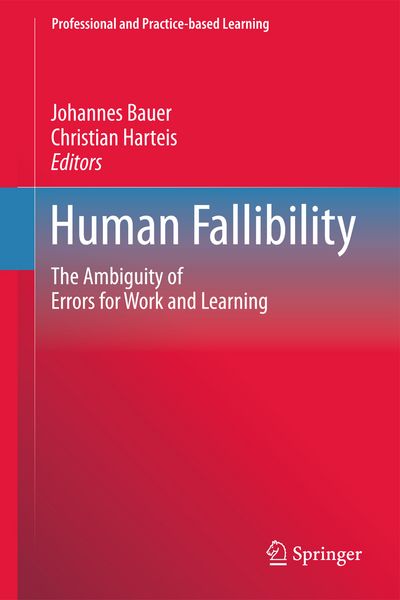
Produktbild: Human Fallibility
Band 6

Human Fallibility The Ambiguity of Errors for Work and Learning

97,99 €

inkl. gesetzl. MwSt., Versandkostenfrei


Beschreibung

Produktdetails

Einband

Gebundene Ausgabe

Erscheinungsdatum

18.03.2012

Abbildungen

XIV, 282 p.

Herausgeber

Johannes Bauer + weitere

Verlag

Springer Netherland

Seitenzahl

282

Maße (L/B/H)

24,1/16/2,1 cm

Gewicht

612 g

Auflage

2012

Sprache

Englisch

ISBN

978-90-481-3940-8

Beschreibung

Rezension

From the book reviews:

“‘Human Fallibility’ offers an up-to-date compilation of varying perspectives, methods, and results of the relations between errors, work, and learning in several contexts. … the editors deliver an up-to-date overview of a wide range of issues and methods related to learning from errors. … The book also reveals several ways of furthering the development of the field. … ‘Human Fallibility’ offers more than just a starting point.” (Andreas Rausch, Vacations and Learning, Vol. 7, 2014)

Portrait

Dr. Christian Harteis ist Wissenschaftlicher Assistent am Lehrstuhl Prof. Dr. Hans Gruber, Institut für Pädagogik der Universität Regensburg.

Produktdetails

Einband

Gebundene Ausgabe

Erscheinungsdatum

18.03.2012

Abbildungen

XIV, 282 p.

Herausgeber

Verlag

Springer Netherland

Seitenzahl

282

Maße (L/B/H)

24,1/16/2,1 cm

Gewicht

612 g

Auflage

2012

Sprache

Englisch

ISBN

978-90-481-3940-8

Herstelleradresse

Springer-Verlag KG
Sachsenplatz 4-6
1201 Wien
AT

Email: ProductSafety@springernature.com

Noch keine Bewertungen vorhanden

Verfassen Sie die erste Bewertung zu diesem Artikel

Helfen Sie anderen Kundinnen und Kunden durch Ihre Meinung.

Kundinnen und Kunden meinen

Bewertungen (0)

  • Produktbild: Human Fallibility

  • The Ambiguity of Errors for Work and Learning: Introduction to the Volume
    Johannes Bauer and Christian Harteis.-
    Part A: Errors, their Learning Potential, and the Processes of Learning from Errors.-
    Errors and Learning from Errors at Work
    Stephen Billett.-
    Tracing Outcomes of Learning from Errors on the Level of Knowledge
    Martin Gartmeier and Elke Schüttelkopf
    .- Towards a Theory of Negative Knowledge (NK): Almost-Mistakes as Drivers of Episodic Memory Amplification
    Fritz Oser, Catherine Näpflin, Christine Hofer, and Philipp Aerni
    .- Professional knowledge is (also) knowledge about errors

    Hans Gruber and Michael Mohe.-
    Part B: Methodological strategies.-
    Research on Errors and Learning from them: Methodological Perspectives
    Klaus Mehl and Theo Wehner.-
    Measuring Organizational Climate for Learning from Errors at Work
    Daniel Putz, Jan Schilling, and Annette Kluge.-
    Part C: Learning from Errors in the Professions.-
    Innovation by Learning from Mistakes: The Relationships between Team Characteristics, Error Orientation, and Team Innovation
    Marianne van Woerkom.-
    Error Orientation and Intuitive Decision Making: Results of an Exploratory Study in the Domain of Emergency Medicine
    Christian Harteis and Franziska Frost.-
    Learning from Errors in the Professions: Empirical Findings on Processes, Outcomes, and Supportive Conditions
    Johannes Bauer, Martin Gartmeier, and Christian Harteis.-
    Part D: Enabling Learning from Errors.-
    Dealing Effectively with Errors during Training  
    Nina Keith.-
    Reflecting on Learning from Errors in School Instruction – Findings and Suggestions from a Swiss-German Video Study
    Inger Marie Dalehefte, Manfred Prenzel, and Tina Seidel.-
    Learning from Errors: The Role of After-Event Reviews
    Shmuel Ellis.-
    Incident Reporting Systems in Hospitals: How does Learning Occur Using this Organizational Instrument?
    Yvonne Pfeiffer and Theo Wehner.-
    Conclusion.-
    Research on Human Fallibility and Learning from Errors at Work: Challenges for Theory, Research, and Practice
    Christian Harteis, Johannes Bauer, and Helmut Heid.

    Part B: Methodological strategies.-
    Research on Errors and Learning from them: Methodological Perspectives
    Klaus Mehl and Theo Wehner.-
    Measuring Organizational Climate for Learning from Errors at Work
    Daniel Putz, Jan Schilling, and Annette Kluge.-
    Part C: Learning from Errors in the Professions.-
    Innovation by Learning from Mistakes: The Relationships between Team Characteristics, Error Orientation, and Team Innovation
    Marianne van Woerkom.-
    Error Orientation and Intuitive Decision Making: Results of an Exploratory Study in the Domain of Emergency Medicine
    Christian Harteis and Franziska Frost.-
    Learning from Errors in the Professions: Empirical Findings on Processes, Outcomes, and Supportive Conditions
    Johannes Bauer, Martin Gartmeier, and Christian Harteis.-
    Part D: Enabling Learning from Errors.-
    Dealing Effectively with Errors during Training  
    Nina Keith.-
    Reflecting on Learning from Errors in School Instruction – Findings and Suggestions from a Swiss-German Video Study
    Inger Marie Dalehefte, Manfred Prenzel, and Tina Seidel.-
    Learning from Errors: The Role of After-Event Reviews
    Shmuel Ellis.-
    Incident Reporting Systems in Hospitals: How does Learning Occur Using this Organizational Instrument?
    Yvonne Pfeiffer and Theo Wehner.-
    Conclusion.-
    Research on Human Fallibility and Learning from Errors at Work: Challenges forTheory, Research, and Practice
    Christian Harteis, Johannes Bauer, and Helmut Heid.