
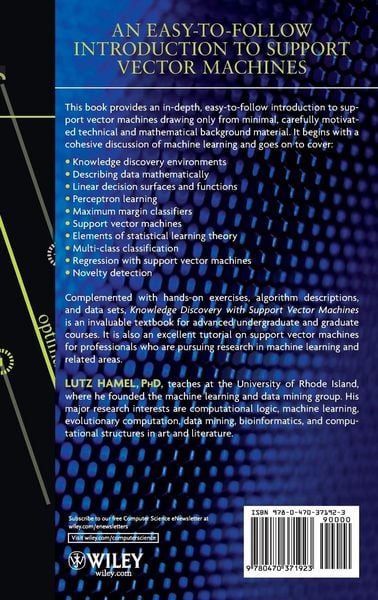
• Produktbild: Knowledge Discovery Support Vector
  • Produktbild: Knowledge Discovery Support Vector
Band 1

Knowledge Discovery Support Vector

167,99 €

inkl. gesetzl. MwSt., Versandkostenfrei


Beschreibung

Produktdetails

Einband

Gebundene Ausgabe

Erscheinungsdatum

01.08.2009

Verlag

Wiley

Seitenzahl

264

Maße (L/B/H)

24/16,1/1,9 cm

Gewicht

566 g

Sprache

Englisch

ISBN

978-0-470-37192-3

Beschreibung

Produktdetails

Einband

Gebundene Ausgabe

Erscheinungsdatum

01.08.2009

Verlag

Wiley

Seitenzahl

264

Maße (L/B/H)

24/16,1/1,9 cm

Gewicht

566 g

Sprache

Englisch

ISBN

978-0-470-37192-3

Herstelleradresse

Libri GmbH
Europaallee 1
36244 Bad Hersfeld
DE

Email: gpsr@libri.de

Noch keine Bewertungen vorhanden

Verfassen Sie die erste Bewertung zu diesem Artikel

Helfen Sie anderen Kundinnen und Kunden durch Ihre Meinung.

Kundinnen und Kunden meinen

Bewertungen (0)

Die Leseprobe wird geladen.
  • Produktbild: Knowledge Discovery Support Vector
  • Produktbild: Knowledge Discovery Support Vector
  • Preface.

    PART I.

    1 What is Knowledge Discovery?

    1.1 Machine Learning.

    1.2 The Structure of the Universe X.

    1.3 Inductive Learning.

    1.4 Model Representations.

    Exercises.

    Bibliographic Notes.

    2 Knowledge Discovery Environments.

    2.1 Computational Aspects of Knowledge Discovery.

    2.1.1 Data Access.

    2.1.2 Visualization.

    2.1.3 Data Manipulation.

    2.1.4 Model Building and Evaluation.

    2.1.5 Model Deployment.

    2.2 Other Toolsets.

    Exercises.

    Bibliographic Notes.

    3 Describing Data Mathematically.

    3.1 From Data Sets to Vector Spaces.

    3.1.1 Vectors.

    3.1.2 Vector Spaces.

    3.2 The Dot Product as a Similarity Score.

    3.3 Lines, Planes, and Hyperplanes.

    Exercises.

    Bibliographic Notes.

    4 Linear Decision Surfaces and Functions.

    4.1 From Data Sets to Decision Functions.

    4.1.1 Linear Decision Surfaces through the Origin.

    4.1.2 Decision Surfaces with an Offset Term.

    4.2 A Simple Learning Algorithm.

    4.3 Discussion.

    Exercises.

    Bibliographic Notes.

    5 Perceptron Learning.

    5.1 Perceptron Architecture and Training.

    5.2 Duality.

    5.3 Discussion.

    Exercises.

    Bibliographic Notes.

    6 Maximum Margin Classifiers.

    6.1 Optimization Problems.

    6.2 Maximum Margins.

    6.3 Optimizing the Margin.

    6.4 Quadratic Programming.

    6.5 Discussion.

    Exercises.

    Bibliographic Notes.

    PART II.

    7 Support Vector Machines.

    7.1 The Lagrangian Dual.

    7.2 Dual MaximumMargin Optimization.

    7.2.1 The Dual Decision Function.

    7.3 Linear Support Vector Machines.

    7.4 Non-Linear Support Vector Machines.

    7.4.1 The Kernel Trick.

    7.4.2 Feature Search.

    7.4.3 A Closer Look at Kernels.

    7.5 Soft-Margin Classifiers.

    7.5.1 The Dual Setting for Soft-Margin Classifiers.

    7.6 Tool Support.

    7.6.1 WEKA.

    7.6.2 R.

    7.7 Discussion.

    Exercises.

    Bibliographic Notes.

    8 Implementation.

    8.1 Gradient Ascent.

    8.1.1 The Kernel-Adatron Algorithm.

    8.2 Quadratic Programming.

    8.2.1 Chunking.

    8.3 Sequential Minimal Optimization.

    8.4 Discussion.

    Exercises.

    Bibliographic Notes.

    9 Evaluating What has been Learned.

    9.1 Performance Metrics.

    9.1.1 The Confusion Matrix.

    9.2 Model Evaluation.

    9.2.1 The Hold-Out Method.

    9.2.2 The Leave-One-Out Method.

    9.2.3 N-Fold Cross-Validation.

    9.3 Error Confidence Intervals.

    9.3.1 Model Comparisons.

    9.4 Model Evaluation in Practice.

    9.4.1 WEKA.

    9.4.2 R.

    Exercises.

    Bibliographic Notes.

    10 Elements of Statistical Learning Theory.

    10.1 The VC-Dimension and Model Complexity.

    10.2 A Theoretical Setting for Machine Learning.

    10.3 Empirical Risk Minimization.

    10.4 VC-Confidence.

    10.5 Structural Risk Minimization.

    10.6 Discussion.

    Exercises.

    Bibliographic Notes.

    PART III.

    11 Multi-Class Classification.

    11.1 One-versus-the-Rest Classification.

    11.2 Pairwise Classification.

    11.3 Discussion.

    Exercises.

    Bibliographic Notes.

    12 Regression with Support Vector Machines.

    12.1 Regression as Machine Learning.

    12.2 Simple and Multiple Linear Regression.

    12.3 Regression with Maximum Margin Machines.

    12.4 Regression with Support Vector Machines.

    12.5 Model Evaluation.

    12.6 Tool Support.

    12.6.1 WEKA.

    12.6.2 R.

    Exercises.

    Bibliographic Notes.

    13 Novelty Detection.

    13.1 Maximum Margin Machines.

    13.2 The Dual Setting.

    13.3 Novelty Detection in R.

    Exercises.

    Bibliographic Notes.

    Appendix A: Notation.

    Appendix B: A Tutorial Introduction to R.

    B.1 Programming Constructs.

    B.2 Data Constructs.

    B.3 Basic Data Analysis.

    Bibliographic Notes.

    References.

    Index.