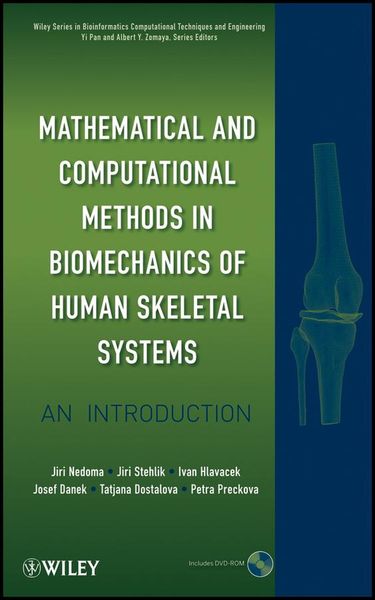
Mathematical and Computational Methods and Algorithms in Biomechanics Human Skeletal Systems
Aus der Reihe
Wiley Series in Bioinformatics
164,99 €
inkl. gesetzl. MwSt.,
Beschreibung
Produktdetails
Einband
Gebundene Ausgabe
Erscheinungsdatum
06.09.2011
Herausgeber
Yi Pan + weitereVerlag
John Wiley & Sons IncSeitenzahl
592
Maße (L/B/H)
23,6/16/3,6 cm
Gewicht
1043 g
Auflage
1. Auflage
Sprache
Englisch
ISBN
978-0-470-40824-7
Cutting-edge solutions to current problems in orthopedics, supported by modeling and numerical analysis
Despite the current successful methods and achievements of good joint implantations, it is essential to further optimize the shape of implants so they may better resist extreme long-term mechanical demands. This book provides the orthopedic, biomechanical, and mathematical basis for the simulation of surgical techniques in orthopedics. It focuses on the numerical modeling of total human joint replacements and simulation of their functions, along with the rigorous biomechanics of human joints and other skeletal parts. The book includes:
* An introduction to the anatomy and biomechanics of the human skeleton, biomaterials, and problems of alloarthroplasty
* The definition of selected simulated orthopedic problems
* Constructions of mathematical model problems of the biomechanics of the human skeleton and its parts
* Replacement parts of the human skeleton and corresponding mathematical model problems
* Detailed mathematical analyses of mathematical models based on functional analysis and finite element methods
* Biomechanical analyses of particular parts of the human skeleton, joints, and corresponding replacements
* A discussion of the problems of data processing from nuclear magnetic resonance imaging and computer tomography
This timely book offers a wealth of information on the current research in this field. The theories presented are applied to specific problems of orthopedics. Numerical results are presented and discussed from both biomechanical and orthopedic points of view and treatment methods are also briefly addressed. Emphasis is placed on the variational approach to the investigated model problems while preserving the orthopedic nature of the investigated problems. The book also presents a study of algorithmic procedures based on these simulation models.
This is a highly useful tool for designers, researchers, and manufacturers of joint implants who require the results of suggested experiments to improve existing shapes or to design new shapes. It also benefits graduate students in orthopedics, biomechanics, and applied mathematics.
Despite the current successful methods and achievements of good joint implantations, it is essential to further optimize the shape of implants so they may better resist extreme long-term mechanical demands. This book provides the orthopedic, biomechanical, and mathematical basis for the simulation of surgical techniques in orthopedics. It focuses on the numerical modeling of total human joint replacements and simulation of their functions, along with the rigorous biomechanics of human joints and other skeletal parts. The book includes:
* An introduction to the anatomy and biomechanics of the human skeleton, biomaterials, and problems of alloarthroplasty
* The definition of selected simulated orthopedic problems
* Constructions of mathematical model problems of the biomechanics of the human skeleton and its parts
* Replacement parts of the human skeleton and corresponding mathematical model problems
* Detailed mathematical analyses of mathematical models based on functional analysis and finite element methods
* Biomechanical analyses of particular parts of the human skeleton, joints, and corresponding replacements
* A discussion of the problems of data processing from nuclear magnetic resonance imaging and computer tomography
This timely book offers a wealth of information on the current research in this field. The theories presented are applied to specific problems of orthopedics. Numerical results are presented and discussed from both biomechanical and orthopedic points of view and treatment methods are also briefly addressed. Emphasis is placed on the variational approach to the investigated model problems while preserving the orthopedic nature of the investigated problems. The book also presents a study of algorithmic procedures based on these simulation models.
This is a highly useful tool for designers, researchers, and manufacturers of joint implants who require the results of suggested experiments to improve existing shapes or to design new shapes. It also benefits graduate students in orthopedics, biomechanics, and applied mathematics.
Kundinnen und Kunden meinen
Verfassen Sie die erste Bewertung zu diesem Artikel
Helfen Sie anderen Kund*innen durch Ihre Meinung
Kurze Frage zu unserer Seite
Vielen Dank für Ihr Feedback
Wir nutzen Ihr Feedback, um unsere Produktseiten zu verbessern. Bitte haben Sie Verständnis, dass wir Ihnen keine Rückmeldung geben können. Falls Sie Kontakt mit uns aufnehmen möchten, können Sie sich aber gerne an unseren Kund*innenservice wenden.
zum Kundenservice