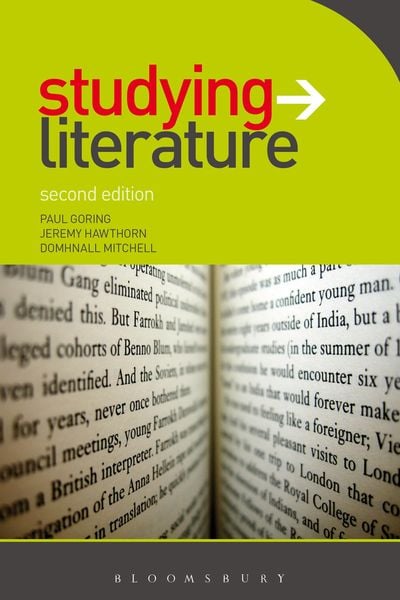
Produktbild: Studying Literature

Studying Literature The Essential Companion

Aus der Reihe Studying...

41,99 €

inkl. gesetzl. MwSt., Versandkostenfrei


Beschreibung

Produktdetails

Einband

Taschenbuch

Erscheinungsdatum

02.08.2010

Verlag

Bloomsbury Academic

Seitenzahl

480

Maße (L/B/H)

23,5/15,7/2,8 cm

Gewicht

718 g

Auflage

2. Auflage

Sprache

Englisch

ISBN

978-0-340-98512-0

Beschreibung

Produktdetails

Einband

Taschenbuch

Erscheinungsdatum

02.08.2010

Verlag

Bloomsbury Academic

Seitenzahl

480

Maße (L/B/H)

23,5/15,7/2,8 cm

Gewicht

718 g

Auflage

2. Auflage

Sprache

Englisch

ISBN

978-0-340-98512-0

Herstelleradresse

Libri GmbH
Europaallee 1
36244 Bad Hersfeld
DE

Email: gpsr@libri.de

Noch keine Bewertungen vorhanden

Verfassen Sie die erste Bewertung zu diesem Artikel

Helfen Sie anderen Kundinnen und Kunden durch Ihre Meinung.

Kundinnen und Kunden meinen

Bewertungen (0)

  • Produktbild: Studying Literature
  • Contents Introduction Introducing your companion Using the companion Cross-referencing Section 1: Guide to Studying Literature at University Introduction What type of guide is this? Is such a guide really necessary? 'Literary', 'primary', 'secondary': a note on terminology Getting organised Your degree scheme Preparing for courses Getting the most from lectures, seminars and tutorials Using the library Reading literary texts Reading and studying: general points Reading prose fiction: novels, novellas and short stories Reading drama Reading poetry Literary criticism What is literary criticism? How to find relevant criticism Using criticism Writing essays Analyzing the question Formulating and structuring an argument Applying literary theory in essays Writing Guidelines on presentation/style Plagiarism and how to avoid it Making a presentation Exams Preparation and revision Taking exams Section 2: Guide to the use of electronic resources Some introductory comments Finding primary electronic information Issues of reliability Reading in the electronic age Searching and analyzing electronic texts Finding secondary materials Searching the Internet for literary resources Evaluating online secondary sources Useful sites Documenting electronic media Revising and editing electronically Safety measures Section 3: Theories and approaches Introduction: Living with theory Molière's Monsieur Jourdain Reinventing the wheel The theoretical 'object' Types of theory Descriptive or prescriptive? Literature-specific? Butcher or biologist? School or theory? Chosen or thrust-upon? Theory and method A note on our groupings Formalisms Russian Formalism The Prague School New Criticism The Hermeneutic tradition Hermeneutics Phenomenology Reception theory Reader-response criticism Structuralism and its progeny Structuralism Semiology/semiotics Narratology Post-structuralism Deconstruction Pragmatics and the reaction against structuralism Speech act theory Psychological and psychoanalytic theories Psychoanalytic criticism Archetypal criticism Cognitive criticism 'Isms' Marxist theory and criticism The Frankfurt School New historicism and cultural materialism Thing theory Postcolonialism Ecocriticism Feminism Queer theory Section 4: Guide to literary theorists Mikhail Bakhtin Roland Barthes Simone de Beauvoir Walter Benjamin Homi K. Bhabha Harold Bloom Bertolt Brecht Hélène Cixous Jacques Derrida Terry Eagleton Umberto Eco T.S. Eliot William Empson Stanley Fish Michel Foucault Northrop Frye Henry Louis Gates, Jr Gérard Genette Sandra Gilbert and Susan Gubar Lucien Goldmann Stephen Jay Greenblatt E.D. Hirsch Jr bell hooks Luce Irigaray Wolfgang Iser Roman Jakobson Fredric Jameson Julia Kristeva Jacques Lacan F.R. Leavis Georg Lukács Jean-François Lyotard Jerome McGann Paul de Man J. Hillis Miller Kate Millett Franco Moretti James Phelan Vladimir Propp I.A. Richards Paul Ricoeur Edward Said Ferdinand de Saussure Viktor Shklovsky Elaine Showalter Gayatri Chakravorty Spivak Tzvetan Todorov René Wellek Raymond Williams Virginia Woolf Section 5: Glossary of literary and theoretical terms Bibliography Index