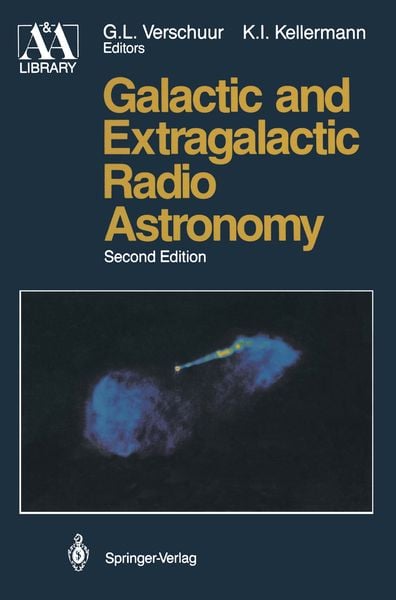

• Produktbild: Galactic and Extragalactic Radio Astronomy
  • Produktbild: Galactic and Extragalactic Radio Astronomy
- 10%

Galactic and Extragalactic Radio Astronomy

10% sparen

76,99 € UVP 85,59 €

inkl. gesetzl. MwSt., Versandkostenfrei


Beschreibung

Produktdetails

Einband

Taschenbuch

Erscheinungsdatum

20.12.1991

Herausgeber

Gerrit L. Verschuur + weitere

Verlag

Springer Us

Seitenzahl

694

Maße (L/B/H)

23,5/15,5/3,9 cm

Gewicht

1072 g

Auflage

Second Edition 1988

Sprache

Englisch

ISBN

978-0-387-97735-5

Beschreibung

Produktdetails

Einband

Taschenbuch

Erscheinungsdatum

20.12.1991

Herausgeber

Verlag

Springer Us

Seitenzahl

694

Maße (L/B/H)

23,5/15,5/3,9 cm

Gewicht

1072 g

Auflage

Second Edition 1988

Sprache

Englisch

ISBN

978-0-387-97735-5

Herstelleradresse

Springer-Verlag KG
Sachsenplatz 4-6
1201 Wien
AT

Email: GPSR Kontakt

Noch keine Bewertungen vorhanden

Verfassen Sie die erste Bewertung zu diesem Artikel

Helfen Sie anderen Kundinnen und Kunden durch Ihre Meinung.

Kundinnen und Kunden meinen

Bewertungen (0)

  • Produktbild: Galactic and Extragalactic Radio Astronomy
  • Produktbild: Galactic and Extragalactic Radio Astronomy
  • 1. Galactic Nonthermal Continuum Emission.- 1.1 Introduction.- 1.1.1 Historical Preface.- 1.1.2 Early Surveys of Galactic Radio Emission.- a. Angular Distribution of the Cosmic Radio Waves.- b. Spectral Distribution of the Cosmic Radio Waves.- c. The Situation Circa-1956.- 1.2 Physical Processes.- 1.2.1 Synchrotron Radiation.- a. Single Particle Emission.- b. Radiation from an Ensemble of Particles.- c. Influence of the Medium.- 1.2.2 The Faraday Effect.- 1.3 Total Intensity Observations of the Galactic Radio Continuum.- 1.3.1 The Medium-Resolution Surveys.- 1.3.2 High-Resolution Surveys of the Galactic Plane.- 1.3.3 The Galactic Loops and Spurs.- 1.3.4 The Nonthermal Radiation and Galactic Structure.- 1.3.5 Galactic Radio Halo?.- 1.4 The Spectrum of the Nonthermal Emission.- 1.4.1 The Galactic Spectrum Above 10 MHz.- 1.4.2 The Very-Low-Frequency Spectrum.- 1.4.3 The Energy Spectrum of Cosmic-Ray Electrons.- 1.5 Linear Polarization of the Nonthermal Emission.- 1.5.1 Surveys of Linear Polarization of the Galactic Emission.- 1.5.2 Implications for the Local Magnetic Field.- 1.5.3 Magnetic Fields in the Galactic Loops.- 1.5.4 Rotation Measure Data and the Galactic Magnetic Field.- 1.6 The Galactic Nonthermal Radiation in Perspective.- Recommended Reading.- References.- 2. HII Regions and Radio Recombination Lines.- 2.1 Ionized Interstellar Hydrogen.- 2.1.1 Emission Nebulae.- 2.1.2 Diffuse Thermal Background.- 2.2 Radiation Transfer.- 2.3 Continuum Thermal Emission (Bremsstrahlung).- 2.3.1 Absorption and Emission Coefficients.- 2.3.2 Transfer Equation for Continuum Radiation.- 2.3.3 Low-Frequency Radiation from HII Regions.- 2.3.4 High-Frequency Radiation from HII Regions.- 2.3.5 Integrated Observations of HII Regions.- 2.3.6 Reality and the “Homogeneous Nebula” Approximation.- 2.3.7 Continuum Observations of HII Regions.- 2.3.8 Thermal Emission from Dust.- 2.4 Basic Theory of Radio Recombination Lines.- 2.4.1 Line Frequencies.- 2.4.2 Shape Function.- 2.4.3 Absorption and Emission Coefficients.- 2.4.4 Transfer Equation for Line Radiation.- 2.5 Refinements to the Transfer Equations.- 2.5.1 Local Thermodynamic Equilibrium.- 2.5.2 Departures from LTE.- 2.5.3 Turbulence Broadening.- 2.5.4 Pressure Broadening.- 2.6 Single-Dish Observations of Radio Recombination Lines from HII Regions.- 2.6.1 Early Observations of Integrated Line Intensities.- 2.6.2 Non-LTE Density-Gradient Models.- 2.6.3 Clumped Models.- 2.6.4 Comparison of the Density-Gradient and Clumped Models.- 2.6.5 Empirical Determinations of Electron Temperature.- 2.7 Exploration of the Milky Way by Radio Recombination Lines.- 2.7.1 Galactic Distribution of HII Regions.- 2.7.2 Galactocentric Variations of Electron Temperatures.- 2.7.3 Abundance Ratio of Helium to Hydrogen.- 2.7.4 The Diffuse Component.- 2.8 Radio Observations of HII Regions with High Angular Resolution.- 2.8.1 Continuum Observations.- 2.8.2 Recombination-Line Observations.- 2.9 Other Aspects of Radio Recombination Lines.- 2.9.1 Low Frequencies.- 2.9.2 Zeeman Effect.- 2.9.3 The Sun.- 2.9.4 Planetary Nebulae.- 2.9.5 Dark Clouds.- 2.9.6 Galaxies and Quasars.- Recommended Reading.- References.- 3. Neutral Hydrogen and the Diffuse Interstellar Medium.- 3.1 Introduction: Fundamentals.- 3.1.1 Radiative Transfer and Excitation of the HI Line.- 3.1.2 Observations of the Diffuse Medium.- a. Brief Review of the Four Phases: CNM, WNM, WIM, HIM.- b. Galactic Distribution of HI.- 3.1.3 Interstellar Pressure.- a.Excitation of CI Fine Structure.- b. Excitation of the CII Fine-Structure Lines.- c. Pressure of the WIM.- 3.1.4 Theory of the Kinetic Temperature of Diffuse Interstellar Gas.- a. Cooling Processes.- b. Heating Processes.- c. The Equilibrium Temperature.- d. Is Statistical Equilibrium Always Obtained?.- 3.1.5 Elements of Interstellar Gas Dynamics.- a. Static Equilibrium: The z-Structure in the Galaxy.- b. Static Equilibrium: A Uniform Spherical Magnetized Cloud.- c. Transient Features: Shocks.- 3.1.6 Two Famous Models of the Interstellar Medium.- 3.2 Structure of the Diffuse Interstellar Medium: HI Emission.- 3.2.1 Low-Velocity Gas.- a. Shells.- b. Filaments.- c. Major HI Concentrations Around Dark Clouds and Newly Formed Stars.- d. Shapes of HI Clouds.- e. Structure of HI Clouds.- 3.2.2 Intermediate-Velocity Gas.- 3.2.3 Supersheils and “Worms”.- 3.3 Temperature and Ionization of the Diffuse Interstellar Medium.- 3.3.1 HI Absorption: Techniques, Data, and Analysis.- a. Techniques and Data.- b. Derived Spin Temperature: Definition and Limitations.- 3.3 2 Temperature of Warm HI.- 3.3.3 Temperature of the Cold HI (CNM).- a. Classical Absorption Studies: The T-? Relation.- b. Statistics of Clouds.- 3.3.4 Temperature Structure of HI Clouds.- a. Temperature Structure and the T-? Relation.- b. Physical Implications.- 3.3.5 Ionization of the Diffuse Interstellar Medium.- a. Observations.- b. Ionization Within Diffuse Clouds.- c. Where Do the Electrons Reside?.- d. The Energy Source for the WIM.- 3.3.6 Filling Factors of the WIM, WNM, and CNM.- 3.4 Interstellar Magnetic Fields.- 3.4.1 Methods of Measurement.- a. B?: Linear Polarization of Starlight.- b. B?: Linear Polarization of Synchrotron Radiation.- c. B?: Linear Polarization of Radio-Wavelength Spectral Lines.- d. B?: Faraday Rotation.- e. B?: Zeeman Splitting.- f. Faraday Rotation Versus Zeeman Splitting.- 3.4.2 Fields in External Galaxies.- 3.4.3 The Galactic Field on Scales Above 100 pc.- a. The Field Strength.- b. The Field Direction.- 3.4.4 The Galactic Field on Scales of 100 pc and Below.- 3.5 Summary.- Recommended Reading.- References.- 4. Molecules as Probes of the Interstellar Medium MID of Star Formation.- 4.1 Introduction.- 4.1.1 Historical Perspective.- 4.1.2 The Central Role of Molecular Spectroscopy.- 4.2 The Large-Scale Morphology of the ISM.- 4.2.1 The Physical Regimes of the ISM.- a. “Coronal” Gas.- b. Intercloud Gas.- c. Diffuse Interstellar Clouds.- d. Cold Dark Clouds.- e. Globules.- f. Giant Molecular Clouds.- g. Hot Molecular Cores in GMCs.- 4.2.2 The Morphology of Dense Molecular Clouds.- 4.2.3 GMCs and Spiral Arms.- 4.3 The Nature of Star-Forming Regions.- 4.3.1 Small Star-Forming Cores in SMCs and GMCs.- 4.3.2 Massive Star-Forming Cores in GMCs.- 4.3.3 Large-Scale Relationships of Star-Forming Regions.- a. Low-Mass-Star-Forming Regions.- b. Massive-Star-Forming Regions.- 4.3.4 Intermediate-Scale Structure: Velocity Outflows and Disks.- 4.3.5 Magnetic Fields.- 4.3.6 Small-Scale Structure of Star-Forming Regions.- a. The Orion Molecular Core.- b. Other Star-Forming Cores.- 4.3.7 A Summary of Star Formation Morphology.- 4.4 The Stability of Molecular Clouds and Cores.- 4.4.1 Star Formation Rates and the Stability of Molecular Clouds.- 4.4.2 Global Relations Between (n, L, ?v) for Molecular Clouds.- 4.4.3 Rotation.- 4.4.4 Magnetic Fields.- 4.4.5 Stellar Winds.- 4.4.6 “Gravito-Turbulence” or “Star Cloud Turbulence”.- 4.5 The Formation of Stars.- 4.5.1 Low-Mass Stars from Low-Mass Cores.- 4.5.2 Formation of Massive Stars from Massive Cores.- a. A Summary of Observational Constraints.- b. Massive-Star Formation: Enhanced Accretion plus Shocks.- 4.5.3 A Stochastic Picture of Star Formation.- 4.6 Future Prospects.- 4.6.1 High-Resolution Studies of Star Formation.- a. Global Aspects As Seen in Other Galaxies.- b. Star-Forming Cores.- c. The Question of the Elusive “Protostar”.- d. Ori(KL) and Detailed Studies of Star-Forming Regions.- 4.6.2 Submillimeter and Far-IR Studies.- a. Far-IR Studies.- b. Submillimeter Studies.- Recommended Reading.- References.- 5. Interstellar Molecules and Astrochemistry.- 5.1 Molecules in Space: An Overview.- 5.1.1 A Brief History.- 5.1.2 The Presently Known Interstellar Molecules.- 5.1.3 Interstellar Chemistry: Some Generalities.- 5.2 Where Molecules Are Found: Basic Morphology of the Dense Interstellar Medium.- 5.2.1 Diffuse Clouds.- 5.2.2 Envelopes of GMCs and SMCs (“Dark Clouds”).- 5.2.3 Cold Cores and Low-Mass Star-Forming Cores in Molecular Clouds.- 5.2.4 Warm Massive Cores in GMCs.- 5.2.5 Shocked Regions.- 5.2.6 Circumstellar Envelopes.- 5.3 Molecular Abundances and Their Determination.- 5.3.1 Method of Analysis.- a. The Simplest Derivation of Column Densities.- b. Elementary Column Density Estimates When Many Transitions Are Observed.- c. Column Density Estimates from Radiative Transfer Techniques.- 5.3.2 Problems in Abundance Determinations.- a. Clumping.- b. Fractional Abundances.- c. Collisional Cross Sections.- d. Kinetic Temperature.- e. Radiation Fields.- 5.3.3 Representative Abundances.- 5.4 The Four Basic Schemes of Interstellar Chemistry.- 5.4.1 Ion-Molecule Chemistry.- 5.4.2 Surface Chemistry on Dust Grains.- a. Difficulties for Grain-Surface Chemistry: Diffuse and Cold Clouds.- b. Grain-Surface Chemistry in Warm Clouds.- c. Summary.- 5.4.3 Shock Chemistry.- 5.4.4 Circumstellar Chemistry.- a. Carbon-Rich Envelopes.- b. Oxygen-Rich Envelopes..- c. Summary.- 5.5 Current Dilemmas and Future Directions.- 5.5.1 The Composition of Interstellar Dust Grains.- 5.5.2 Diffuse Bands.- 5.5.3 Synthesis of Complex Molecules.- 5.5.4 Ring Molecules.- 5.5.5 NO Bonds.- 5.5.6 Chemistry Involving Second- and Third-Row Elements.- 5.5.7“Biological” Molecules.- 5.5.8 Unidentified Lines.- 5.5.9 A Final Perspective: What Has Astrochemistry Revealed?.- Recommended Reading.- References.- 6. Astronomical Masers.- 6.1 Introduction.- 6.2 Maser Theory.- 6.2.1 Radiative Transfer.- 6.2.2 Input Sources.- 6.2.3 Geometry and Apparent Sizes.- 6.2.4 Saturation.- 6.2.5 Line Widths.- 6.2.6 Polarization.- 6.2.7 Pump Models.- a. Interstellar Maser Pumps.- b. Stellar Maser Pumps.- 6.3 Interstellar Masers.- 6.3.1 H2O Masers.- 6.3.2 OH Masers.- 6.4 Stellar Masers.- 6.4.1 Supergiants.- 6.5 Extragalactic Masers.- 6.6 Interstellar Scattering.- 6.7 Distance Measurements.- Recommended Reading.- References.- 7. The Structure of Our Galaxy Derived from Observations of Neutral Hydrogen.- 7.1 Observations of Galactic Neutral Hydrogen.- 7.2 Kinematics of Galactic Neutral Hydrogen.- 7.2.1 Velocities Due to Differential Galactic Rotation.- 7.2.2 The Galactic Rotation Curve.- 7.2.3 Galactic Constants.- 7.2.4 Deviations from Circular Symmetry and Circular Motions.- 7.3 Mapping the Galaxy Using Neutral Hydrogen Observations.- 7.3.1 Line Profile Characteristics Caused by Geometrical Effects.- 7.3.2 Profile Characteristics Caused by Kinematic Irregularities.- 7.3.3 Some Remarks on the Spiral Structure of the Galaxy.- 7.4 The Inner-Galaxy Gas Layer.- 7.4.1 Radial Distribution of the Inner-Galaxy Gas and Dust Layer.- 7.4.2 Thickness and Flatness of the Inner-Galaxy Gas and Dust Layer.- 7.4.3 Other Parameters of the Inner-Galaxy Gas and Dust Layer.- 7.5 The Outer-Galaxy Gas Layer.- 7.5.1 The Shape of the Warped, Flaring, Outer-Galaxy Gas Layer.- 7.5.2 Some Characteristics of the Warped Gas Layer in Other Galaxies.- 7.5.3 Brief Remarks on the Phenomenon of High-Velocity Clouds.- Recommended Reading.- References.- 8. The Galactic Center.- 8.1 Introduction and Apologia.- 8.2 Radio Continuum Emission from the Provinces of Sagittarius.- 8.2.1 Sgr D.- 8.2.2 Sgr B.- 8.2.3 Sgr C.- 8.2.4 SgrE.- 8.2.5 Taking Stock of the Situation in the Provinces.- 8.3 Sgr A and Its Immediate Environment.- 8.3.1 The Compact Source Sgr A*.- 8.3.2 Sgr A East Is Both East and West.- 8.3.3 Sgr A West.- a. A Massive Rotating Ring.- b. A Small “Bar”.- 8.3.4 Sgr A* Redux.- 8.3.5 All the King’s Horses.- 8.4 Material in Sgr A Observed on 10- to 50-pc Scales.- 8.5 The Neutral Gas Reservoir in the Inner Galactic Regions.- 8.5.1 The “Expanding 3-kpc Arm”.- 8.5.2 A Tilted Disk—The Galaxy’s Bar?.- 8.5.3 More on the Central Gas Reservoir.- Recommended Reading.- References.- 9. Radio Stars.- 9.1 The Early Years.- 9.1.1 The Search for the Radio Sun.- 9.1.2 Early Flare Star Observations.- 9.1.3 When Is a Star a Radio Star?.- 9.1.4 The “Twilight” Years.- 9.1.5 The Dawn of Stellar Radio Astronomy.- 9.2 Fundamental Radio Emission Processes and Stellar Radiative Transfer.- 9.2.1 Radiative Transfer in Stellar Environments.- 9.2.2 Fundamental Radiation Processes.- a. Thermal Bremsstrahlung.- b. Magneto-Bremsstrahlung.- c. Thermal Versus Nonthermal and Incoherent Versus Coherent.- 9.3 Solar Radio Emission.- 9.3.1 Types of Solar Radio Emission.- 9.3.2 Quiet Sun Emission and the Slowly Varying Component.- 9.3.3 Enhanced Radio Emission Associated with Sunspots and Active Regions.- 9.3.4 Solar Noise Storms.- 9.3.5 Solar Radio Bursts.- a. Radio Emission Associated with First-Stage Flares.- b. Radio Emission Associated with Second-Stage Flares.- 9.3.6 The Solar Wind.- 9.4 Flare Stars and Active Binaries.- 9.4.1 Flare Star Radio Emission.- 9.4.2 “Radio-Active” Binaries—Particularly RS CVn’s.- 9.4.3 Pre-Main-Sequence Stars.- 9.5 Stellar Winds.- 9.5.1 Ionized Stellar Winds.- 9.5.2 Stellar Wind Observables.- 9.5.3 Cool, Weakly Ionized Winds.- 9.5.4 VV Cephei Binaries—Ionized Subregions of Cool Supergiant Winds.- 9.5.5 Symbiotic Stars—Interacting Winds and Ionized Subregions of Winds.- 9.6 Cataclysmic Variables.- 9.6.1 Classical Novae.- 9.6.2 Recurrent Novae.- 9.6.3 Dwarf Novae.- 9.6.4 Magnetic Cataclysmic Variables.- 9.7 Radio-Emitting X-Ray Binaries.- 9.7.1 Summary of Major Radio-Emitting X-Ray Binaries.- 9.7.2 Relativistic Jets and Synchrotron Flaring in Cyg X-3.- a. Cyg X-3 as a Sychrotron Flaring Source.- b. Cyg X-3 as a Relativistic Jet Source.- 9.7.3 Periodic Radio Variations in Cir X-l, LSI +61°303, and Cyg X-3.- 9.7.5 Relativistic Jets in SS433.- 9.7.5 Evolving Bubbles, Layers, and Cones of Relativistic Electrons.- a. Type of Geometry for Synchrotron-Radiating Regions.- b. Radio-Emitting Bubbles and Layers with Spherical Symmetry.- c. Evolution of Conical Radio Jets.- 9.7.6 Sco X-l—Radio Variable with Companion Double Radio Source.- 9.7.7 The Very Large Remnants Around SS433 and Cir X-l.- 9.7.8 Other X-Ray Binaries.- 9.7.9 Transient X-Ray/Radio Stars.- 9.7.10 A Unified View of Radio-Emitting X-Ray Binaries.- 9.8 Future Work on Radio Stars.- Recommended Reading.- References.- 10. Supernova Remnants.- 10.1 Introduction.- 10.1.1 History.- 10.2 Supernovae.- 10.2.1 Type I and Type II.- 10.2.2 Rates.- 10.3 Observed Properties of Supernova Remnants.- 10.3.1 Radio Characteristics.- 10.3.2 Optical Characteristics.- 10.3.3 X-Ray Characteristics.- 10.3.4 Variability.- 10.3.5 Statistics of Supernova Remnants.- 10.3.6 Radio Supernovae.- 10.4 Theory.- 10.4.1 Evolution.- 10.4.2 Relation of Evolutionary Theory to Observations.- 10.4.3 Crablike Supernova Remnants.- 10.4.5 Nonthermal Emission from Supernova Remnants.- 10.4.6 Radio Supernovae.- 10.5 Collective Interactions of Supernova Remnants with the Galaxy.- 10.5.1 Structure of the Interstellar Medium.- 10.5.2 Energy and Mass Input into the Interstellar Medium.- 10.5.3 Cosmic Rays.- 10.6 Future Prospects.- Recommended Reading.- Catalogues of Galactic Supernova Remnants.- References.- 11. Pulsars.- 11.1 Introduction.- 11.1.1 Brief History of Neutron Stars.- 11.1.2 New Types of Pulsars.- 11.2 Basic Properties.- 11.2.1 Intensity Spectra.- 11.2.2 Dispersion and Distance Scale.- 11.2.3 Pulse Timing.- 11.2.4 Standard Model of Emission Mechanism.- 11.3 Pulse Morphology and Polarization.- 11.3.1 Pulse Components.- 11.3.2 Polarization.- 11.3.3 Hollow-Cone Beam Model.- 11.3.4 More Polarization Effects.- 11.3.5 A Beam Model.- 11.3.6 Interpulses and Steady Emission.- 11.4 Intensity Fluctuations.- 11.4.1 Micropulses.- 11.4.2 Subpulses.- 11.4.3 Periodic Subpulse Phenomena.- 11.4.4 Pulse Nulling.- 11.4.5 Other Modulations.- 11.5 Interstellar Propagation.- 11.5.1 Neutral Hydrogen Absorption.- 11.5.2 Thermal Plasma Dispersion.- 11.5.3 Birefringence.- 11.5.4 Secular Variations of Path Integrals.- 11.5.5 Diffraction Caused by Interstellar Turbulence.- a. Thin-Screen Model.- b. Pulse Broadening.- c. Scintillation.- d. Scattering Measure.- 11.5.6 Refraction by Interstellar Turbulence.- 11.6 Timing and Astrometry.- 11.6.1 Time of Arrival Measurements.- 11.6.2 Time of Arrival Analysis.- 11.6.3 Interpretation of Pulsar Spin Properties.- 11.6.4 Astrometry.- 11.7 Binary and Millisecond Pulsars.- 11.7.1 The New Pulsars.- 11.7.2 Timing a Binary Pulsar.- 11.7.3 Timing a Millisecond Pulsar.- 11.8 Radio Emission Mechanism.- 11.8.1 Basic Requirements.- 11.8.2 Emission Site.- 11.8.3 Polar-Cap Models.- 11.9 Origin and Evolution.- 11.9.1 Introduction.- 11.9.2 Galactic Distribution.- 11.9.3 Period Evolution.- 11.9.4 Binary Pulsar Evolution.- Recommended Reading.- References.- 12. Extragalactic Neutral Hydrogen.- 12.1 Introduction.- 12.1 1 The Role of Neutral Hydrogen in Galaxies.- 12.1.2 The Information in the 21-cm Line.- 12.1.3 Pictorial Presentation of HI Data.- 12.2 The Distribution of HI in Galaxies.- 12.2.1 Morphology.- 12.2.2 Sizes.- 12.2.3 Warps.- 12.2.4 Appendages.- 12.3 Velocity Fields.- 12.3.1 Rotation Curves.- 12.3.2 Distortions in the Velocity Field.- 12.3.3 The Mass Distribution in Spiral Galaxies.- 12.3.4 Dark Matter in Dwarf Galaxies.- 12.4 The Velocity Width as a Distance Indicator.- 12.4.1 The Velocity Width-Magnitude Relation.- 12.4.2 Deviations from Hubble Flow.- 12.5 HI Content and Other Global Properties.- 12.5.1 Relations Between Global Properties for Spirals (Sa and Later).- 12.5.2 HI Content of Early-Type Galaxies.- 12.6 Environmental Effects.- 12.6.1 Tidal Interactions.- 12.6.2 Gas Deficiency in Cluster Spirals.- 12.7 Cosmological Studies.- 12.7.1 21-cm Redshift Surveys.- 12.7.2 Voids and the Segregation of Galaxian Properties.- 12.7.3 HI in Active Galaxies.- 12.7.4 HI in Quasars and in Their Spectra.- Recommended Reading.- References.- 13. Radio Galaxies and Quasars.- 13.1 Introduction.- 13.1.1 Optical Counterparts.- a. Historical Background.- b. Radio Galaxies.- c. Quasars.- 13.1.2 Radio Source Properties.- 13.1.3 Radio Spectra.- 13.1.4 Energy Considerations.- 13.2 Low-Luminosity Sources.- 13.2.1 Spiral, Seyfert, and Irregular Galaxies.- 13.2.2 Elliptical Galaxies.- 13.3 Compact Sources.- 13.3.1 Self-Absorption.- 13.3.2 Inverse Compton Radiation.- 13.3.3 Polarization.- 13.3.4 Structure.- 13.3.5 Variability.- 13.3.6 Source Dynamics and Superluminal Motion.- 13.3.7 Relativistic Beaming.- 13.4 Extended Sources.- 13.4.1 Jets, Lobes, and Hot Spots.- 13.4.2 Jet Physics.- a. Straight Jets.- b. Bent Jets.- 13.5 Summary.- Recommended Reading.- References.- 14. The Microwave Background Radiation.- 14.1 Introduction.- 14.1.1 The Discovery.- 14.1.2 Cosmological Setting.- 14.2 The Spectrum of the Microwave Background.- 14.2.1 Summary.- 14.2.2 Heterodyne Radiometer Methods (? ? 3 mm).- 14.2.3 Bolometric Measurements (? ? 3 mm).- 14.2.4 Measurements Using Interstellar Molecules.- 14.2.5 Summary and Future Prospects.- 14.3 Polarization of the Microwave Background.- 14.4 Anisotropy Searches.- 14.4.1 Small-Scale Measurements.- a. A Scenario.- b. Measurements.- c. Constraints on Cosmological Models.- d. Near-Future Improvements.- 14.4.2 Measurements of Large-Scale Structure.- a. A Scenario.- b. Measurements.- c. Likely Near-Future Improvements.- 14.5 The Sunyaev-Zel’dovich Effect.- 14.5.1 Concept and Cosmological Consequences.- 14.5.2 Measurements.- 14.5.3 Cosmological Applications.- Recommended Reading.- References.- 15. Radio Sources and Cosmology.- 15.1 Introduction.- 15.2 Basic Relations.- 15.3 The “World Picture” and Source Evolution.- 15.4 Source Population Data.- 15.4.1 The Local Luminosity Function.- 15.4.2 Source Counts.- 15.4.3 Spectral-Index Distributions.- 15.4.4 Redshift/Spectral-Index Diagrams.- 15.4.5 Redshift and Luminosity Distributions of Strong Sources.- 15.4.6 Optical Constraints.- 15.5 Evolutionary Models.- 15.5.1 Source Distribution Equations.- 15.5.2 Evolutionary Models of Radio Luminosity Functions.- 15.6 Source Size Evolution.- 15.6.1 The Angular Size-Redshift Relation.- 15.6.2 The Angular Size-Flux Density Data.- 15.6.3 Models of the Angular Size-Flux Density Relation.- 15.7 The Faint-Source Population.- 15.8 Isotropy and Homogeneity.- 15.9 Cosmology Made Simple: The Shell Model.- 15.10 What Next?.- Recommended Reading.- References.