• Produktbild: Oxford Handbook of Political Methodology
  • Produktbild: Oxford Handbook of Political Methodology

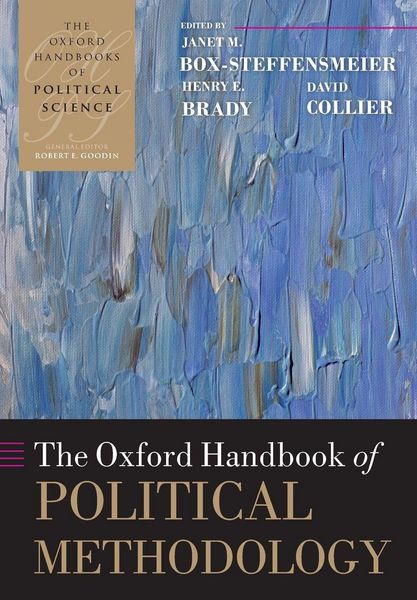
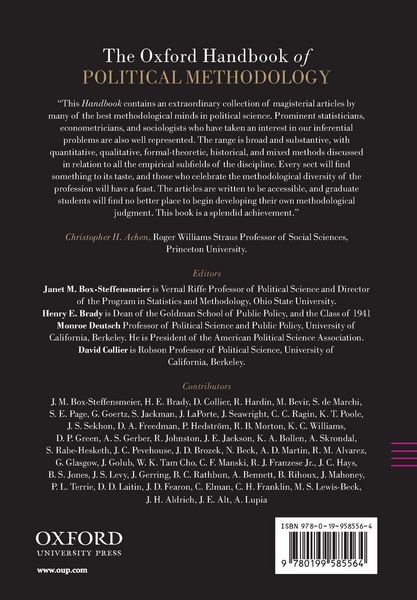
Oxford Handbook of Political Methodology

85,99 €

inkl. gesetzl. MwSt., Versandkostenfrei


Beschreibung

Produktdetails

Einband

Taschenbuch

Erscheinungsdatum

01.07.2010

Herausgeber

Henry E. Brady + weitere

Verlag

Oxford University Press

Seitenzahl

896

Maße (L/B/H)

24,4/17/4,8 cm

Gewicht

1513 g

Sprache

Englisch

ISBN

978-0-19-958556-4

Beschreibung

Produktdetails

Einband

Taschenbuch

Erscheinungsdatum

01.07.2010

Herausgeber

Verlag

Oxford University Press

Seitenzahl

896

Maße (L/B/H)

24,4/17/4,8 cm

Gewicht

1513 g

Sprache

Englisch

ISBN

978-0-19-958556-4

Herstelleradresse

Libri GmbH
Europaallee 1
36244 Bad Hersfeld
DE

Email: gpsr@libri.de

Kundinnen und Kunden meinen

0 Bewertungen

Informationen zu Bewertungen

Zur Abgabe einer Bewertung ist eine Anmeldung im Konto notwendig. Die Authentizität der Bewertungen wird von uns nicht überprüft. Wir behalten uns vor, Bewertungstexte, die unseren Richtlinien widersprechen, entsprechend zu kürzen oder zu löschen.

Die Bewertungen sind nach Format, Anzahl Sterne und Datum sortiert.

Verfassen Sie die erste Bewertung zu diesem Artikel

Helfen Sie anderen Kund*innen durch Ihre Meinung

Kundinnen und Kunden meinen

0 Bewertungen filtern

  • Produktbild: Oxford Handbook of Political Methodology
  • Produktbild: Oxford Handbook of Political Methodology
    • Part I: Introduction

    • 1: Janet Box-Steffensmeier, Henry Brady, David Collier: Political Science Methodology

    • 2: Russell Hardin: Normative Methodology

    • Part II: Approaches to Social Science Methodology

    • 3: Mark Bevir: Meta-methodology: Clearing the Underbrush

    • 4: Scott de Marchi and Scott E. Page: Agent-based Modeling

    • Part III: Concepts and Measurement

    • 5: Gary Goertz: Concepts, Theories, and Numbers: A Checklist for Constructing, Evaluating, and Using Concepts or Quantitative Measures

    • 6: Simon Jackman: Measurement

    • 7: David Collier, Jody LaPorte, and Jason Seawright: Typologies: Forming Concepts and Creating Catagorical Variables

    • 8: Charles C. Ragin: Measurement versus Calibration: A Set-theoretic Approach

    • 9: Keith T. Poole: The Evolving Influence of Psychometrics in Political Science

    • Part IV: Causality and Explanation in Social Research

    • 10: Henry E. Brady: Causation and Explanation in Social Science

    • 11: Jasjeet S.Sekhon: The Neyman-Rubin Model of Causal Inference and Estimation via Matching Methods

    • 12: David A. Freedman: On Types of Scientific Enquiry: The Role of Qualitative Reasoning

    • 13: Peter Hedstrom: Studying Mechanisms to Strengthen Causal Inferences in Quantitative Research

    • Part V: Experiments, Quasi-experiments and Natural Experiments

    • 14: Rebecca B. Morton and Kenneth C. Williams: Experimentation in Political Science

    • 15: Alan S. Gerber and Donald P. Green: Field Experiments and Natural Experiments

    • Part VI: Quantitative Tools for Descriptive and Causal Inference: General Methods

    • 16: Richard Johnston: Survey Methodology

    • 17: John E. Jackson: Endogeneity and Structural Equation Estimation in Political Science

    • 18: Kenneth A. Bollen, Sophia Rabe-Hesketh, and Anders Skrondal: Structural Equation Models

    • 19: Jon C. Pevehouse and Jason D. Brozek: Time-series Analysis

    • 20: Nathaniel Beck: Time-series Cross-section Methods

    • 21: Andrew D. Martin: Bayesian Analysis

    • Part VII: Quantitative Tools for Descriptive and Causal Inference: Special Topics

    • 22: Garrett Glasgow and R. Michael Alvarez: Discrete Choice Methods

    • 23: Jonathan Golub: Survival Analysis

    • 24: Wendy K. Tam Cho and Charles F. Manski: Cross-level/Ecological Inference

    • 25: Robert J. Franzese Jr, and Jude C. Hays: Empirical Models of Spatial Interdependence

    • 26: Bradford S. Jones: Multilevel Models

    • Part VIII: Qualitative Tools for Descriptive and Causal Inference

    • 27: Jack S. Levy: Counterfactuals and Case Studies

    • 28: John Gerring: Case Selection for Case-study Analysis: Qualitative and Quantitative Techniques

    • 29: Brian C. Rathbun: Interviewing and Qualitative Field Methods: Pragmatism and Practicalities

    • 30: Andrew Bennett: Process Tracing: A Bayesian Perspective

    • 31: Benoit Rihoux: Case-oriented Configurational Research: Qualitative Comparative Analysis (QCA), Fuzzy Sets, and Related Techniques

    • 32: James Mahoney and P. Larkin Terrie: Comparative-historical Analysis in Contemporary Political Science

    • 33: James D. Fearon and David D. Laitin: Integrating Qualitative and Quantitative Methods

    • Part IX: Organizations, Institutions, and Movements in the Field of Methodology

    • 34: David Collier and Colin Elman: Qualitative and Multimethod Research: Organizations, Publication, and Reflections on Integration

    • 35: Charles H. Franklin: Quantitative Methodology

    • 36: Michael S. Lewis-Beck: Forty Years of Publishing in Quantitative Methodology

    • 37: John H. Aldrich, James E. Alt, and Arthur Lupia: The EITM Approach: Origins and Interpretations

    • Index