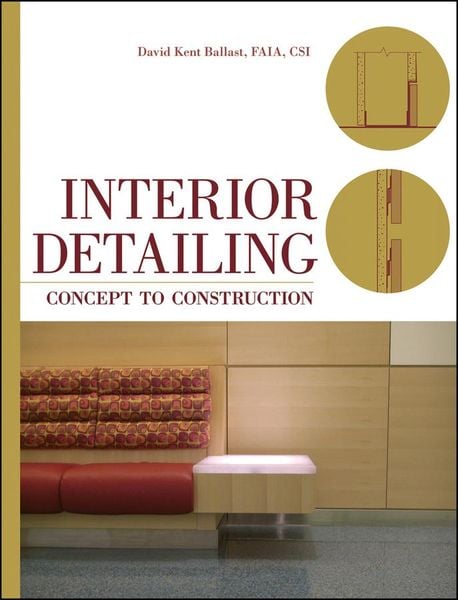
Produktbild: Interior Detailing

Interior Detailing Concept to Construction

111,99 €

inkl. gesetzl. MwSt., Versandkostenfrei


Beschreibung

Produktdetails

Einband

Gebundene Ausgabe

Erscheinungsdatum

28.09.2010

Verlag

John Wiley & Sons

Seitenzahl

304

Maße (L/B/H)

28,7/22,2/2,5 cm

Gewicht

885 g

Auflage

1. Auflage

Sprache

Englisch

ISBN

978-0-470-50497-0

Beschreibung

Produktdetails

Einband

Gebundene Ausgabe

Erscheinungsdatum

28.09.2010

Verlag

John Wiley & Sons

Seitenzahl

304

Maße (L/B/H)

28,7/22,2/2,5 cm

Gewicht

885 g

Auflage

1. Auflage

Sprache

Englisch

ISBN

978-0-470-50497-0

Herstelleradresse

Libri GmbH
Europaallee 1
36244 Bad Hersfeld
DE

Email: gpsr@libri.de

Kundinnen und Kunden meinen

0 Bewertungen

Informationen zu Bewertungen

Zur Abgabe einer Bewertung ist eine Anmeldung im Konto notwendig. Die Authentizität der Bewertungen wird von uns nicht überprüft. Wir behalten uns vor, Bewertungstexte, die unseren Richtlinien widersprechen, entsprechend zu kürzen oder zu löschen.

Die Bewertungen sind nach Format, Anzahl Sterne und Datum sortiert.

Verfassen Sie die erste Bewertung zu diesem Artikel

Helfen Sie anderen Kund*innen durch Ihre Meinung

Kundinnen und Kunden meinen

0 Bewertungen filtern

Die Leseprobe wird geladen.
  • Produktbild: Interior Detailing
  • List of Tables xiii

    List of Illustrations xv

    Preface xix

    Acknowledgments xxi

    Introduction xxiii

    How SI Units Are Used in This Book  xxv

    Part 1 Roadmap To Solving Detailing Problems

    1 The Design/Detailing Process 3

    1-1 Introduction 3

    1-2 What Is Detailing? 3

    Detailing as a Wicked Problem 4

    1-3 The Drawing-Thinking-Drawing Cycle 5

    1-4 Process Tools and Techniques 6

    Process Tools 6

    Practical Tips 8

    1-5 Detailing Components and Process 11

    The Four Aspects of Detailing 11

    The Detailing Process 12

    Example 12

    1-6 Three Purposes of a Detail 16

    Contributes to Design Concept 16

    Resolves Problems of Connection or Transition 17

    Coordinates with Adjacent Construction 17

    1-7 Programmatic Concepts versus Design Concepts 17

    2 Constraints 19

    2-1 Introduction 19

    2-2 Substrates and Adjacent Construction 19

    Substrate Material 21

    Substrate Condition 21

    Substrate Size and Position 21

    Substrate Space 21

    2-3 Regulatory Requirements 22

    Fire Tests for Finish Materials 23

    Fire Tests for Construction Assemblies 27

    2-4 Budget 28

    2-5 Time 29

    2-6 Climate 29

    2-7 Local Labor Conditions and Trade Practices 29

    2-8 Industry Standards 30

    2-9 Materials 34

    Aesthetic Qualities 35

    Function 35

    Safety and Health 37

    Durability 38

    Maintainability 39

    Cost and Delivery Time 40

    Sustainability 40

    3 Function 41

    3-1 Introduction 41

    3-2 Concealment and Finish 41

    Covering Substrates 41

    Covering Joints and Connections 42

    Hiding Mechanical and Electrical Services 46

    3-3 Human Fit/Object Fit 49

    Base Dimensions on Human Size and Reach or Object Size 49

    Recognize Differences in Age, Height, Abilities 51

    Provide Adjustable Details 52

    Provide Alternate Fits 52

    3-4 Safety: Protection from Accidental Harm 52

    Use Nonslip Flooring 52

    Avoid Sharp Edges Close to Human Contact 52

    Provide Handrails and Guards When Necessary 53

    Design Stairs Correctly 53

    Mark Full-Height Glass 55

    Avoid Single Steps 55

    Avoid Slight Change of Level 55

    Use Nontoxic Materials 55

    3-5 Security: Protection from Intentional Harm 55

    Use Locks, Detection, and Intrusion Alarms as Appropriate 56

    Design Physical Barriers for the Level of Security Required 56

    Use Electronic Surveillance When Required 56

    Use Ballistic-Resistant Assemblies 56

    Devise Space Plan for Supervision 57

    3-6 Sustainability 58

    Detail with Materials That Incorporate as Little Embodied Energy as Possible 58

    Use Renewable Materials 59

    Use Materials with High Recycled Content 59

    When Possible, Use Products or Design Details That Can Reduce Energy Consumption 60

    Use Local Materials 60

    Use Materials with Low or No VOCs 60

    Use Materials with Low Toxicity 60

    Design Details and Select Materials to Minimize Moisture Problems 61

    Use Durable Materials and Details 61

    Design Details to Simplify Maintenance 61

    Specify Materials and Design Details to Maximize Recycling Potential 61

    Design Details for Reusability 62

    3-7 Change and Relocatability 63

    Design for Relocating the Detail with the Same User 63

    Detail for the Same Function but with a Change in Users 63

    Detail for a Change of Function of the Space with Different Users 64

    3-8 Fire Resistance 64

    Use Noncombustible Materials in Details 64

    Limit the Amount of Flammable Materials 64

    Use Applied Fire Retardants When Required 64

    Use Only Tested and Rated Assemblies and Materials 65

    Use Listed or Labeled Components 66

    3-9 Acoustical Control 66

    Noise Control and Reverberation 66

    Transmission Control 68

    Vibration and Impact Noise Control 72

    3-10 Moisture/Water Resistance 74

    Use Nonabsorbent Materials 74

    Use Nonferrous Metals 75

    Eliminate or Minimize Joints 75

    Employ Overlap 75

    Use Drips 75

    Use the Correct Sealant and Joint Design 75

    4 Constructability 77

    4-1 Introduction 77

    4-2 Structural Requirements 77

    Basic Concepts of Structure 78

    Use Simple Direct Bearing Connections Whenever Possible 79

    Incorporate Beam Action 79

    Use the Simplest Connections Possible 80

    Use Redundant Connections or Bearing When Required 80

    Use Structural Connections Approved by the Manufacturer 80

    Use Removable Connections for Reuse Potential 81

    4-3 Connections 81

    Use the Appropriate Method for Rigid Connections 81

    Determine Movable Connection Type Based on Use 82

    Minimize Number and Types of Connections 82

    Make Connections Accessible 83

    4-4 Movement 83

    Use Acclimated Materials 84

    Use Relieved Backs on Wood 84

    Use Control Joints 85

    Provide Expansion Joints 85

    Use Sliding/Overlapping Joints 86

    Use Slip Joints 86

    Use Building Expansion Joints 88

    Provide Clear Space 88

    4-5 Tolerances 89

    Provide Shim Space 90

    Provide Scribe 91

    Use Reveals 91

    Use Offsets 92

    Use Filler Strips 92

    Use Sliding or Overlapping Fit 92

    Use Adjustable Connections 92

    Give Adequate Clearance and Incorporate Intermediate Attachments 93

    4-6 Clearances 93

    Allow Space for Working and Assembly 93

    Provide Space for Installation of Pieces 93

    Allow for Tolerances 93

    4-7 Durability 94

    Self-Durable 94

    Applied Protection 94

    4-8 Maintainability 95

    Cleanability 95

    Adjustability 96

    Repair and Replacement 98

    4-9 Construction Process 99

    Number of Parts 99

    Sequence 100

    Trade Division of Labor 100

    Off-Shelf versus Custom Parts 101

    Shop versus Field Fabricated 101

    Part 2 elements

    5 Dividing And Creating Space With Permanent Barriers 105

    5-1 Introduction 105

    5-2 Element Concepts 106

    5-3 Function 106

    5-4 Constraints 107

    5-5 Coordination 108

    Tolerance Coordination 108

    5-6 Methods 109

    Planar 109

    Panelized 113

    Barriers with Openings 118

    Translucent 120

    Partial Height 126

    Thick 129

    6 Dividing And Creating Space With Temporary Barriers 133

    6-1 Introduction 133

    6-2 Element Concepts 134

    6-3 Function 135

    6-4 Constraints 136

    6-5 Coordination 137

    6-6 Methods 137

    Full Height 138

    Partial Height 138

    7 Overhead Limits-Ceilings 141

    7-1 Introduction 141

    7-2 Element Concepts 141

    7-3 Function 144

    7-4 Constraints 145

    7-5 Coordination 146

    Sprinkler Spacing 147

    HVAC Coordination 148

    Tolerance Coordination 149

    7-6 Methods 150

    Closed 150

    Open 155

    8 The Ground Plane-Floors, Stairs, And Ramps 159

    8-1 Introduction 159

    8-2 Element Concepts 159

    Flooring 160

    Stairs 161

    Ramps 161

    8-3 Function 162

    8-4 Constraints 163

    Fire Resistance of Floor Finishes 163

    Fire Resistance of Structural Flooring Components 164

    Slip Resistance and Tripping 165

    Accessibility 165

    Code Requirements 165

    8-5 Coordination 168

    Tolerance Coordination 168

    Light Reflectance and Acoustic Coordination 169

    8-6 Methods 169

    Flooring 169

    Handrails, Guards, and Stairways 175

    9 Spatial Connection-Openings, Doors, And Glazing 179

    9-1 Introduction 179

    9-2 Element Concepts 180

    Openings 180

    Doors 180

    Glazing 182

    Window Covering 183

    9-3 Function 185

    9-4 Constraints 186

    9-5 Coordination 187

    9-6 Methods 187

    Doors 187

    Glazed Openings 189

    Window Coverings 196

    Part 3 Transitions

    10 Wall Transitions 199

    10-1 Introduction 199

    10-2 Connections of Major Elements 199

    10-3 Wall to Floor 200

    Standard Bases 201

    Featured Bases 203

    Component Bases 208

    10-4 Wall to Ceiling 209

    Standard Ceiling Transitions 210

    Structural Transitions 212

    Planar Transitions 215

    11 Planar Transitions 219

    11-1 Partition to Partition 219

    In-Plane Transitions 219

    Plain Offsets 221

    11-2 Floor to Floor 226

    In-Plane Transitions 226

    Plain Offset Floors 229

    Interrupted Offset  229

    11-3 Ceiling to Ceiling  231

    In-Plane Transitions  232

    Offset Transitions 234

    12 Structural Transitions 239

    12-1 Introduction 239

    12-2 Columns 240

    Column-to-Ceiling Transitions 240

    Column-to-Floor Transitions 244

    Column-to-Beam Transitions 246

    12-3 Beams 250

    Beam-to-Partition Transitions 250

    Beam-to-Ceiling Transitions 252

    Beam-to-Beam Transitions 254

    12-4 Suspended Objects 255

    Thin Supports 256

    Clamps 256

    Thick Supports 257

    Rigid Supports 258

    Appendix A: Resources 259

    Appendix B: Industry Standards for Interior Materials and Products 261

    Index 273