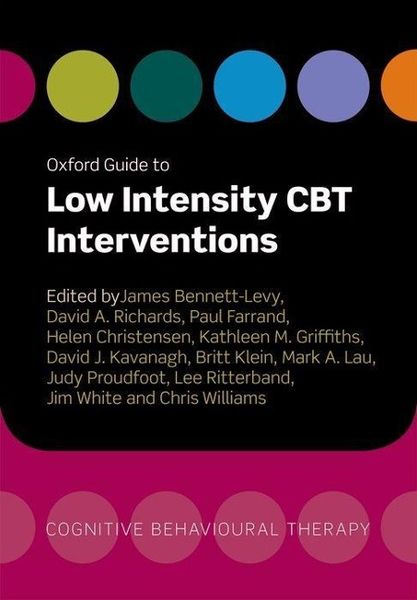
Produktbild: Oxford Guide to Low Intensity CBT Interventions

Oxford Guide to Low Intensity CBT Interventions

79,99 €

inkl. gesetzl. MwSt., Versandkostenfrei


Beschreibung

Produktdetails

Einband

Taschenbuch

Erscheinungsdatum

13.05.2010

Herausgeber

Britt Klein + weitere

Verlag

Oxford University Press

Seitenzahl

632

Maße (L/B/H)

24,6/17,4/4,1 cm

Gewicht

1131 g

Sprache

Englisch

ISBN

978-0-19-959011-7

Beschreibung

Produktdetails

Einband

Taschenbuch

Erscheinungsdatum

13.05.2010

Herausgeber

Verlag

Oxford University Press

Seitenzahl

632

Maße (L/B/H)

24,6/17,4/4,1 cm

Gewicht

1131 g

Sprache

Englisch

ISBN

978-0-19-959011-7

Herstelleradresse

Libri GmbH
Europaallee 1
36244 Bad Hersfeld
DE

Email: gpsr@libri.de

Kundinnen und Kunden meinen

0 Bewertungen

Informationen zu Bewertungen

Zur Abgabe einer Bewertung ist eine Anmeldung im Konto notwendig. Die Authentizität der Bewertungen wird von uns nicht überprüft. Wir behalten uns vor, Bewertungstexte, die unseren Richtlinien widersprechen, entsprechend zu kürzen oder zu löschen.

Die Bewertungen sind nach Format, Anzahl Sterne und Datum sortiert.

Verfassen Sie die erste Bewertung zu diesem Artikel

Helfen Sie anderen Kund*innen durch Ihre Meinung

Kundinnen und Kunden meinen

0 Bewertungen filtern

  • Produktbild: Oxford Guide to Low Intensity CBT Interventions
    • Foreword

    • Section 1 Low Intensity CBT Models and Conceptual Underpinnings

    • Overview

    • 1: 1. James Bennett-Levy, Dave Richards and Paul Farrand: Low Intensity CBT Interventions: A Revolution in Mental Health Services

    • 2: Dave Richards: Access and Organisation: Putting Low Intensity Interventions to Work in Clinical Services

    • 3: Jim White: The STEPS Model: a High Volume, Multi-level, Multi-purpose approach to address Common Mental Health Problems

    • 4: Helen Christensen: Increasing Access and Effectiveness: Using the Internet to deliver Low Intensity Cognitive Behaviour Therapy

    • 5: Chris Williams and Jill Morrison
      : A New Language for CBT: New ways of Working Require New Thinking as well as New Words

    • Section 2A: Introducing and Supporting Guided CBT

    • Overview

    • 6: Paul Farrand and Chris Williams: Low Intensity CBT Assessment: In Person or by Phone

    • 7: Judy Proudfoot and Jennifer Nicholas: Monitoring and Evaluation in Low Intensity CBT Interventions

    • 8: Mark Kenwright: Introducing and Supporting Written and Internet-Based Guided CBT

    • 9: Rebecca Martinez and Chris Williams: Matching clients to CBT self-help resources

    • 10: Dave Richards: Collaborative Care: The Effective Organization of Treatment for Depression

    • 11: Dave Richards
      : Supervising low intensity workers

    • Section 2B Key Low Intensity CBT Interventions in Depression and Anxiety

    • Overview

    • 12: Dave Richards: Behavioural Activation for Depression

    • 13: Laurence Mynors-Wallis and Mark Lau: Problem Solving Therapy for Depression

    • 14: Adrian Taylor: Increasing Physical activity as a Low Intensity Treatment for Depression

    • 15: Nick Titov, Gavin Andrews and Peter McEvoy: Key Components of Low Intensity Interventions for Anxiety

    • 16: Leanne Hides, Steve Carroll, Dan I Lubman and Amanda Baker: Brief Motivational Interviewing for Depression and Anxiety

    • 17: Norah Vincent and Maxine Holmqvist
      : Low Intensity Interventions for Chronic Insomnia

    • Section 2C: Guided CBT Interventions using Written Materials

    • Overview

    • 18: Dave Richards and Paul Farrand: Choosing self-help books wisely: Sorting the wheat from the chaff

    • 19: Paul Farrand and Joanne Woodford: Using Guided Self-Help Book Prescription Schemes

    • 20: Marie Chellingsworth, Chris Williams, Ann McCreath, Paul Tanto and Kirsten Thomlinson
      : Delivering book based CBT Self-Help Classes in health service, further education and voluntary sector services

    • Section 2D: Guided CBT Interventions using the Internet

    • Overview

    • 21: Kate Cavanagh: Turn On, Tune In and (Don't) Drop Out: Engagement, Adherence, Attrition and Alliance with Internet-based CBT Interventions

    • 22: Lee Ritterband, Frances Thorndike, Drew Saylor and Desi Vásquez: Treatment Credibility and Satisfaction with Internet Interventions

    • 23: Tara Donker, Annemieke Van Straten and Pim Cuijpers: Internet-based Mental Health Screening

    • 24: Lisa Whitehead and Judy Proudfoot: Standards and Operating Guidelines for Internet Interventions

    • 25: Proudfoot, Andersson, Carlbring, Klein, Kyrios, Lauder, Munro, Palermo, Riper, Blankers
      : Guided CBT Internet Interventions: Specific Issues in Supporting Clients with Depression, Anxiety and Co-Morbid Conditions

    • Section 2E Novel Uses of Communication Technologies: Supporting Low Intensity CBT in New Environments

    • Overview

    • 26: Gerhard Andersson and Per Carlbring: Using different communication channels to support internet interventions

    • 27: Karina Lovell: Supporting Low Intensity Interventions using the Telephone

    • 28: Jennifer Shapiro and Stephanie Bauer: Use of Short-Messaging Service (SMS) To Enhance Low Intensity CBT

    • 29: Nick Titov: Email in Low Intensity CBT Interventions

    • 30: Kathy Griffiths and Julia Reynolds: Online Mutual Support Bulletin Boards

    • 31: David Kavanagh, Jennifer Connolly, Amy Kelly, Angela White and Jan Parry
      : Low Intensity Cognitive Behavioural Therapies by Mail (M-CBT)

    • Section 2F Stepping Further Outside the Box: Extending the Environments for Low Intensity CBT

    • Overview

    • 32: Jim White: Large group didactic CBT classes for common mental health problems

    • 33: Ingrid Sochting, Christopher Wilson and Theo DeGagne: Cognitive Behaviour Group Therapy (CBGT): Capitalizing on efficiency and humanity

    • 34: Tim Carey: Will you follow while they lead? Introducing a patient-led approach to low intensity CBT interventions

    • 35: Jim White: The Advice Clinic or What I did in my thirty minutes

    • 36: Lee David: Low intensity CBT Interventions by General Practitioners

    • 37: Frank Deane and David Kavanagh
      : Adapting low intensity CBT for clients with severe mental disorder

    • Section 2G: Going Upstream: Using Low Intensity CBT Interventions to Prevent Mental Health Problems

    • Overview

    • 38: Pim Cuijpers: Group CBT for prevention of depression in adults

    • 39: Tahlee Marian and Justin Kenardy: Internet-delivered prevention for anxiety and depression disorders in adults

    • 40: Greg Clarke: Low intensity targeted group prevention of depression in adolescents and children

    • 41: Alison Calear, Helen Christensen, Kathy Griffiths: Internet-based anxiety and depression prevention programs for children and adolescents

    • 42: Matthew Sanders and James Kirby: Parental programs for preventing behavioural and emotional problems in children

    • 43: Mark Lau
      : Mindfulness-based cognitive therapy: a low intensity group program to prevent depressive relapse

    • Section 3 Training Low Intensity CBT Practitioners

    • Overview

    • 44: Dave Richards: Training low intensity workers

    • 45: Dave Ekers: Training Depression Care Managers

    • 46: Sharon Lawn, Ann Smith, Kelly Hunter, Jim Smith, Nicki Hurst, Michael Nanai, and Kylie Neate: Training Peers to Provide Low Intensity CBT Support: The Value of Personal Experience

    • 47: Chris Williams, Catriona Kent and Anne Joice: Training the Wider Workforce in the Use of Cognitive Behaviour Therapy Written Self-help Resources

    • 48: Dan Bilsker and Elliot Goldner: Training GPs to prescribe depression self-management

    • 49: David Austin, Britt Klein, Kerrie Shandley and Lisa Ciechomski: Training Clinicians Online to be Etherapists: The 'Anxiety Online' model

    • 50: Jillian Telford and Rea Wilson
      : From Classroom to 'Shop Floor': Challenges Faced As A Low Intensity Practitioner

    • Section 4A: Facilitating the Uptake of Low Intensity CBT Interventions: Changing Systems and Routine Practice

    • Overview

    • 51: James Seward, Michael Clark: Establishing the Improved Access to Psychological Therapies (IAPT) Program: Lessons from large-scale change in England

    • 52: Alex McMahon: Implementing Low Intensity Interventions: What Governments want and why

    • 53: Gehard Andersson, Per Carlbring, Viktor Kaldo, Pim Cuijpers: Challenges and Potential Solutions in Integrating Internet-based CBT Interventions into Specialist Services

    • 54: Matthew Sanders and Majella Murphy Brennan: Achieving widespread dissemination of low intensity evidence-based practices: The experience of the Triple P-Positive Parenting Program

    • 55: Michael Smith: Practical Service Redesign: Helping GPs to Enhance Depression Care

    • 56: David Kavanagh and Frank Deane: Implementing low-intensity CBT (LI CBT) in case management of clients with severe mental illness

    • 57: Kevin Khayat
      : Effective Partnerships with Community Groups

    • Section 4B: Facilitating the Uptake of Low Intensity CBT Interventions: Adapting Interventions to Different Community Contexts

    • Overview

    • 58: Jim White: Bringing the public on board: Health promotion and social marketing in deprived communities

    • 59: Nicole Highet, Clare Shann and Leonie Young: Enhancing Community Awareness of Depression and Access to Treatment: Experiences with beyondblue

    • 60: Mark Lau: Problems and Potentials in Rolling out Low Intensity CBT in Rural Communities

    • 61: Judy Leibowitz: Improving Access to Low intensity Interventions for Ethnic Minority Communities

    • 62: Arlene Laliberte, Tricia Nagel, and Melissa Haswell-Elkins: Low intensity CBT with Indigenous consumers: Creative solutions for culturally appropriate mental health care