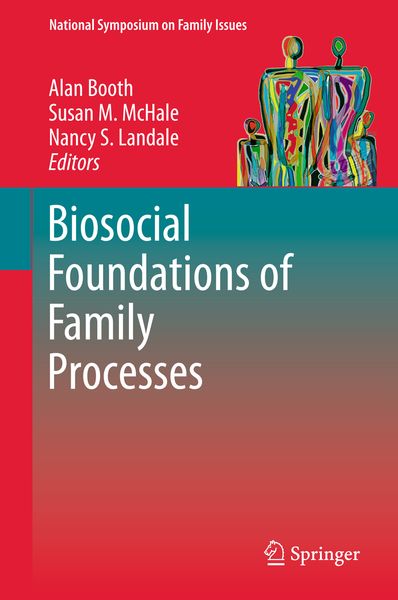
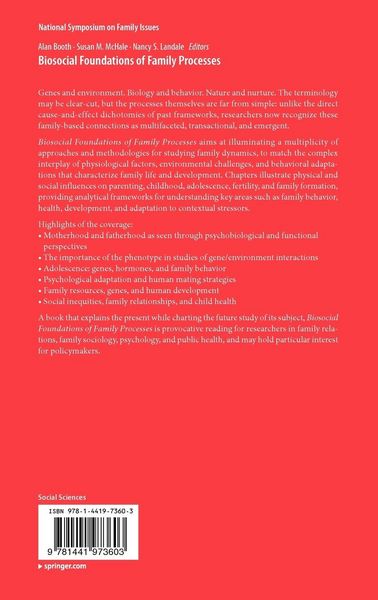
• Produktbild: Biosocial Foundations of Family Processes
  • Produktbild: Biosocial Foundations of Family Processes
- 13%

Biosocial Foundations of Family Processes

13% sparen

92,99 € UVP 106,99 €

inkl. gesetzl. MwSt., Versandkostenfrei


Beschreibung

Produktdetails

Einband

Gebundene Ausgabe

Erscheinungsdatum

10.12.2010

Herausgeber

Alan Booth + weitere

Verlag

Springer Us

Seitenzahl

272

Maße (L/B/H)

24,2/16,5/2,8 cm

Gewicht

543 g

Auflage

2011

Sprache

Englisch

ISBN

978-1-4419-7360-3

Beschreibung

Portrait

Nancy S. Landale, Ph.D., is Liberal Arts Research Professor of Sociology and Demography at The Pennsylvania State University. Dr. Landale's areas of interest include family demography, children's health, immigration and immigrant incorporation, and the Hispanic population. She is widely known for her research on the implications of migration to the U.S. mainland for family processes and maternal/infant health among Puerto Ricans. Her current work focuses on the educational and health outcomes of Mexican children of immigrants.
Alan Booth, Ph.D., is Distinguished Professor of Sociology, Demography, and Human Development & Family Studies at The Pennsylvania State University. He has been a senior scientist in Penn State's Population Research Institute since 1991. Dr. Booth has co-organized the university's National Symposium of Family Issues since its inception in 1993. Dr. Booth directed a 20 year study of marital instability in a national sample of 2000 married persons. The project has been the basis for many studies on the causes of divorce, the effects of divorce on children's well-being, remarriage and step families, as well as the effects on psychological distress, educational achievement, romantic relationships and family formation of having a non-resident parent.
Susan M. McHale, Ph.D., is Director of the Social Science Research Institute and The Children, Youth, and Family Consortium and Professor of Human Development at The Pennsylvania State University. Her research focuses on children's and adolescents' family roles, relationships, and daily experiences and how these family dynamics are linked to youth development and adjustment.

Produktdetails

Einband

Gebundene Ausgabe

Erscheinungsdatum

10.12.2010

Herausgeber

Verlag

Springer Us

Seitenzahl

272

Maße (L/B/H)

24,2/16,5/2,8 cm

Gewicht

543 g

Auflage

2011

Sprache

Englisch

ISBN

978-1-4419-7360-3

Herstelleradresse

Libri GmbH
Europaallee 1
36244 Bad Hersfeld
DE

Email: gpsr@libri.de

Noch keine Bewertungen vorhanden

Verfassen Sie die erste Bewertung zu diesem Artikel

Helfen Sie anderen Kundinnen und Kunden durch Ihre Meinung.

Kundinnen und Kunden meinen

Bewertungen (0)

  • Produktbild: Biosocial Foundations of Family Processes
  • Produktbild: Biosocial Foundations of Family Processes
  • I. Parenting and Early Childhood Behavior and Development.- How Mothers Are Born: A Psychobiological Analysis Of Mothering.- How Fathers Evolve: A Functional Analysis Of Fathering Behavior.- Caregiving As Co-Regulation: Psychobiological Processes And Child Functioning.- The Determinants of Parenting in GXE Perspective: A Case of Differential Susceptibility.- II. Development and Adjustment in Adolescence.- Gene-Environment Interplay Helps To Explain Influences Of Family Relationships On Adolescent Adjustment And Development.- The Importance of the Phenotype in Explorations of Gene-Environment Interplay.- The Importance of Puberty in Adolescent Development.- Genes, Hormones, and Family Behavior: What Makes Adolescence Unique.- III. Mate Selection, Family Formation, and Fertility.- Human Adaptations for Mating: Frameworks for Understanding Patterns of Family Formation and Fertility.- The Need for Family Research Using Multiple Approaches and Methods.- Psychological Adaptation and Human Fertility Patterns: Some Evidence of Human Mating Strategies as Evoked Sexual Culture.- Comments on Consilience Efforts.- IV. Family Adaptations to Resource Disparities.- Family Influences on Children’s Well-Being: Potential Roles of Molecular Genetics and Epigenetics.- Social Inequalities, Family Relationships, and Child Health.- Family Resources, Genes, and Human Development.- In Search of GE: Why We Haven’t Documented a Gene-Social Environment Interaction Yet.- A Promising Approach to Future Biosocial Research on the Family: Considering The Role of Temporal Context.