Produktbild: From Animals to Animats 11
Band 6226

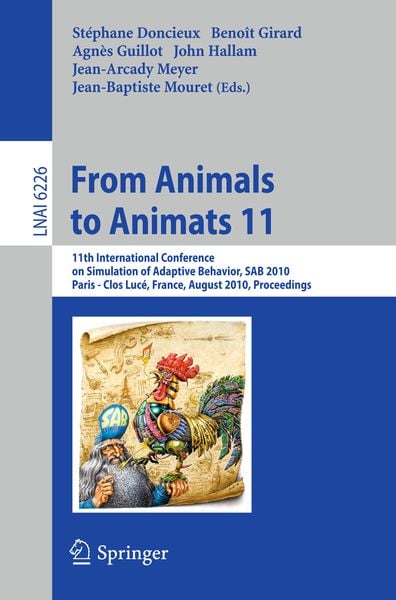
From Animals to Animats 11 11th International Conference on Simulation of Adaptive Behavior, SAB 2010, Paris - Clos Lucé, France, August 25-28, 2010. Proceedings

97,99 €

inkl. gesetzl. MwSt., Versandkostenfrei


Beschreibung

Produktdetails

Einband

Taschenbuch

Erscheinungsdatum

11.08.2010

Herausgeber

Stephane Doncieux + weitere

Verlag

Springer Berlin

Seitenzahl

662

Maße (L/B/H)

24,1/15,8/2,8 cm

Gewicht

959 g

Auflage

2010

Sprache

Englisch

ISBN

978-3-642-15192-7

Beschreibung

Produktdetails

Einband

Taschenbuch

Erscheinungsdatum

11.08.2010

Herausgeber

Verlag

Springer Berlin

Seitenzahl

662

Maße (L/B/H)

24,1/15,8/2,8 cm

Gewicht

959 g

Auflage

2010

Sprache

Englisch

ISBN

978-3-642-15192-7

Herstelleradresse

Springer-Verlag GmbH
Heidelberger Platz 3
14197 Berlin
Deutschland
Email: sdc-bookservice@springer.com
Url: www.springer.com
Telephone: +49 30 827870
Fax: +49 30 8214091

Noch keine Bewertungen vorhanden

Verfassen Sie die erste Bewertung zu diesem Artikel

Helfen Sie anderen Kundinnen und Kunden durch Ihre Meinung.

Kundinnen und Kunden meinen

Bewertungen (0)

  • Produktbild: From Animals to Animats 11
  • Animat Approaches for Adaptive Behaviour.- From Mirror Writing to Mirror Neurons.- How Virtual Machinery Can Bridge the “Explanatory Gap”, in Natural and Artificial Systems.- Do Empirical Models of Robot-Environment Interaction Have a Meaning?.- Information Dynamics of Evolved Agents.- Taming the Beast: Guided Self-organization of Behavior in Autonomous Robots.- Perception and Motor Control.- Slime Mold Inspired Chemical Sounding.- A Conserved Network for Control of Arthropod Exteroceptive Optical Flow Reflexes during Locomotion.- Modifying Directionality through Auditory System Scaling in a Robotic Lizard.- SCRATCHbot: Active Tactile Sensing in a Whiskered Mobile Robot.- Toward a Spiking-Neuron Model of the Oculomotor System.- An Integrated Neuromimetic Model of the Saccadic Eye Movements for the Psikharpax Robot.- Reconstructing the Acoustic Signal of a Sound Source: What Did the Bat Say?.- Simulating the Morphological Feasibility of Adaptive Beamforming in Bats.- On the Influence of Sensor Morphology on Vergence.- Adapting Preshaped Grasping Movements Using Vision Descriptors.- Multimodal Predictive Control in Crickets.- Tactile Discrimination Using Template Classifiers: Towards a Model of Feature Extraction in Mammalian Vibrissal Systems.- A Supramodal Vibrissa Tactile and Auditory Model for Texture Recognition.- Learning to Look in Different Environments: An Active-Vision Model Which Learns and Readapts Visual Routines.- Estimating Relative Positions of Multiple Objects in the Weakly Electric Fish.- From Force Control and Sensory-Motor Informations to Mass Discrimination.- The Approach Behaviour of the Hawkmoth Manduca sexta toward Multi-modal Stimuli: A Simulation Model.- The Indiana Experiment: Investigating the Role of Anticipation and Attention in a Dynamic Environment.- Attentional Mechanisms for Lateral Line Sensing through Spectral Analysis.- BeeIP: Bee-Inspired Protocol for Routing in Mobile Ad-Hoc Networks.- Action Selection and Behavioural Sequences.- Simulating Human Table Tennis with a Biomimetic Robot Setup.- Attentional Modulation of Mutually Dependent Behaviors.- An Empirical Evidence of Braitenberg Vehicle 2b Behaving as a Billiard Ball.- Insectomorphic Robot Maneuvering on a Movable Ball.- A Study of Adaptive Locomotive Behaviors of a Biped Robot: Patterns Generation and Classification.- Navigation and Internal World Models.- Predicting Affordances from Gist.- Analyzing Interactions between Cue-Guided and Place-Based Navigation with a Computational Model of Action Selection: Influence of Sensory Cues and Training.- A Cortical Column Model for Multiscale Spatial Planning.- Why and How Hippocampal Transition Cells Can Be Used in Reinforcement Learning.- The Complementary Roles of Allostatic and Contextual Control Systems in Foraging Tasks.- Path Integration Working Memory for Multi Tasks Dead Reckoning and Visual Navigation.- Minimal Model of Strategy Switching in the Plus-Maze Navigation Task.- Learning and Adaptation.- Distributed Online Learning of Central Pattern Generators in Modular Robots.- Learning New Motion Primitives in the Mirror Neuron System: A Self-organising Computational Model.- A Computational Model of Integration between Reinforcement Learning and Task Monitoring in the Prefrontal Cortex.- Internal Models in the Cerebellum: A Coupling Scheme for Online and Offline Learning in Procedural Tasks.- eMOSAIC Model for Humanoid Robot Control.- Noisy-or Nodes for Conditioning Models.- Adaptation of Coupled Sensorimotor Mappings: An Investigation towards Developmental Learning of Humanoids.- Learning Inverse Kinematics for Pose-Constraint Bi-manual Movements.- TeXDYNA: Hierarchical Reinforcement Learning in Factored MDPs.- Learning Robot-Environment Interaction Using Echo State Networks.- A Novel Information Measure for Predictive Learning in a Social System Setting.- Evolution.- Co-development of Linguistic and Behavioural Skills: Compositional Semantics and Behaviour Generalisation.- Indirectly Encoding Neural Plasticity as a Pattern of Local Rules.- Fractal Gene Regulatory Networks for Robust Locomotion Control of Modular Robots.- The Dependence of Braking Strategies on Optical Variables in an Evolved Model of Visually-Guided Braking.- Self-organizing Robot Teams Using Asynchronous Situated Co-evolution.- Emergence of an Internal Model in Evolving Robots Subjected to Sensory Deprivation.- Emergent Distribution of Computational Workload in the Evolution of an Undulatory Animat.- Multi-objective Evolutionary Algorithms to Investigate Neurocomputational Issues: The Case Study of Basal Ganglia Models.- Collective and Social.- Cooperative Stigmergic Navigation in a Heterogeneous Robotic Swarm.- How to Pick the Right One: Investigating Tradeoffs among Female Mate Choice Strategies in Treefrogs.- Autonomous Development of Social Referencing Skills.- A Model of Symmetry Breaking in Collective Decision-Making.- Simulation of How Neuromodulation Influences Cooperative Behavior.