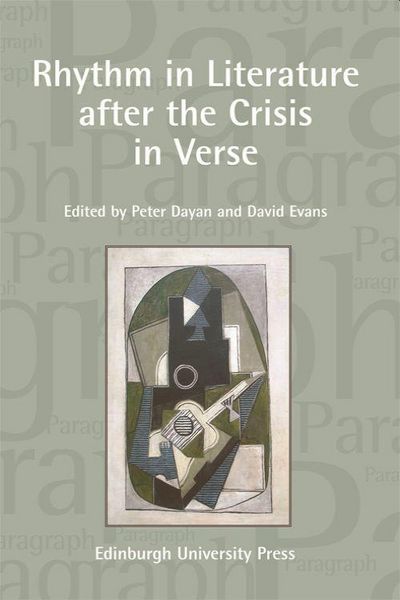
Rhythm in Literature After the Crisis in Verse Paragraph Volume 33, Number 2
-
- Englisch ausgewählt
42,99 €
inkl. gesetzl. MwSt.,
Beschreibung
Produktdetails
Einband
Taschenbuch
Erscheinungsdatum
15.07.2010
Herausgeber
Peter Dayan + weitereVerlag
Edinburgh University PressSeitenzahl
128
Maße (L/B/H)
23,4/15,6/0,8 cm
Gewicht
270 g
Sprache
Englisch
ISBN
978-0-7486-4064-5
Shout lineTraces rhythm in literature in the analysable patterns of metrical verse as it unfolds in the work of post-crisis writersBefore the 'crise de vers' which Mallarmé diagnosed in the 1880s, just as rhythm in music had to do with note values and repeated patterns, so rhythm in literature could be safely sought in the analysable patterns of metrical verse. The crisis abolished that security yet the conviction that rhythm is fundamental to literature survived that destruction. Tracing rhythm as it unfolds in the work of post-crisis writers from Valéry, Woolf, Campana, and the Dadaists, via the strange history of Russian verse under Communism, to Réda, Cortázar, and John Wilkinson, this volume seeks to found such a theory precisely in the space between rhythm's elusiveness as a general concept, and the continuing specific force of its presence in the works of literature.Before the 'crise de vers' which Mallarmé diagnosed in the 1880s, just as rhythm in music had to do with note values and repeated patterns, so rhythm in literature could be safely sought in the analysable patterns of metrical verse. The crisis abolished that security: free verse and prose poetry destroyed the privilege of the old countable rhythms. Yet the conviction that rhythm is fundamental to literature survived that destruction. How? Why? Is there really anything one can say, any theory that can measure up to rhythm since the crisis, to a rhythm that cannot be localised in measurable convention? Tracing rhythm as it unfolds in the work of post-crisis writers from Valéry, Woolf, Campana, and the Dadaists, via the strange history of Russian verse under Communism, to Réda, Cortázar, and John Wilkinson, this volume seeks to found such a theory precisely in the space between rhythm's elusiveness as a general concept, and the continuing specific force of its presence in the works of literature.
Noch keine Bewertungen vorhanden
Verfassen Sie die erste Bewertung zu diesem Artikel
Helfen Sie anderen Kundinnen und Kunden durch Ihre Meinung.
Kurze Frage zu unserer Seite
Vielen Dank für Ihr Feedback
Wir nutzen Ihr Feedback, um unsere Produktseiten zu verbessern. Bitte haben Sie Verständnis, dass wir Ihnen keine Rückmeldung geben können. Falls Sie Kontakt mit uns aufnehmen möchten, können Sie sich aber gerne an unseren Kund*innenservice wenden.
zum Kundenservice