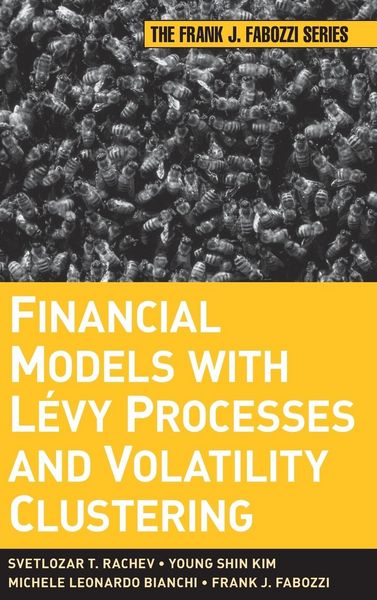
• Produktbild: Financial Models with Levy Processes and Volatility Clustering
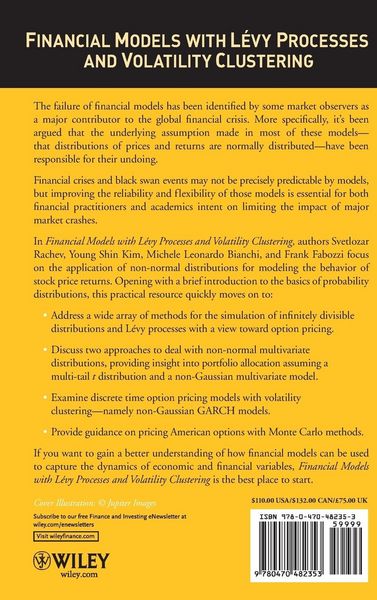
  • Produktbild: Financial Models with Levy Processes and Volatility Clustering

Financial Models with Levy Processes and Volatility Clustering

Aus der Reihe Frank J. Fabozzi Series

96,99 €

inkl. gesetzl. MwSt., Versandkostenfrei


Beschreibung

Produktdetails

Einband

Gebundene Ausgabe

Erscheinungsdatum

24.01.2011

Verlag

John Wiley & Sons Inc

Seitenzahl

416

Maße (L/B/H)

23,5/15,7/2,7 cm

Gewicht

752 g

Auflage

1. Auflage

Sprache

Englisch

ISBN

978-0-470-48235-3

Beschreibung

Produktdetails

Einband

Gebundene Ausgabe

Erscheinungsdatum

24.01.2011

Verlag

John Wiley & Sons Inc

Seitenzahl

416

Maße (L/B/H)

23,5/15,7/2,7 cm

Gewicht

752 g

Auflage

1. Auflage

Sprache

Englisch

ISBN

978-0-470-48235-3

Herstelleradresse

Libri GmbH
Europaallee 1
36244 Bad Hersfeld
DE

Email: GPSR Kontakt

Noch keine Bewertungen vorhanden

Verfassen Sie die erste Bewertung zu diesem Artikel

Helfen Sie anderen Kundinnen und Kunden durch Ihre Meinung.

Kundinnen und Kunden meinen

Bewertungen (0)

Die Leseprobe wird geladen.
  • Produktbild: Financial Models with Levy Processes and Volatility Clustering
  • Produktbild: Financial Models with Levy Processes and Volatility Clustering
  • Preface.
     
    About the Authors.
     
    Chapter 1 Introduction.
     
    1.1 The need for better financial modeling of asset prices.
     
    1.2 The family of stable distribution and its properties.
     
    1.3 Option pricing with volatility clustering.
     
    1.4 Model dependencies.
     
    1.5 Monte Carlo.
     
    1.6 Organization of the book.
     
    Chapter 2 Probability distributions.
     
    2.1 Basic concepts.
     
    2.2 Discrete probability distributions.
     
    2.3 Continuous probability distributions.
     
    2.4 Statistic moments and quantiles.
     
    2.5 Characteristic function.
     
    2.6 Joint probability distributions.
     
    2.7 Summary.
     
    Chapter 3 Stable and tempered stable distributions.
     
    3.1 alpha-Stable distribution.
     
    3.2 Tempered stable distributions.
     
    3.3 Infinitely divisible distributions.
     
    3.4 Summary.
     
    3.5 Appendix.
     
    Chapter 4 Stochastic Processes in Continuous Time.
     
    4.1 Some preliminaries.
     
    4.2 Poisson Process.
     
    4.3 Pure jump process.
     
    4.4 Brownian motion.
     
    4.5 Time-Changed Brownian motion.
     
    4.6 Lévy process.
     
    4.7 Summary.
     
    Chapter 5 Conditional Expectation and Change of Measure.
     
    5.1 Events, s-fields, and filtration.
     
    5.2 Conditional expectation.
     
    5.3 Change of measures.
     
    5.4 Summary.
     
    Chapter 6 Exponential Lévy Models.
     
    6.1 Exponential Lévy Models.
     
    6.2 Fitting a-stable and tempered stable distributions.
     
    6.3 Illustration: Parameter estimation for tempered stable distributions.
     
    6.4 Summary.
     
    6.5 Appendix : Numerical approximation of probability density and cumulative distribution functions.
     
    Chapter 7 Option Pricing in Exponential Lévy Models.
     
    7.1 Option contract.
     
    7.2 Boundary conditions for the price of an option.
     
    7.3 No-arbitrage pricing and equivalent martingale measure.
     
    7.4 Option pricing under the Black-Scholes model.
     
    7.5 European option pricing under exponential tempered stable Models.
     
    7.6 The subordinated stock price model.
     
    7.7 Summary.
     
    Chapter 8 Simulation.
     
    8.1 Random number generators.
     
    8.2 Simulation techniques for Lévy processes.
     
    8.3 Tempered stable processes.
     
    8.4 Tempered infinitely divisible processes.
     
    8.5 Time-changed Brownian motion.
     
    8.6 Monte Carlo methods.
     
    Chapter 9 Multi-Tail t-distribution.
     
    9.1 Introduction.
     
    9.2 Principal component analysis.
     
    9.3 Estimating parameters.
     
    9.4 Empirical results.
     
    9.5 Conclusion.
     
    Chapter 10 Non-Gaussian portfolio allocation.
     
    10.1 Introduction.
     
    10.2 Multifactor linear model.
     
    10.3 Modeling dependencies.
     
    10.4 Average value-at-risk.
     
    10.5 Optimal portfolios.
     
    10.6 The algorithm.
     
    10.7 An empirical test.
     
    10.8 Summary.
     
    Chapter 11 Normal GARCH models.
     
    11.1 Introduction.
     
    11.2 GARCH dynamics with normal innovation.
     
    11.3 Market estimation.
     
    11.4 Risk-neutral estimation.
     
    11.5 Summary.
     
    Chapter 12 Smoothly truncated stable GARCH models.
     
    12.1 Introduction.
     
    12.2 A Generalized NGARCH Option Pricing Model.
     
    12.3 Empirical Analysis.
     
    12.4 Conclusion.
     
    Chapter 13 Infinitely divisible GARCH models.
     
    13.1 Stock price dynamic.
     
    13.2 Risk-neutral dynamic.
     
    13.3 Non-normal infinitely divisible GARCH.
     
    13.4 Simulate infin