• Produktbild: Physics of Planetary Rings
  • Produktbild: Physics of Planetary Rings
- 10%

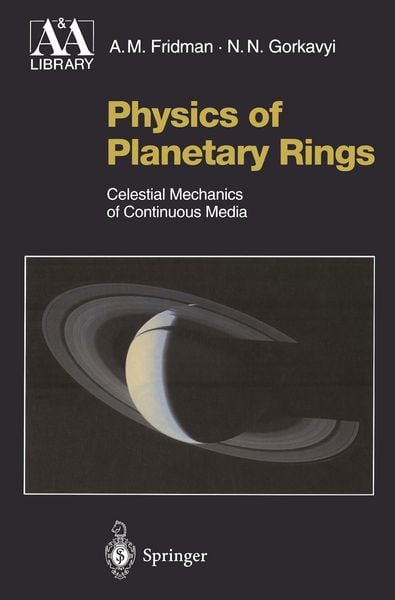
Physics of Planetary Rings Celestial Mechanics of Continuous Media

10% sparen

95,99 € UVP 106,99 €

inkl. gesetzl. MwSt., Versandkostenfrei


Beschreibung

Produktdetails

Einband

Taschenbuch

Erscheinungsdatum

01.12.2010

Abbildungen

XXI, 437 p.

Verlag

Springer Berlin

Seitenzahl

437

Maße (L/B/H)

23,5/15,5/2,5 cm

Gewicht

692 g

Auflage

Softcover reprint of hardcover 1st ed. 1999

Übersetzt von

D. ter Haar

Sprache

Englisch

ISBN

978-3-642-08437-9

Beschreibung

Rezension

From the reviews


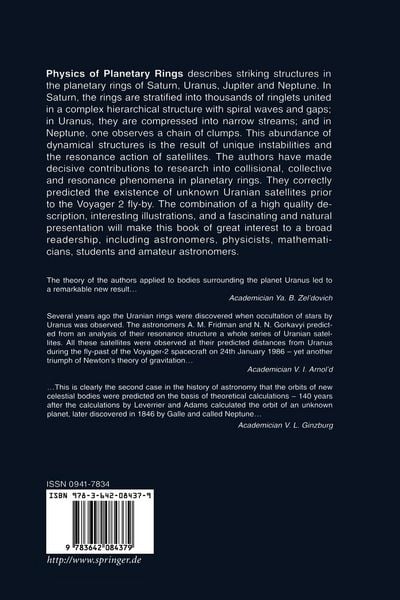
"The book will become essential reading for all researchers into the diverse ring systems of Jupiter, Saturn, Uranus and Neptune."


Irish Astronomical Journal, 2000


Produktdetails

Einband

Taschenbuch

Erscheinungsdatum

01.12.2010

Abbildungen

XXI, 437 p.

Verlag

Springer Berlin

Seitenzahl

437

Maße (L/B/H)

23,5/15,5/2,5 cm

Gewicht

692 g

Auflage

Softcover reprint of hardcover 1st ed. 1999

Übersetzt von

D. ter Haar

Sprache

Englisch

ISBN

978-3-642-08437-9

Herstelleradresse

Springer-Verlag KG
Sachsenplatz 4-6
1201 Wien
AT

Email: GPSR Kontakt

Noch keine Bewertungen vorhanden

Verfassen Sie die erste Bewertung zu diesem Artikel

Helfen Sie anderen Kundinnen und Kunden durch Ihre Meinung.

Kundinnen und Kunden meinen

Bewertungen (0)

  • Produktbild: Physics of Planetary Rings
  • Produktbild: Physics of Planetary Rings
  • 1. Introduction.- 2. Observational Data.- 3. Celestial Mechanics Minimum.- 4. Elementary Particle Dynamics. I Rigid Body Collisions.- 5. Elementary Particle Dynamics. II Ring Cosmogony.- 6. Elementary Particle Dynamics. III Wave, Photometric, and Other Effects.- 7. Collective Dynamics of Disc Particles. I Formalism.- 8. Collective Dynamics of Disc Particles. II Stability Analysis.- 9. Resonance Effects in Planetary Rings. I Spiral Waves.- 10. Resonance Effects in Planetary Rings. II Narrow Ringlets and Satellites.- 11. Formation and Stability of the Uranian Rings.- 12. Origin, Dynamics, and Stability of the Neptunian Rings.- 13. Self-organisation of the Solar System.- 14. Space Studies of the Outer Planets.- Conclusion.- Appendices I. The Possibility of Studying the Dynamics of Astrophysical Discs in a Two-Dimensional Approach.- 1. Introduction.- 2. Original Equations for the “Volume” Functions.- 2.1 Initial Dynamic Equations.- 2.2 Equation of State.- 3. Derivation of the Basic Equations for the “Plane” Functions.- 3.1 Order-of-Magnitude Estimates of the Terms in the Initial Equations.- 3.2 The Two Limiting Cases of Astrophysical Discs.- 3.3 Limitations of the Characteristic Times of Processes Studied in the Two-Dimensional Approximation.- 3.4 Closed System of Integro-differential Equations for a Barotropic Disc.- 4. Closed Set of Differential Equations for a Polytropic Disc in an External Gravitational Field.- 4.1 Derivation of the Two-Dimensional Equations.- 5. Closed Set of Differential Equations for a Polytropic Self-gravitating Disc.- 5.1 Derivation of the Two-Dimensional Equations.- 5.2 Why Does the Gradient of the Plane Pressure Not Have the Physical Meaning of a Force?.- 6. Conclusion.- 1. Derivation of a Closed Set of Integro-differential Equations.- 2.Derivation of the Dispersion Equation Describing the Three-Dimensional Perturbations.- 4. Dispersion Relation for Waves in the Plane of the Disc.- 5. The Role of Perturbations Along the Rotation Axis.- 5.1 Condition for Neglecting Mass Transfer Along the Rotation Axis.- 5.1.1 General Case.- 5.1.2 Isothermal Disc.- 6. Conclusion.- III. Derivation of the Linearised Equations for Oscillations of a Viscous Disc.- 1. Derivation of the Linearised Equations for Oscillations of a Viscous Uniformly Rotating Disc.- 2. Derivation of the Linearised Equations for Oscillations of a Viscous Differentially Rotating Disc of Inelastic Particles with Account of External Matter Fluxes.- 3. Derivation of the General Dispersion Equation.- IV. Evaluating the Gravitational Potential Inside and Outside a Triaxial Ellipsoid.- 1. Potential Inside the Ellipsoid.- 2. Potential Outside the Ellipsoid.- V. A Drift Mechanism for the Formation of the Cassini Division.- 1. Introduction.- 2. Statement of the Problem.- 3. Derivation of the Non-linear Momentum Conservation Equations.- 4. Time-Averaged Non-linear Momentum Conservation Equations.- 5. Absence of Averaged Radial Mass Flux in a Dissipationless Disc. Large-Scale Convection.- 6. Radial Mass Transfer in a Viscous Disc.- 7. Evolution of the Surface Density of a Disc.- 8. Conditions for the Formation of Different Types of Resonant Structures: Gaps or Wavetrains?.- 9. Estimate of the Maximum Width of a Gap Produced by a Density Wave.- 10. Some Additional Remarks.- VI. Resonance Structures in Saturn’s C Ring.- References.