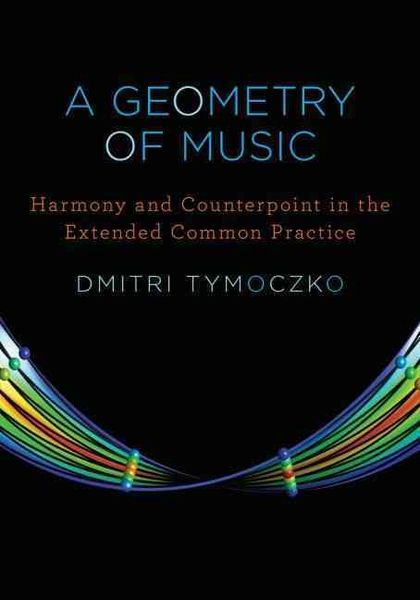
Geometry of Music Harmony and Counterpoint in the Extended Common Practice
108,99 €
inkl. gesetzl. MwSt.,
Beschreibung
Produktdetails
Einband
Gebundene Ausgabe
Erscheinungsdatum
21.03.2011
Verlag
Oxford University PressSeitenzahl
470
Maße (L/B/H)
25,9/18,7/3,5 cm
Gewicht
998 g
Sprache
Englisch
ISBN
978-0-19-533667-2
How is the Beatles' "Help!" similar to Stravinsky's "Dance of the Adolescents?" How does Radiohead's "Just" relate to the improvisations of Bill Evans? And how do Chopin's works exploit the non-Euclidean geometry of musical chords?
In this groundbreaking work, author Dmitri Tymoczko describes a new framework for thinking about music that emphasizes the commonalities among styles from medieval polyphony to contemporary rock. Tymoczko identifies five basic musical features that jointly contribute to the sense of tonality, and shows how these features recur throughout the history of Western music. In the process he sheds new light on an age-old question: what makes music sound good?
A Geometry of Music provides an accessible introduction to Tymoczko's revolutionary geometrical approach to music theory. The book shows how to construct simple diagrams representing relationships among familiar chords and scales, giving readers the tools to translate between the musical and visual realms and revealing surprising degrees of structure in otherwise hard-to-understand pieces.
Tymoczko uses this theoretical foundation to retell the history of Western music from the eleventh century to the present day. Arguing that traditional histories focus too narrowly on the "common practice" period from 1680-1850, he proposes instead that Western music comprises an extended common practice stretching from the late middle ages to the present. He discusses a host of familiar pieces by a wide range of composers, from Bach to the Beatles, Mozart to Miles Davis, and many in between.
A Geometry of Music is accessible to a range of readers, from undergraduate music majors to scientists and mathematicians with an interest in music. Defining its terms along the way, it presupposes no special mathematical background and only a basic familiarity with Western music theory. The book also contains exercises designed to reinforce and extend readers' understanding, along with a series of appendices that explore the technical details of this exciting new theory.
In this groundbreaking work, author Dmitri Tymoczko describes a new framework for thinking about music that emphasizes the commonalities among styles from medieval polyphony to contemporary rock. Tymoczko identifies five basic musical features that jointly contribute to the sense of tonality, and shows how these features recur throughout the history of Western music. In the process he sheds new light on an age-old question: what makes music sound good?
A Geometry of Music provides an accessible introduction to Tymoczko's revolutionary geometrical approach to music theory. The book shows how to construct simple diagrams representing relationships among familiar chords and scales, giving readers the tools to translate between the musical and visual realms and revealing surprising degrees of structure in otherwise hard-to-understand pieces.
Tymoczko uses this theoretical foundation to retell the history of Western music from the eleventh century to the present day. Arguing that traditional histories focus too narrowly on the "common practice" period from 1680-1850, he proposes instead that Western music comprises an extended common practice stretching from the late middle ages to the present. He discusses a host of familiar pieces by a wide range of composers, from Bach to the Beatles, Mozart to Miles Davis, and many in between.
A Geometry of Music is accessible to a range of readers, from undergraduate music majors to scientists and mathematicians with an interest in music. Defining its terms along the way, it presupposes no special mathematical background and only a basic familiarity with Western music theory. The book also contains exercises designed to reinforce and extend readers' understanding, along with a series of appendices that explore the technical details of this exciting new theory.
Kundinnen und Kunden meinen
Verfassen Sie die erste Bewertung zu diesem Artikel
Helfen Sie anderen Kund*innen durch Ihre Meinung
Kurze Frage zu unserer Seite
Vielen Dank für Ihr Feedback
Wir nutzen Ihr Feedback, um unsere Produktseiten zu verbessern. Bitte haben Sie Verständnis, dass wir Ihnen keine Rückmeldung geben können. Falls Sie Kontakt mit uns aufnehmen möchten, können Sie sich aber gerne an unseren Kund*innenservice wenden.
zum Kundenservice