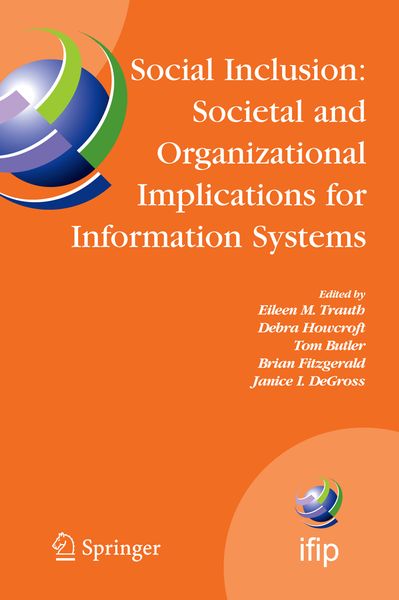
Social Inclusion: Societal and Organizational Implications for Information Systems IFIP TC8 WG 8.2 International Working Conference, July 12-15, 2006, Limerick, Ireland
-
- Hardcover
- Taschenbuch ausgewählt
-
Sprache:Englisch
93,99 €
UVP
106,99 €
inkl. gesetzl. MwSt.,
Beschreibung
Produktdetails
Einband
Taschenbuch
Erscheinungsdatum
11.02.2011
Herausgeber
Eileen Trauth + weitereVerlag
Springer UsSeitenzahl
420
Maße (L/B/H)
22,9/15,2/2,4 cm
Gewicht
622 g
Auflage
Softcover reprint of hardcover 1st ed. 2006
Sprache
Englisch
ISBN
978-1-4419-4181-7
Changes in society resulting from the pervasiveness of information technology have produced positive and negative, intended and unintended consequences. Key among them is the exclusion of individuals—who lack access to technological resources—from various societal processes and services. The theme of this book, social inclusion, explores the many dimensions of this exclusion. This issue has been the focus of much debate within the social sciences, yet has largely been underresearched in the Information Systems field, despite our concerns with the social and organizational aspects of technology. To the extent that contemporary debates have identified access to information as a key component of poverty, digital exclusion is seen as the problem. Thus, ICTs are portrayed as either exacerbating exclusion or are presented as the solution for greater inclusion. This conference will provide us with the opportunity to build upon our strong tradition of studying technology design and use in organizations, and expand our field of enquiry to consider the processes that engender social exclusion and the issues that derive from it.
This theme invites consideration of social and organizational constraints that result in the underrepresentation of certain groups and, by implication, certain issues. Likewise, it invites consideration of emerging technologies that have the potential to alter social, political, and economic relations. Much is being written about the ubiquitous nature of ICTs to change society, for example, open source software has recently emerged as a concept with implications far beyond the technology domain. This suggests that the role of ICTs in addressing social exclusion is far more complex than often thought. For this reason it is timely to expand our focus and progress the study of IS beyond the organizational level of analysis so that we may consider wider concerns affecting all citizens.
This book contains the proceedings of theWorking Conference on the societal and organizational implications for information systems of social inclusion. This conference, sponsored by the International Federation for Information Processing Working Group 8.2, was held in Limerick, Ireland, July 12-15, 2006.
Noch keine Bewertungen vorhanden
Verfassen Sie die erste Bewertung zu diesem Artikel
Helfen Sie anderen Kundinnen und Kunden durch Ihre Meinung.
Kurze Frage zu unserer Seite
Vielen Dank für Ihr Feedback
Wir nutzen Ihr Feedback, um unsere Produktseiten zu verbessern. Bitte haben Sie Verständnis, dass wir Ihnen keine Rückmeldung geben können. Falls Sie Kontakt mit uns aufnehmen möchten, können Sie sich aber gerne an unseren Kund*innenservice wenden.
zum Kundenservice