• Produktbild: Elementary Probability Theory
  • Produktbild: Elementary Probability Theory

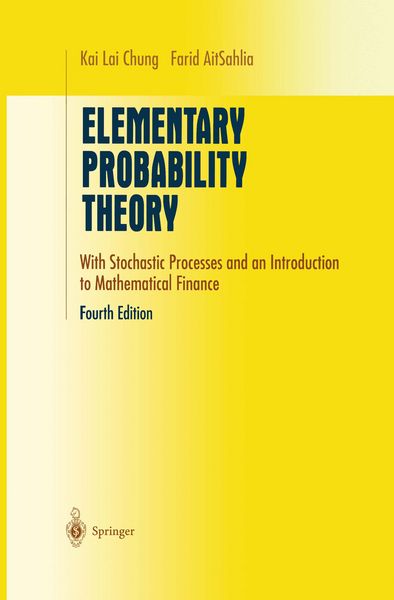
Elementary Probability Theory With Stochastic Processes and an Introduction to Mathematical Finance

59,99 €

inkl. gesetzl. MwSt., Versandkostenfrei


Beschreibung

Produktdetails

Einband

Taschenbuch

Erscheinungsdatum

01.12.2010

Verlag

Springer Us

Seitenzahl

404

Maße (L/B/H)

23,5/15,5/2,3 cm

Gewicht

1290 g

Auflage

4th ed.

Sprache

Englisch

ISBN

978-1-4419-3062-0

Beschreibung

Rezension

"In spite of the original edition of the book being nearly thirty years old, the text still has its role to play in first and second year undergraduate probability courses. It provides an excellent foundation to more advanced courses in the subject."

Short Book Reviews, Vol. 23/3, Dec. 2003


"This edition is the third revision of a text on mathematical probability first published in 1974. The text is aimed at undergraduate mathematics students and is accessible to a general audience. The prose is accurate, entertaining, and dense with historical tidbits. Two concluding chapters on mathematical finance have been added to the eight chapters in the third edition by the second author." The American Statistician, May 2004


From the reviews of the fourth edition:


"The main novelty in the fourth edition of this well-written book is the addition of new chapters … . The new chapters share the friendly yet rigorous style of the former ones. They beginwith an account of the financial vocabulary, which is then expounded in probabilistic terms. … Almost thirty years after its first edition, this charming book continues to be an excellent text for teaching and for self study." (Ricardo Maronna, Statistical Papers, Vol. 45 (4), 2004)

Produktdetails

Einband

Taschenbuch

Erscheinungsdatum

01.12.2010

Verlag

Springer Us

Seitenzahl

404

Maße (L/B/H)

23,5/15,5/2,3 cm

Gewicht

1290 g

Auflage

4th ed.

Sprache

Englisch

ISBN

978-1-4419-3062-0

Herstelleradresse

Springer-Verlag KG
Sachsenplatz 4-6
1201 Wien
AT

Email: ProductSafety@springernature.com

Kundinnen und Kunden meinen

0 Bewertungen

Informationen zu Bewertungen

Zur Abgabe einer Bewertung ist eine Anmeldung im Konto notwendig. Die Authentizität der Bewertungen wird von uns nicht überprüft. Wir behalten uns vor, Bewertungstexte, die unseren Richtlinien widersprechen, entsprechend zu kürzen oder zu löschen.

Die Bewertungen sind nach Format, Anzahl Sterne und Datum sortiert.

Verfassen Sie die erste Bewertung zu diesem Artikel

Helfen Sie anderen Kund*innen durch Ihre Meinung

Kundinnen und Kunden meinen

0 Bewertungen filtern

  • Produktbild: Elementary Probability Theory
  • Produktbild: Elementary Probability Theory
  • 1 Set.- 1.1 Sample sets.- 1.2 Operations with sets.- 1.3 Various relations.- 1.4 Indicator.- Exercises.- 2 Probability.- 2.1 Examples of probability.- 2.2 Definition and illustrations.- 2.3 Deductions from the axioms.- 2.4 Independent events.- 2.5 Arithmetical density.- Exercises.- 3 Counting.- 3.1 Fundamental rule.- 3.2 Diverse ways of sampling.- 3.3 Allocation models; binomial coefficients.- 3.4 How to solve it.- Exercises.- 4 Random Variables.- 4.1 What is a random variable?.- 4.2 How do random variables come about?.- 4.3 Distribution and expectation.- 4.4 Integer-valued random variables.- 4.5 Random variables with densities.- 4.6 General case.- Exercises.- Appendix 1: Borel Fields and General Random Variables.- 5 Conditioning and Independence.- 5.1 Examples of conditioning.- 5.2 Basic formulas.- 5.3 Sequential sampling.- 5.4 Pólya’s urn scheme.- 5.5 Independence and relevance.- 5.6 Genetical models.- Exercises.- 6 Mean, Variance, and Transforms.- 6.1 Basic properties of expectation.- 6.2 The density case.- 6.3 Multiplication theorem; variance and covariance.- 6.4 Multinomial distribution.- 6.5 Generating function and the like.- Exercises.- 7 Poisson and Normal Distributions.- 7.1 Models for Poisson distribution.- 7.2 Poisson process.- 7.3 From binomial to normal.- 7.4 Normal distribution.- 7.5 Central limit theorem.- 7.6 Law of large numbers.- Exercises.- Appendix 2: Stirling’s Formula and de Moivre-Laplace’ Theorem.- 8 From Random Walks to Markov Chains.- 8.1 Problems of the wanderer or gambler.- 8.2 Limiting schemes.- 8.3 Transition probabilities.- 8.4 Basic structure of Markov chains.- 8.5 Further developments.- 8.6 Steady state.- 8.7 Winding up (or down?).- Exercises.- Appendix 3: Martingale.- 9 Mean-Variance Pricing Model.- 9.1 An investments primer.- 9.2 Asset return and risk.- 9.3 Portfolio allocation.- 9.4 Diversification.- 9.5 Mean-variance optimization.- 9.6 Asset return distributions.- 9.7 Stable probability distributions.- Exercises.- Appendix 4: Pareto and Stable Laws.- 10 Option Pricing Theory.- 10.1 Options basics.- 10.2 Arbitrage-free pricing: 1-period model.- 10.3 Arbitrage-free pricing: N-period model.- 10.4 Fundamental asset pricing theorems.- Exercises.- General References.- Answers to Problems.- Values of the Standard Normal Distribution Function.