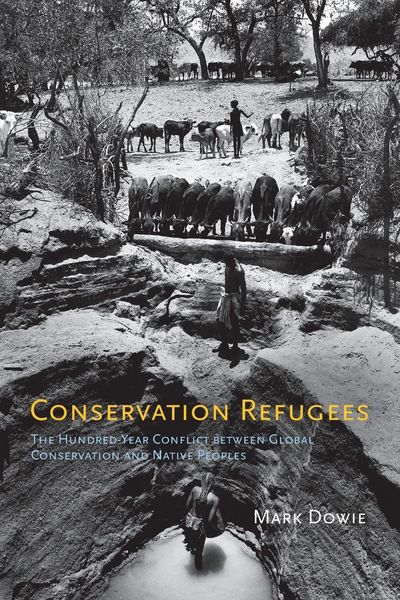
Conservation Refugees The Hundred-Year Conflict between Global Conservation and Native Peoples
-
- Taschenbuch ausgewählt
- eBook
-
Sprache:Englisch
37,99 €
inkl. gesetzl. MwSt.,
Beschreibung
Produktdetails
Einband
Taschenbuch
Altersempfehlung
ab 18 Jahr(e)
Erscheinungsdatum
25.02.2011
Verlag
KNV BesorgungSeitenzahl
376
Maße (L/B/H)
22,9/15,2/2,2 cm
Gewicht
499 g
Sprache
Englisch
ISBN
978-0-262-51600-6
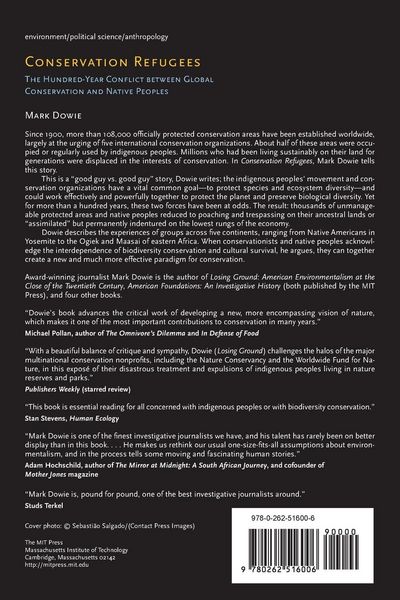
Since 1900, more than 108,000 officially protected conservation areas have been established worldwide, largely at the urging of five international conservation organizations. About half of these areas were occupied or regularly used by indigenous peoples. Millions who had been living sustainably on their land for generations were displaced in the interests of conservation. In Conservation Refugees, Mark Dowie tells this story. This is a “good guy vs. good guy” story, Dowie writes; the indigenous peoples' movement and conservation organizations have a vital common goal—to protect biological diversity—and could work effectively and powerfully together to protect the planet and preserve biological diversity. Yet for more than a hundred years, these two forces have been at odds. The result: thousands of unmanageable protected areas and native peoples reduced to poaching and trespassing on their ancestral lands or “assimilated” but permanently indentured on the lowest rungs of the money economy. Dowie begins with the story of Yosemite National Park, which by the turn of the twentieth century established a template for bitter encounters between native peoples and conservation. He then describes the experiences of other groups, ranging from the Ogiek and Maasai of eastern Africa and the Pygmies of Central Africa to the Karen of Thailand and the Adevasis of India. He also discusses such issues as differing definitions of “nature” and “wilderness,” the influence of the “BINGOs” (Big International NGOs, including the Worldwide Fund for Nature, Conservation International, and The Nature Conservancy), the need for Western scientists to respect and honor traditional lifeways, and the need for native peoples to blend their traditional knowledge with the knowledge of modern ecology. When conservationists and native peoples acknowledge the interdependence of biodiversity conservation and cultural survival, Dowie writes, they can together create a new and much more effective paradigm for conservation.
Kundinnen und Kunden meinen
Verfassen Sie die erste Bewertung zu diesem Artikel
Helfen Sie anderen Kund*innen durch Ihre Meinung
Kurze Frage zu unserer Seite
Vielen Dank für Ihr Feedback
Wir nutzen Ihr Feedback, um unsere Produktseiten zu verbessern. Bitte haben Sie Verständnis, dass wir Ihnen keine Rückmeldung geben können. Falls Sie Kontakt mit uns aufnehmen möchten, können Sie sich aber gerne an unseren Kund*innenservice wenden.
zum Kundenservice