• Produktbild: Ultra Low-Power Biomedical Signal Processing
  • Produktbild: Ultra Low-Power Biomedical Signal Processing
- 13%

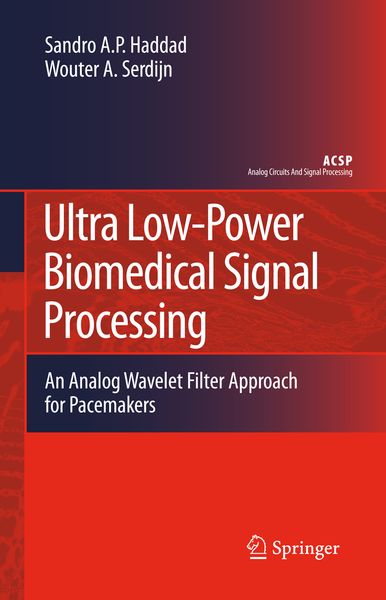
Ultra Low-Power Biomedical Signal Processing An Analog Wavelet Filter Approach for Pacemakers

13% sparen

92,99 € UVP 106,99 €

inkl. gesetzl. MwSt., Versandkostenfrei


Beschreibung

Produktdetails

Einband

Taschenbuch

Erscheinungsdatum

28.10.2010

Verlag

Springer Netherland

Seitenzahl

215

Maße (L/B/H)

23,5/15,5/1,3 cm

Gewicht

353 g

Auflage

Softcover reprint of hardcover 1st edition 2009

Sprache

Englisch

ISBN

978-90-481-8061-5

Beschreibung

Produktdetails

Einband

Taschenbuch

Erscheinungsdatum

28.10.2010

Verlag

Springer Netherland

Seitenzahl

215

Maße (L/B/H)

23,5/15,5/1,3 cm

Gewicht

353 g

Auflage

Softcover reprint of hardcover 1st edition 2009

Sprache

Englisch

ISBN

978-90-481-8061-5

Herstelleradresse

Springer-Verlag KG
Sachsenplatz 4-6
1201 Wien
AT

Email: ProductSafety@springernature.com

Kundinnen und Kunden meinen

0 Bewertungen

Informationen zu Bewertungen

Zur Abgabe einer Bewertung ist eine Anmeldung im Konto notwendig. Die Authentizität der Bewertungen wird von uns nicht überprüft. Wir behalten uns vor, Bewertungstexte, die unseren Richtlinien widersprechen, entsprechend zu kürzen oder zu löschen.

Die Bewertungen sind nach Format, Anzahl Sterne und Datum sortiert.

Verfassen Sie die erste Bewertung zu diesem Artikel

Helfen Sie anderen Kund*innen durch Ihre Meinung

Kundinnen und Kunden meinen

0 Bewertungen filtern

  • Produktbild: Ultra Low-Power Biomedical Signal Processing
  • Produktbild: Ultra Low-Power Biomedical Signal Processing
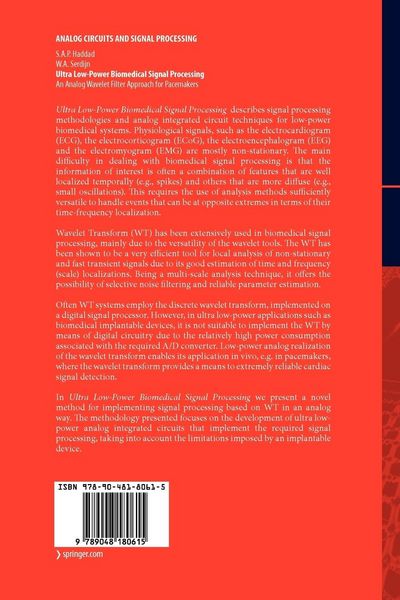
  • 1 Introduction. 1.1 Biomedical signal processing. 1.2 Biomedical applications of the wavelet transform. 1.3 Analog versus digital circuitry - a power consumption challenge for biomedical front-ends. 1.4 Objective and scope of this thesis. 1.5 Outline. 2 The Evolution of Pacemakers: An Electronics Perspective. 2.1 The Heart. 2.2 Cardiac Signals. 2.3 The history and development of cardiac pacing. 2.4 New Features in Modern Pacemakers. 2.5 Summary and Conclusions. 3 Wavelet versus Fourier analysis. 3.1 Introduction. 3.2 Fourier transform. 3.3 Windowing function. 3.4 Wavelet transform. 3.5 Signal Processing with Wavelet Transform. 3.6 Low-power analog wavelet filter design. 3.7 Conclusions. 4 Analog Wavelet filters: the need for approximation. 4.1 Introduction. 4.2 Complex First Order filters. 4.3 Pad¿e Approximation in the Laplace domain. 4.4 L2 Approximation. 4.5 Other approaches for Wavelet bases approximation. 4.6 Discussion. 4.7 Conclusions. 5 Optimal State Space Descriptions. 5.1 State space description. 5.2 Dynamic Range. 5.3 Sparsity. 5.4 Sensitivity. 5.5 Conclusion. 6 Ultra Low-power Integrator Designs. 6.1 Gm-C filters. 6.2 Translinear (Log-domain) filters. 6.3 Class-A log-domain filter design examples. 6.4 Low-power Class-AB Sinh Integrators. 6.5 Discussion. 6.6 Conclusions. 7 Ultra Low-power Biomedical System Designs. 7.1 Dynamic Translinear Cardiac Sense Amplifier for Pacemakers. 7.2 QRS-complex wavelet detection using CFOS. 7.3 Wavelet filter designs. 7.4 Morlet Wavelet Filter. 7.5 Conclusions. 8 Conclusions and Future Research. 8.1 Future Research. A High-Performance Analog Delays. A.1 Bessel-Thomson approximation. A.2 Pad¿e approximation. A.3 Comparison of Bessel-Thomson and Pad¿e approximation delay filters. A.4 Gaussian Time-domain impulse-response method. B Model reduction - the BalancedTruncation method. C Switched-Capacitor Wavelet Filters. D Ultra-Wideband Circuit Designs. D.1 Impulse Generator for Pulse Position Modulator. D.2 A Delay Filter for an UWB Front-End. D.3 A FCC Compliant Pulse Generator for UWB Communications. Summary.