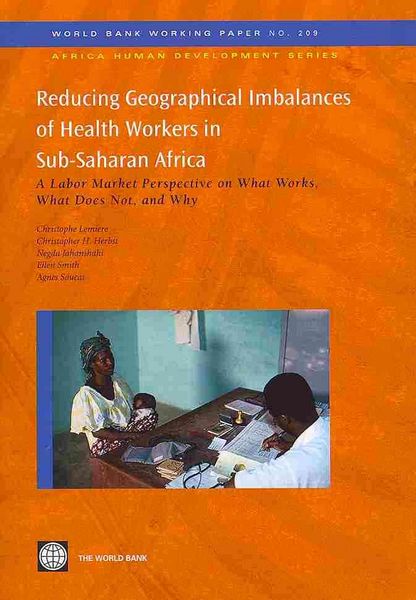
Reducing Geographical Imbalances of Health Workers in Sub-Saharan Africa A Labor Market Perspective on What Works, What Does Not, and Why
-
- Englisch ausgewählt
14,99 €
inkl. gesetzl. MwSt.,
Beschreibung
Produktdetails
Einband
Taschenbuch
Erscheinungsdatum
01.12.2010
Verlag
World Bank PublicationsSeitenzahl
58
Maße (L/B/H)
25,4/17,8/0,3 cm
Gewicht
120 g
Sprache
Englisch
ISBN
978-0-8213-8599-9
The human resources crisis in the health sector has been gathering attention on the global stage. To date, however, most of this attention has focused on shortages of health human resources (HRH) at the national level. At least as important are problems at the sub-national level. Massive geographic and skill mix imbalances are reflected in the perilous undersupply of HRH in most rural areas. Virtually all Sub-Saharan African countries suffer from significant geographic imbalances. Very little substantive information or documentation exists on the problem. Even less is known about the lessons from policies aimed at addressing urban-rural human resource imbalances, let alone experiences of Sub-Saharan Africa countries, with such policies. There also appears to be a disconnect between the objectives and efforts of policymakers on the one hand and the functioning of national health labor markets and labor market behavior on the other hand. This disconnect hinders policy effectiveness and the efficient utilization of resources intended to narrow urban-rural inequities. In Sub-Saharan Africa government policies, often limited to the management of public sector vacancies, appear to be elaborated, prescribed, and implemented independently of labor market considerations. Partly as a result, they are unable to effectively address urban-rural imbalances, which are an outcome of labor market dynamics. This report discusses and analyzes labor market dynamics and outcomes (including unemployment, worker shortages, and urban-rural imbalances of categories of health workers) from a labor economics perspective. It then use insights from this perspective as a basis for elaborating policy options that incorporate the underlying labor market forces. The goal of the study is to address undesirable outcomes (including urban-rural HRH imbalances) more effectively. The book is thus suitable for researchers, policy analysts and policy makers with an interest in understanding and improving the allocation of human resources for health in the developing world.
Noch keine Bewertungen vorhanden
Verfassen Sie die erste Bewertung zu diesem Artikel
Helfen Sie anderen Kundinnen und Kunden durch Ihre Meinung.
Kurze Frage zu unserer Seite
Vielen Dank für Ihr Feedback
Wir nutzen Ihr Feedback, um unsere Produktseiten zu verbessern. Bitte haben Sie Verständnis, dass wir Ihnen keine Rückmeldung geben können. Falls Sie Kontakt mit uns aufnehmen möchten, können Sie sich aber gerne an unseren Kund*innenservice wenden.
zum Kundenservice