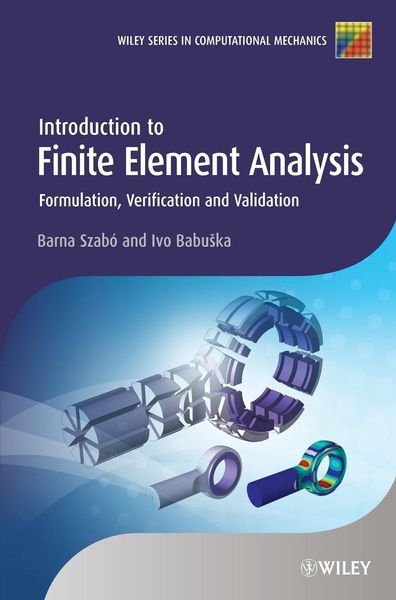
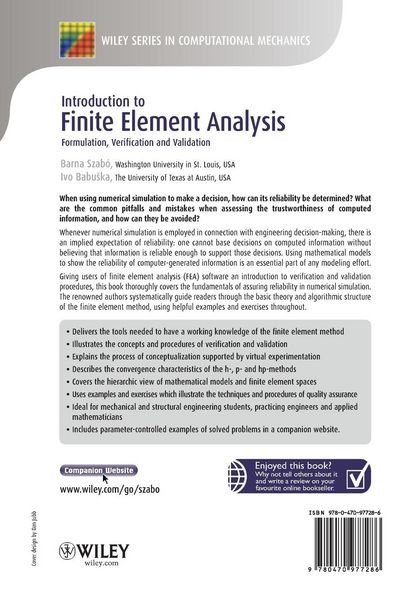
• Produktbild: Introduction to Finite Element Analysis
  • Produktbild: Introduction to Finite Element Analysis

Introduction to Finite Element Analysis Formulation, Verification and Validation

153,99 €

inkl. gesetzl. MwSt., Versandkostenfrei


Beschreibung

Produktdetails

Einband

Gebundene Ausgabe

Erscheinungsdatum

18.04.2011

Verlag

John Wiley & Sons

Seitenzahl

382

Maße (L/B/H)

25/17,5/2,5 cm

Gewicht

783 g

Auflage

1. Auflage

Sprache

Englisch

ISBN

978-0-470-97728-6

Beschreibung

Rezension

"I highly recommend this as a textbook for an undergraduate engineering course on FE analysis. Moreover, I recommend this book to every engineer who practices FE computation, since this is a well-written and unique source for studying the extremely important issue of reliability of FE analysis in practice." ( IACM Expressions , 1 September 2012)

Produktdetails

Einband

Gebundene Ausgabe

Erscheinungsdatum

18.04.2011

Verlag

John Wiley & Sons

Seitenzahl

382

Maße (L/B/H)

25/17,5/2,5 cm

Gewicht

783 g

Auflage

1. Auflage

Sprache

Englisch

ISBN

978-0-470-97728-6

Herstelleradresse

Produktsicherheitsverantwortliche/r
Europaallee 1
36244 Bad Hersfeld
DE

Email: gpsr@libri.de

Noch keine Bewertungen vorhanden

Verfassen Sie die erste Bewertung zu diesem Artikel

Helfen Sie anderen Kundinnen und Kunden durch Ihre Meinung.

Kundinnen und Kunden meinen

Bewertungen (0)

Die Leseprobe wird geladen.
  • Produktbild: Introduction to Finite Element Analysis
  • Produktbild: Introduction to Finite Element Analysis
  • About the Authors.
     
    Series Preface.
     
    Preface.
     
    1 Introduction.
     
    1.1 Numerical simulation.
     
    1.2 Why is numerical accuracy important?
     
    1.3 Chapter summary.
     
    2 An outline of the finite element method.
     
    2.1 Mathematical models in one dimension.
     
    2.2 Approximate solution.
     
    2.3 Generalized formulation in one dimension.
     
    2.4 Finite element approximations.
     
    2.5 FEM in one dimension.
     
    2.6 Properties of the generalized formulation.
     
    2.7 Error estimation based on extrapolation.
     
    2.8 Extraction methods.
     
    2.9 Laboratory exercises.
     
    2.10 Chapter summary.
     
    3 Formulation of mathematical models.
     
    3.1 Notation.
     
    3.2 Heat conduction.
     
    3.3 The scalar elliptic boundary value problem.
     
    3.4 Linear elasticity.
     
    3.5 Incompressible elastic materials.
     
    3.6 Stokes' flow.
     
    3.7 The hierarchic view of mathematical models.
     
    3.8 Chapter summary.
     
    4 Generalized formulations.
     
    4.1 The scalar elliptic problem.
     
    4.2 The principle of virtual work.
     
    4.3 Elastostatic problems.
     
    4.4 Elastodynamic models.
     
    4.5 Incompressible materials.
     
    4.6 Chapter summary.
     
    5 Finite element spaces.
     
    5.1 Standard elements in two dimensions.
     
    5.2 Standard polynomial spaces.
     
    5.3 Shape functions.
     
    5.4 Mapping functions in two dimensions.
     
    5.5 Elements in three dimensions.
     
    5.6 Integration and differentiation.
     
    5.7 Stiffness matrices and load vectors.
     
    5.8 Chapter summary.
     
    6 Regularity and rates of convergence.
     
    6.1 Regularity.
     
    6.2 Classification.
     
    6.3 The neighborhood of singular points.
     
    6.4 Rates of convergence.
     
    6.5 Chapter summary.
     
    7 Computation and verification of data.
     
    7.1 Computation of the solution and its first derivatives.
     
    7.2 Nodal forces.
     
    7.3 Verification of computed data.
     
    7.4 Flux and stress intensity factors.
     
    7.5 Chapter summary.
     
    8 What should be computed and why?
     
    8.1 Basic assumptions.
     
    8.2 Conceptualization: drivers of damage accumulation.
     
    8.3 Classical models of metal fatigue.
     
    8.4 Linear elastic fracture mechanics.
     
    8.5 On the existence of a critical distance.
     
    8.6 Driving forces for damage accumulation.
     
    8.7 Cycle counting.
     
    8.8 Validation.
     
    8.9 Chapter summary.
     
    9 Beams, plates and shells.
     
    9.1 Beams.
     
    9.2 Plates.
     
    9.3 Shells.
     
    9.4 The Oak Ridge experiments.
     
    9.5 Chapter summary.
     
    10 Nonlinear models.
     
    10.1 Heat conduction.
     
    10.2 Solid mechanics.
     
    10.3 Chapter summary.
     
    A Definitions.
     
    A.1 Norms and seminorms.
     
    A.2 Normed linear spaces.
     
    A.3 Linear functionals.
     
    A.4 Bilinear forms.
     
    A.5 Convergence.
     
    A.6 Legendre polynomials.
     
    A.7 Analytic functions.
     
    A.8 The Schwarz inequality for integrals.
     
    B Numerical quadrature.
     
    B.1 Gaussian quadrature.
     
    B.2 Gauss-Lobatto quadrature.
     
    C Properties of the stress tensor.
     
    C.1 The traction vector.
     
    C.2 Principal stresses.
     
    C.3 Transformation of vectors.
     
    C.4 Transformation of stresses.
     
    D Computation of stress intensity factors.
     
    D.1 The contour integral method.
     
    D.2 The energy release rate.
     
    E Saint-V