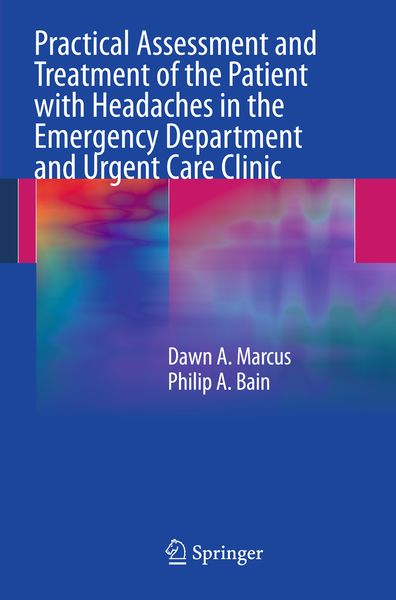
Practical Assessment and Treatment of the Patient with Headaches in the Emergency Department and Urgent Care Clinic
-
- Taschenbuch ausgewählt
- eBook
-
Sprache:Englisch
48,99 €
inkl. gesetzl. MwSt.,
Beschreibung
Produktdetails
Einband
Taschenbuch
Erscheinungsdatum
29.07.2011
Abbildungen
XII, 212 p. 57 illus., 52 illus. in color.
Verlag
Springer UsSeitenzahl
212
Maße (L/B/H)
23,5/15,5/1,3 cm
Gewicht
347 g
Sprache
Englisch
ISBN
978-1-4614-0001-1
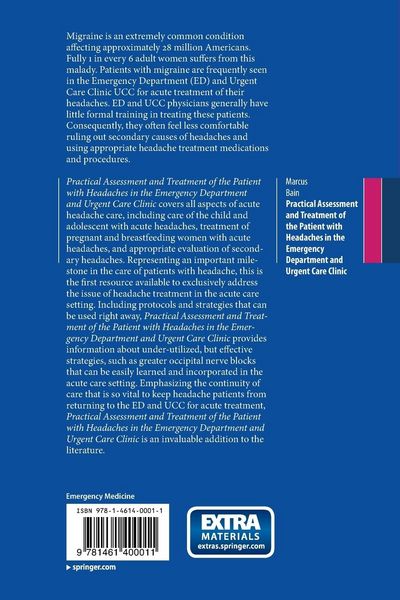
Migraine is an extremely common condition affecting 28 million Americans. Fully 1 in every 6 adult women suffers from this malady. Patients with migraine are frequently seen in the Emergency Room and Urgent Care Clinic for acute treatment of their headaches. Headache generally accounts for nearly 3 % of all ER visits, resulting in almost 3.5 million visits annually.
There currently are no widely used guidelines for the treatment of patients with headache in the ER or UCC, and reducing the number of CT scans remains a key goal for administrators in many ER or urgent care settings. In one study, 35 drugs, alone or in combination, were used to treat migraine. The most common medication class used was narcotics, which were used in 25% of the visits. The next two most commonly used classes were antiemetics and NSAIDs. Only 5% of patients seen for headache received headache-specific medications during their visit.
ER and Urgent Care physicians generally have little or no formal training in treating these patients. Consequently, they often feel less comfortable ruling out secondary causes of headaches and using appropriate headache treatment medications and procedures. Since many patients have received narcotics in previous visits, providers may view them as drug seekers. Patients seen in ERs and UCCs for acute treatment of their headaches often report high levels of dissatisfaction. They often end up in the ER or UCC because they don’t have a formal treatment strategy for their severe headaches.
Health plans and insurance agencies are often frustrated by the high cost of fragmented care for patients with headaches. Because of the environment that most ER and UCC providers operate in, many unnecessary scans and tests are done because of uncertainty of the diagnosis and unfamiliarity of the patient. Primary care physicians are also frustrated by patients with headaches presenting to them after being seen in the ERor UCC, wanting a refill of their narcotics that they were given. Many patients don’t follow up with their PCPs and simply keep returning to the ER/UCC for their treatment.
In short, all involved in the care for patients with headache are frustrated by the current system. The care for these patients is clearly not optimal. It doesn’t have to be that way. There are a wide variety of effective treatment options available, but are underutilized in the acute setting. With these treatment options, patients no longer have to be treated only with parenteral narcotics, only to perpetuate the cycle of suboptimal care described above.
This concise handbook covers all aspects of acute headache care, including care of the child and adolescent with acute headaches, treatment of pregnant and breastfeeding women with acute headaches and appropriate evaluation of secondary headaches. In addition, two other novel chapters are included: one on caring for older patients with acute headaches as well as a chapter describing how to ensure a seamless transition of the patient back to a headache interested provider.
Representing an important milestone in the care of patients with headache, this is the first concise handbook available to exclusively address the issue of headache treatment in the acute care setting. Including protocols and strategies that can be used right away, Management of Headaches in Emergency Room and Urgent Care Settings: Diagnosis and Management provides information about lesser known, but effective strategies such as greater occipital nerve blocks that can be easily learned and incorporated in the acute care setting. It emphasizes the continuity of care that is so vital to keep headache patients from returning to the ER and UCC for acute treatment.
Noch keine Bewertungen vorhanden
Verfassen Sie die erste Bewertung zu diesem Artikel
Helfen Sie anderen Kundinnen und Kunden durch Ihre Meinung.
Kurze Frage zu unserer Seite
Vielen Dank für Ihr Feedback
Wir nutzen Ihr Feedback, um unsere Produktseiten zu verbessern. Bitte haben Sie Verständnis, dass wir Ihnen keine Rückmeldung geben können. Falls Sie Kontakt mit uns aufnehmen möchten, können Sie sich aber gerne an unseren Kund*innenservice wenden.
zum Kundenservice