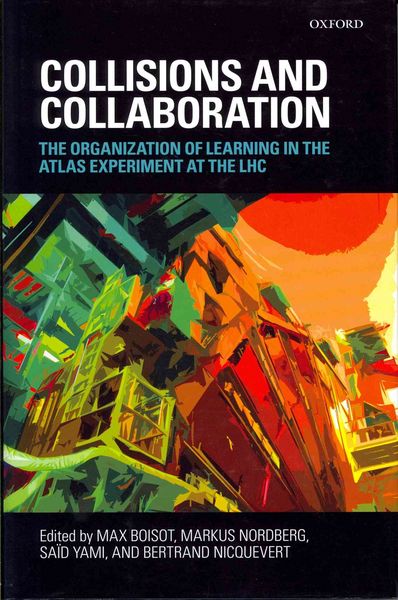
Collisions and Collaboration The Organization of Learning in the Atlas Experiment at the Lhc
68,99 €
inkl. gesetzl. MwSt.,
Beschreibung
Produktdetails
Einband
Gebundene Ausgabe
Erscheinungsdatum
11.10.2011
Abbildungen
Numerous figures and tables and colour plate section
Herausgeber
Max Boisot + weitereVerlag
Oxford University PressSeitenzahl
336
Maße (L/B/H)
24,1/16,4/2,9 cm
Gewicht
669 g
Sprache
Englisch
ISBN
978-0-19-956792-8
After twenty-five years of preparation, the Large Hadron Collider at CERN, Geneva, is finally running its intensive scientific experiments into high-energy particle physics. These experiments, which have so captured the public's imagination, take the world of physics to a new energy level, the terascale, at which elementary particles are accelerated to one millionth of a percent of the speed of light and made to smash into each other with a combined energy of around fourteen trillion electron-volts. What new world opens up at the terascale? No one really knows, but the confident expectation is that radically new phenomena will come into view. The kind of 'big science' being pursued at CERN, however, is becoming ever more uncertain and costly. Do the anticipated benefits justify the efforts and the costs? This book aims to give a broad organizational and strategic understanding of the nature of 'big science' by analyzing one of the major experiments that uses the Large Hadron Collider, the ATLAS Collaboration. It examines such issues as: the flow of 'interlaced' knowledge between specialist teams; the intra- and inter-organizational dynamics of 'big science'; the new knowledge capital being created for the workings of the experiment by individual researchers, suppliers, and e-science and ICTs; the leadership implications of a collaboration of nearly three thousand members; and the benefits for the wider societal setting. This book aims to examine how, in the face of high levels of uncertainty and risk, ambitious scientific aims can be achieved by complex organizational networks characterized by cultural diversity, informality, and trust - and where 'big science' can head next.
Noch keine Bewertungen vorhanden
Verfassen Sie die erste Bewertung zu diesem Artikel
Helfen Sie anderen Kundinnen und Kunden durch Ihre Meinung.
Kurze Frage zu unserer Seite
Vielen Dank für Ihr Feedback
Wir nutzen Ihr Feedback, um unsere Produktseiten zu verbessern. Bitte haben Sie Verständnis, dass wir Ihnen keine Rückmeldung geben können. Falls Sie Kontakt mit uns aufnehmen möchten, können Sie sich aber gerne an unseren Kund*innenservice wenden.
zum Kundenservice