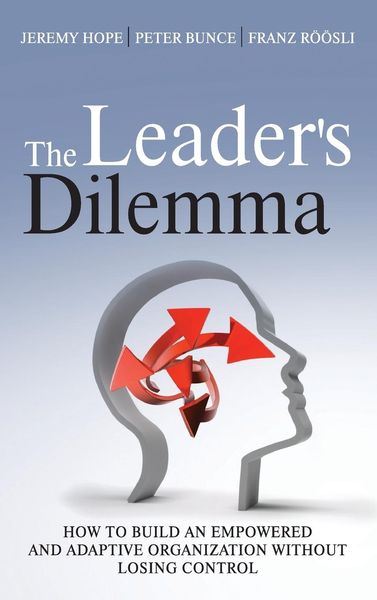
The Leader's Dilemma How to Build an Empowered and Adaptive Organization Without Losing Control
39,99 €
inkl. gesetzl. MwSt.,
Beschreibung
Produktdetails
Einband
Gebundene Ausgabe
Erscheinungsdatum
23.05.2011
Verlag
John Wiley & SonsSeitenzahl
344
Maße (L/B/H)
23,5/15,7/2,3 cm
Gewicht
653 g
Auflage
1. Auflage
Sprache
Englisch
ISBN
978-1-119-97000-2
Drawing on their work on performance management within the 'beyond budgeting' movement over the past ten years, including many interviews and case studies, Jeremy Hope, Peter Bunce and Franz Röösli set out in this book an executive guide to building a new management model based on eight key change management issues:
* 1. Governance: From rules and budgets to purpose and values
* 2. Success: From fixed targets to relative improvement
* 3. Organization: From centralized functions to customer-oriented teams
* 4. Accountability: From narrow targets to holistic success criteria
* 5. Trust: From central control to local autonomy
* 6. Transparency: From closed information to open book management
* 7. Rewards: From individual incentives to team-based reward
* 8. Risk: From complying with rules to understanding pressure points
This book is about rethinking how we manage organizations in a post-industrial, post credit crunch world where innovative management models represent the only remaining source of sustainable competitive advantage.[i] The changes suggested by the authors will enable and encourage a cultural climate change that will help organizations to attract and keep the best people as well as drive continuous innovation and growth.
Above all, The CEO's Dilemma is about learning how to change business - based on best practice and innovation drawn from leaders world-wide who have built and managed successful organizations.
* 1. Governance: From rules and budgets to purpose and values
* 2. Success: From fixed targets to relative improvement
* 3. Organization: From centralized functions to customer-oriented teams
* 4. Accountability: From narrow targets to holistic success criteria
* 5. Trust: From central control to local autonomy
* 6. Transparency: From closed information to open book management
* 7. Rewards: From individual incentives to team-based reward
* 8. Risk: From complying with rules to understanding pressure points
This book is about rethinking how we manage organizations in a post-industrial, post credit crunch world where innovative management models represent the only remaining source of sustainable competitive advantage.[i] The changes suggested by the authors will enable and encourage a cultural climate change that will help organizations to attract and keep the best people as well as drive continuous innovation and growth.
Above all, The CEO's Dilemma is about learning how to change business - based on best practice and innovation drawn from leaders world-wide who have built and managed successful organizations.
Kundinnen und Kunden meinen
Verfassen Sie die erste Bewertung zu diesem Artikel
Helfen Sie anderen Kund*innen durch Ihre Meinung
Kurze Frage zu unserer Seite
Vielen Dank für Ihr Feedback
Wir nutzen Ihr Feedback, um unsere Produktseiten zu verbessern. Bitte haben Sie Verständnis, dass wir Ihnen keine Rückmeldung geben können. Falls Sie Kontakt mit uns aufnehmen möchten, können Sie sich aber gerne an unseren Kund*innenservice wenden.
zum Kundenservice