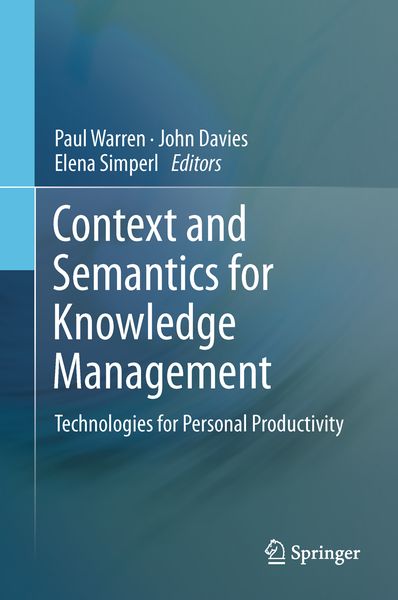
Context and Semantics for Knowledge Management Technologies for Personal Productivity
-
- Hardcover ausgewählt
- Taschenbuch
- eBook
-
Sprache:Englisch
97,99 €
inkl. gesetzl. MwSt.,
Beschreibung
Produktdetails
Einband
Gebundene Ausgabe
Erscheinungsdatum
15.09.2011
Abbildungen
XIV, 337 p.
Herausgeber
Paul Warren + weitereVerlag
Springer BerlinSeitenzahl
337
Maße (L/B/H)
24,1/16/2,4 cm
Gewicht
694 g
Auflage
2011
Sprache
Englisch
ISBN
978-3-642-19509-9
Knowledge and information are among the biggest assets of enterprises and organizations. However, efficiently managing, maintaining, accessing, and reusing this intangible treasure is difficult. Information overload makes it difficult to focus on the information that really matters; the fact that much corporate knowledge only resides in employees’ heads seriously hampers reuse.
The work described in this book is motivated by the need to increase the productivity of knowledge work. Based on results from the EU-funded ACTIVE project and complemented by recent related results from other researchers, the application of three approaches is presented: the synergy of Web 2.0 and semantic technology; context-based information delivery; and the use of technology to support informal user processes. The contributions are organized in five parts. Part I comprises a general introduction and a description of the opportunities and challenges faced by organizations in exploiting Web 2.0 capabilities. Part II looks at the technologies, and also some methodologies, developed in ACTIVE. Part III describes how these technologies have been evaluated in three case studies within the project. Part IV starts with a chapter describing the principal market trends for knowledge management solutions, and then includes a number of chapters describing work complementary to ACTIVE. Finally, Part V draws conclusions and indicates further areas for research.
Overall, this book mainly aims at researchers in academia and industry looking for a state-of-the-art overview of the use of semantic and Web 2.0 technologies for knowledge management and personal productivity. Practitioners in industry will also benefit, in particular from the case studies which highlight cutting-edge applications in these fields.
Noch keine Bewertungen vorhanden
Verfassen Sie die erste Bewertung zu diesem Artikel
Helfen Sie anderen Kundinnen und Kunden durch Ihre Meinung.
Kurze Frage zu unserer Seite
Vielen Dank für Ihr Feedback
Wir nutzen Ihr Feedback, um unsere Produktseiten zu verbessern. Bitte haben Sie Verständnis, dass wir Ihnen keine Rückmeldung geben können. Falls Sie Kontakt mit uns aufnehmen möchten, können Sie sich aber gerne an unseren Kund*innenservice wenden.
zum Kundenservice