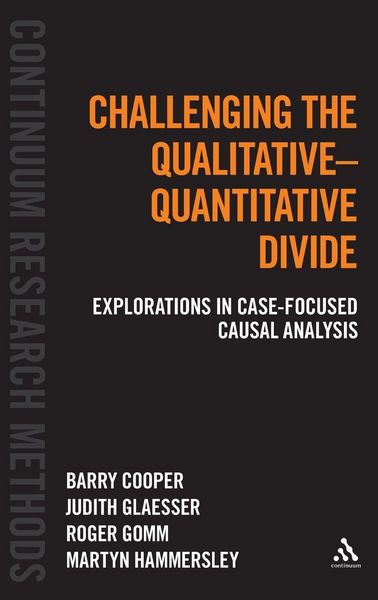
Challenging the Qualitative-Quantitative Divide Explorations in Case-Focused Causal Analysis
276,99 €
inkl. gesetzl. MwSt.,
Beschreibung
Produktdetails
Einband
Gebundene Ausgabe
Erscheinungsdatum
01.03.2012
Verlag
Bloomsbury 3PLSeitenzahl
288
Maße (L/B/H)
24/16,1/2 cm
Gewicht
599 g
Sprache
Englisch
ISBN
978-1-4411-7144-3
This book challenges the divide between qualitative and quantitative approaches that is now institutionalized within social science. Rather than suggesting the 'mixing' of methods, Challenging the Qualitative-Quantitative Divide provides a thorough interrogation of the arguments and practices characteristic of both sides of the divide, focusing on how well they address the common problems that all social research faces, particularly as regards causal analysis. The authors identify some fundamental weaknesses in both quantitative and qualitative approaches, and explore whether case-focused analysis - for instance, in the form of Qualitative Comparative Analysis, Analytic Induction, Grounded Theorising, or Cluster Analysis - can bridge the gap between the two sides.
Noch keine Bewertungen vorhanden
Verfassen Sie die erste Bewertung zu diesem Artikel
Helfen Sie anderen Kundinnen und Kunden durch Ihre Meinung.
Kurze Frage zu unserer Seite
Vielen Dank für Ihr Feedback
Wir nutzen Ihr Feedback, um unsere Produktseiten zu verbessern. Bitte haben Sie Verständnis, dass wir Ihnen keine Rückmeldung geben können. Falls Sie Kontakt mit uns aufnehmen möchten, können Sie sich aber gerne an unseren Kund*innenservice wenden.
zum Kundenservice