Beschreibung
Produktdetails
Einband
Gebundene Ausgabe
Erscheinungsdatum
01.09.2005
Herausgeber
Bernice W. Kliman + weitereVerlag
Bloomsbury USASeitenzahl
347
Maße (L/B/H)
23,4/15,7/2,8 cm
Gewicht
658 g
Sprache
Englisch
ISBN
978-1-61147-306-3
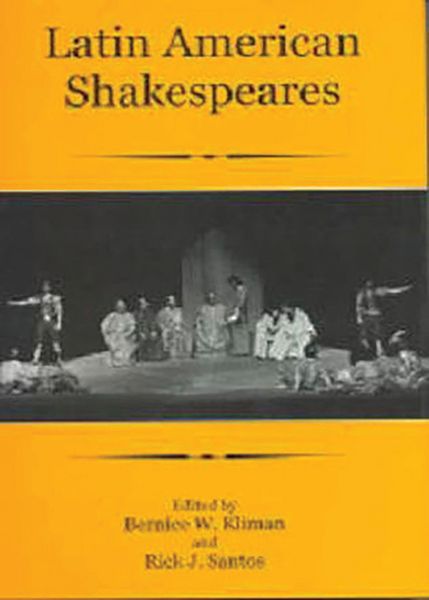
The subjects of the essays in Latin American Shakespeares range from the nineteenth century through the present; from high- to middle- to low-brow stories, plays, films, and poems; from Mexico to Argentina, Chile, Cuba, the U.S. barrio, and diverse sections of Brazil; from artists deservedly famous to artists undeservedly obscure. Shakespeare in Latin America is often implicated in struggles for power - tangentially or directly - and therefore swells the story of world wide political Shakespeare. For Latin American artists, the Shakespearean legacy is available for co-optation not only through parody, adaptation, and both reverent and irreverent (re)creation but also through absorption into unique indigenous genres.
Rick J. Santos in his introduction writes of mestizo Shakespeare - mixed as are the native, colonial, and immigrant populations throughout Latin America. In part 1, Jose Roberto O'Shea queries whether the father of Brazilian theatre can be an impresario who performed Shakespeare rather than encouraging native writers. Roberto Ferreira da Rocha explores how a planned political statement against a military dictatorship failed to make its point. Jesus Tronch-Perez discusses the independence of two adaptors of Hamlet who push the view of the inactive prince to its limits. Gregary J. Racz explains how Pablo Neruda acted upon his understanding of Romeo and Juliet as an exemplar of his views about society. Juan J. Zaro explores political exile Leon Felipe's spiritual rather than political approach. Catherine Boyle examines the translation of Lear by Nicanor Parra during the transitional period after the fall of the Pinochet dictatorship. Margarida Gandara Rauen offers a close-up view of Guilherme Schiffer Duraes's transgressive use of Caliban.
In part 2, Grace Tiffany explores Borges's oeuvre widely and deeply, confirming the fiction writer's fascination with the poet-playwright. Jose Luiz Passos clarifies the debt of Brazilian realist novelist Joaquim Maria Machado de
Noch keine Bewertungen vorhanden
Verfassen Sie die erste Bewertung zu diesem Artikel
Helfen Sie anderen Kundinnen und Kunden durch Ihre Meinung.
Kurze Frage zu unserer Seite
Vielen Dank für Ihr Feedback
Wir nutzen Ihr Feedback, um unsere Produktseiten zu verbessern. Bitte haben Sie Verständnis, dass wir Ihnen keine Rückmeldung geben können. Falls Sie Kontakt mit uns aufnehmen möchten, können Sie sich aber gerne an unseren Kund*innenservice wenden.
zum Kundenservice