• Produktbild: Plant Cell and Tissue Culture - A Tool in Biotechnology
  • Produktbild: Plant Cell and Tissue Culture - A Tool in Biotechnology

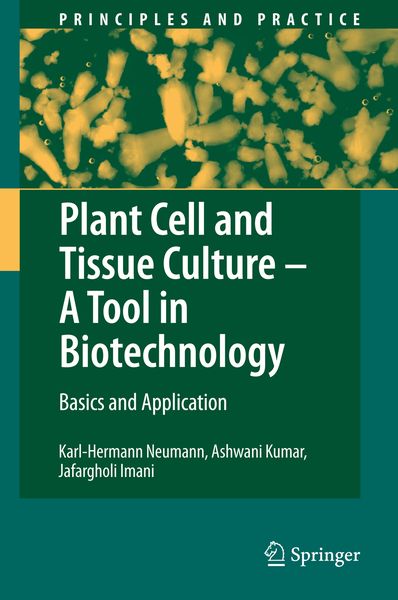
Plant Cell and Tissue Culture - A Tool in Biotechnology Basics and Application

Aus der Reihe Principles and Practice

201,99 €

inkl. gesetzl. MwSt., Versandkostenfrei


Beschreibung

Produktdetails

Einband

Taschenbuch

Erscheinungsdatum

21.10.2010

Abbildungen

IX, 153 illus., schwarz-weiss Illustrationen

Verlag

Springer Berlin

Seitenzahl

333

Maße (L/B/H)

23,5/15,5/1,9 cm

Auflage

1. Auflage

Sprache

Englisch

ISBN

978-3-642-10102-1

Beschreibung

Rezension

From the reviews: "The approach of including several examples and description of well-illustrated protocols from available primary literature and the author’s own laboratory experiences and helpful guidelines make this volume a gem for conventional tissue culture practices. … To the best of our experiences, this volume is suitable for both undergraduate and postgraduate level courses in life sciences, biotechnology, plant tissue culture, plant biotechnology … or plant science courses. We also recommend this volume for M.Tech., M.Phil., and PhD level courses in the above-mentioned areas and related disciplines." (S. K. Basu and A. Goyal, Applied Biochemistry and Biotechnology, November, 2009)

Produktdetails

Einband

Taschenbuch

Erscheinungsdatum

21.10.2010

Abbildungen

IX, 153 illus., schwarz-weiss Illustrationen

Verlag

Springer Berlin

Seitenzahl

333

Maße (L/B/H)

23,5/15,5/1,9 cm

Auflage

1. Auflage

Sprache

Englisch

ISBN

978-3-642-10102-1

Herstelleradresse

Springer-Verlag GmbH
Heidelberger Platz 3
14197 Berlin
Deutschland
Email: sdc-bookservice@springer.com
Url: www.springer.com
Telephone: +49 30 827870
Fax: +49 30 8214091

Noch keine Bewertungen vorhanden

Verfassen Sie die erste Bewertung zu diesem Artikel

Helfen Sie anderen Kundinnen und Kunden durch Ihre Meinung.

Kundinnen und Kunden meinen

Bewertungen (0)

  • Produktbild: Plant Cell and Tissue Culture - A Tool in Biotechnology
  • Produktbild: Plant Cell and Tissue Culture - A Tool in Biotechnology
  • 1 Introduction 2 Historical Developments of Cell and Tissue Culture Techniques 3 Callus Cultures
    3.1 Establishment of a Primary Culture from Explants of the Secondary Phloem of the Carrot Root
    3.2 Fermenter Cultures
    3.3 Immobilized Cell Cultures
    3.4 Nutrient Media
    3.5 Evaluation of Experiments
    3.6 Maintenance of Strains, Cryopreservation
    3.7 Some Physiological, Biochemical, and Histological Aspects 4 Cell Suspension Cultures
    4.1 Methods to Establish a Cell Suspension
    4.2 Cell Population Dynamics 5 Protoplast Cultures
    5.1 Production of Protoplasts
    5.2 Protoplast Fusion 6 Haploid Techniques
    6.1 Application Possibilities
    6.2 Physiological and Histological Background
    6.3 Methods for Practical Application
    6.4 Haploid Plants 7 Plant Propagation—Meristem Cultures, Somatic Embryogenesis
    7.1 General Remarks, and Meristem Cultures
    7.2 Protocols of Some Propagation Systems
    7.2.1 In Vitro Propagation of Cymbidium
    7.2.2 Meristem Cultures of Raspberries
    7.2.3 In Vitro Propagation of Anthurium
    7.3 Somatic Embryogenesis
    7.3.1 Basics of Somatic Embryogenesis
    7.3.2 Ontogenesis of Competent Cells
    7.3.3 Genetic Aspects—DNA Organization
    7.3.4 The Phytohormone System
    7.3.5 The Protein System
    7.3.6 Cell Cycle Studies
    7.4 Practical Application of Somatic Embryogenesis
    7.5 Artificial Seeds
    7.6 Embryo Rescue 8 Some Endogenous and Exogenous Factors in Cell Culture Systems
    8.1 Endogenous Factors
    8.1.1 Genetic Influences
    8.1.2 Physiological Status of 'Mother Tissue'
    8.1.3 Growth Conditions of the 'Mother Plant'
    8.2 Exogenous Factors
    8.2.1 Growth Regulators
    8.2.2 Nutritional Factors
    8.2.2.1 Improvement of Nutrient Uptake by Transgenic Carrot Cultures
    8.3 Physical Factors 9 Primary Metabolism
    9.1 Carbon Metabolism
    9.2Nitrogen Metabolism

    10 Secondary Metabolism
    10.1 Introduction
    10.2 Mechanism of Production of Secondary Metabolites
    10.3 Historical Background
    10.4 Plant Cell Cultures and Pharmaceuticals, and Other Biologically Active Compounds
    10.4.1 Antitumor Compounds
    10.4.2 Anthocyanin Production
    10.5 Strategies for Improvement of Metabolite Production
    10.5.1 Addition of Precursors, and Biotransformations
    10.5.2 Immobilization of Cells
    10.5.3 Differentiation and Secondary Metabolite Production
    10.5.4 Elicitation
    10.5.4.1 Jasmonic Acid
    10.5.4.2 Effect of UV on Production of Secondary Metabolites in Cultured Tissues
    10.6 Organ Cultures
    10.6.1 Shoot Cultures
    10.6.2 Root Cultures
    10.7 Genetic Engineering of Secondary Metabolites
    10.8 Membrane Transport and Accumulation of Secondary Metabolites
    10.9 Bioreactors
    10.9.1 Technical Aspects of Bioreactor Systems
    10.10 Prospects 11 Phytohormones and Growth Regulators 12 Cell Division, Cell Growth, Cell Differentiation 13 Genetic Problems and Gene Technology 13.1 Somaclonal Variations
    13.1.1 Ploidy Stability
    13.1.2 Some More Somaclonal Variations
    13.2 Gene Technology
    13.2.1 Transformation Techniques
    13.2.1.1 Direct Gene Transfer
    13.2.1.2 Agrobacterium-Mediated Gene Transformation
    13.2.2 Selectable Marker Genes
    13.2.2.1 Reporter Genes
    13.2.2.2 Variants of GFP
    13.2.3 ß-Glucuronidase (GUS)
    13.2.3.1 Procedures for Assay of GUS Gene Expression
    13.2.4 Antibiotics Resistance Genes
    13.2.5 Elimination of Marker Genes
    13.2.5.1 Cre-lox Recombination-Based Systems
    13.2.5.2 Ac/Ds System
    13.2.5.3 Double Cassette System
    13.2.6 Agrobacterium-Mediated Transformation in Dicotyledonous Plants
    13.2.6.1 Transgenic Carrot: Potential Source of Edible Vaccines
    13.2.6.2 Cell Culture and Transformation Procedures
    13.2.6.3 Uses of Transgenes to Increase Host Plant