Synthese natürlicher DNA Modifikationen und deren Detektion in DNA - Identifikation und Totalsynthese eines neuartigen DNA Photoschadens
-
- Taschenbuch ausgewählt
- eBook
-
Sprache:Englisch
42,95 €
inkl. gesetzl. MwSt.,
Beschreibung
Produktdetails
Einband
Taschenbuch
Erscheinungsdatum
21.09.2011
Verlag
Cuvillier, ESeitenzahl
250
Maße (L/B/H)
21/14,8/1,4 cm
Gewicht
329 g
Auflage
1. Auflage
Sprache
Englisch
ISBN
978-3-86955-882-0
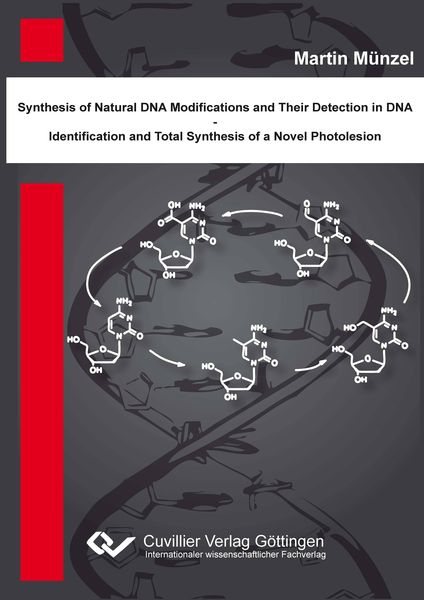
In the human body almost all cells contain the same genetic material; however, individual cells can perform vastly different functions. This is only possible, if different genes are active in different cell types. Furthermore, every cell stems from the same zygote; Hence the genetic information in cells needs to undergo reprogramming during differentiation. These processes require precise time dependent and robust control of gene expression, i.e. both stable and dynamic gene activation and silencing. The 'ATCG' DNA base sequence alone cannot control these processes. To enable the regulation of gene activity, cytosine bases in DNA can be further modified. The presence of methylated cytosines is long known to silence genes and aberrant methylation is the reason for many diseases including cancer. Thus, DNA modification is one of the most fundamental events in epigenetics.
To be able to detect methylated cytosines a methodology was developed that allows the efficient discrimination of cytosine and methylcytosine in DNA. The technique relies on different reaction products of the nucleosides with O-Allylhydroxylamine. These products exhibit different base pairing properties which can be readily detected by pyrosequencing.
As a further DNA modification, methylcytosine can be oxidized to hydroxymethylcytosine. By using a stable isotope dilution LC-MS approach the exact distribution of hydroxymethylcytosine in the mammalian body was determined for the first time. Especially high amounts of the nucleoside are present in the central nervous system. The hydroxymethylcytosine levels increase during brain development and are strongly reduced in cancerous tissue. It was furthermore investigated, if hydroxymethylcytosine was subject to further oxidation to formylcytosine and carboxylcytosine which - after final decarboxylation or excision by a glycosylase - would be an attractive mechanism for active DNA demethylation. This study ultimately led to the identification of formylcytosine and carboxylcytosine as constituents of mammalian DNA in our laboratory and by collaboration partners.
To enable the studies, natural and isotope labeled versions of the nucleosides were synthesized using Pd(0) catalyzed carbonylative couplings. This also allowed the design and synthesis of new phosphoramidite building blocks for the incorporation of hydroxymethylcytosine, formylcytosine and carboxylcytosine into DNA. Here, a cyclic carbamate was used as a protecting group in solid phase DNA synthesis for the first time.
DNA is not only subject to natural modifications, but can also be damaged by exogenous factors, of which UV light is one of the most prominent. The influence of UV light on CpG dinucleotides - the site of epigenetic modification - was investigated and new UV light induced DNA photolesions (the C(4-8)G and G(8-4)C photolesions) were identified. The photoproducts feature a bond between the exocyclic amino group of cytosine and a carbon atom on the 5 membered ring of guanine. The structures were proven by a total synthesis which featured a challenging Buchwald-Hartwig coupling as a key step. The identification of the DNA lesions shows that UV light does not only harm the genome but that it also disturbs the epigenetic information.
Noch keine Bewertungen vorhanden
Verfassen Sie die erste Bewertung zu diesem Artikel
Helfen Sie anderen Kundinnen und Kunden durch Ihre Meinung.
Kurze Frage zu unserer Seite
Vielen Dank für Ihr Feedback
Wir nutzen Ihr Feedback, um unsere Produktseiten zu verbessern. Bitte haben Sie Verständnis, dass wir Ihnen keine Rückmeldung geben können. Falls Sie Kontakt mit uns aufnehmen möchten, können Sie sich aber gerne an unseren Kund*innenservice wenden.
zum Kundenservice