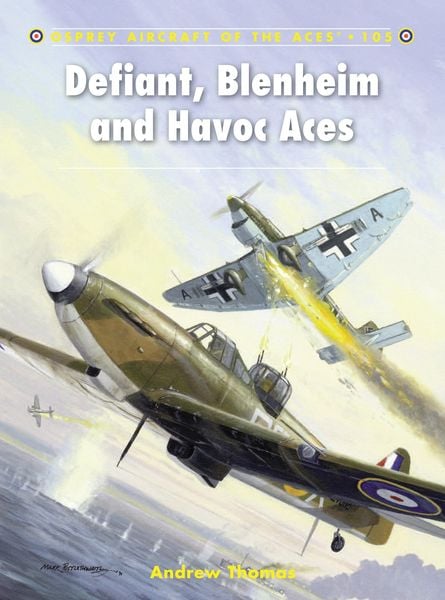
Defiant, Blenheim and Havoc Aces
-
- Taschenbuch ausgewählt
- eBook
-
Sprache:Englisch
22,99 €
inkl. gesetzl. MwSt.,
Beschreibung
Produktdetails
Einband
Taschenbuch
Erscheinungsdatum
19.06.2012
Illustriert von
Mark Postlethwaite
Verlag
Osprey PublishersSeitenzahl
96
Maße (L/B/H)
25,8/18,7/1 cm
Gewicht
308 g
Sprache
Englisch
ISBN
978-1-84908-666-0
The World War 1 concept of the two-seat fighter persisted during the interwar period, with the RAF's biplane Demons being replaced by the twin-engined Blenheim IF - a fighter derivative of the light bomber then in service. By the start of World War 2 four regular and three Auxiliary squadrons of Fighter Command flew them, although very soon over a dozen more received them, albeit some used the Blenheim as interim equipment. The Blenheim IF flew some of Fighter Command's early offensive operations, and the type soon proved vulnerable when pitted against single-seat fighters. However, for much of 1940 the Blenheim fighter squadrons provided the RAF's main long-range convoy escort and nightfighter capability. Indeed it was a Blenheim that achieved the first night victory using then secret airborne radar, and many of the RAF's leading nightfighter aces were to learn their craft when flying the type. In the mid-1930s, in an attempt to capitalise on its expertise in power-operated gun turrets, the Boulton Paul company developed the Defiant, a single-engined fighter in which all the armament was concentrated in the turret behind the pilot. Intended as a 'bomber destroyer', the Defiant had its combat debut over Dunkirk, and initially achieved some considerable success. It sustained heavy losses when confronted by single-seat fighters, however. Later, with the Battle of Britain at its height, the two Defiant squadrons were deployed to southeast England, where, in spite of some early victories, they sustained crippling losses. These units, joined by a further ten squadrons, were then switched to nightfighter work, and achieved considerable success in holding the line through the night Blitz. The last examples were not finally withdrawn from frontline units until 1942. The fall of France saw an increasing number of American-built aircraft that had been ordered by the French government flown to Britain, including large numbers of Douglas DB-7 light bombers. Named Havoc by the RAF, some were fitted with radar for nightfighter duties and others replaced the Blenheim as night intruders. They proved successful in both roles. Less successfully, Havocs were also modified to mount an airborne searchlight to illuminate enemy bombers whilst others were employed as airborne minelayers to lay parachute mines ahead of enemy bombers. A total of 11 pilots claimed five or more victories when flying these three types to become aces, whilst no fewer than became 33 more aces claimed at least part of their scores when flying the Blenheim, Defiant or Havoc. More than 100 further aces also flew them, often honing and developing their skills before moving onto more efficacious nightfighters such as the Mosquito or Beaufighter.
Noch keine Bewertungen vorhanden
Verfassen Sie die erste Bewertung zu diesem Artikel
Helfen Sie anderen Kundinnen und Kunden durch Ihre Meinung.
Kurze Frage zu unserer Seite
Vielen Dank für Ihr Feedback
Wir nutzen Ihr Feedback, um unsere Produktseiten zu verbessern. Bitte haben Sie Verständnis, dass wir Ihnen keine Rückmeldung geben können. Falls Sie Kontakt mit uns aufnehmen möchten, können Sie sich aber gerne an unseren Kund*innenservice wenden.
zum Kundenservice