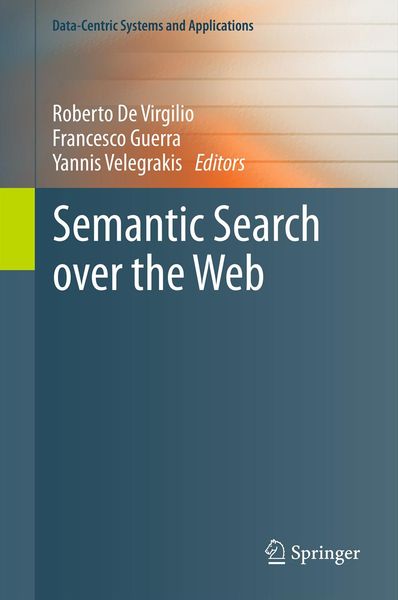
Semantic Search over the Web
-
- Hardcover ausgewählt
- Taschenbuch
- eBook
-
Sprache:Englisch
49,99 €
inkl. gesetzl. MwSt.,
Beschreibung
Produktdetails
Einband
Gebundene Ausgabe
Erscheinungsdatum
04.08.2012
Herausgeber
Roberto De Virgilio + weitereVerlag
Springer BerlinSeitenzahl
420
Maße (L/B/H)
24,1/16/2,8 cm
Gewicht
811 g
Auflage
2012
Sprache
Englisch
ISBN
978-3-642-25007-1
The Web has become the world’s largest database, with search being the main tool that allows organizations and individuals to exploit its huge amount of information. Search on the Web has been traditionally based on textual and structural similarities, ignoring to a large degree the semantic dimension, i.e., understanding the meaning of the query and of the document content. Combining search and semantics gives birth to the idea of semantic search. Traditional search engines have already advertised some semantic dimensions. Some of them, for instance, can enhance their generated result sets with documents that are semantically related to the query terms even though they may not include these terms. Nevertheless, the exploitation of the semantic search has not yet reached its full potential.
In this book, Roberto De Virgilio, Francesco Guerra and Yannis Velegrakis present an extensive overview of the work done in Semantic Search and other related areas. They explore different technologies and solutions in depth, making their collection a valuable and stimulating reading for both academic and industrial researchers.
The book is divided into three parts. The first introduces the readers to the basic notions of the Web of Data. It describes the different kinds of data that exist, their topology, and their storing and indexing techniques. The second part is dedicated to Web Search. It presents different types of search, like the exploratory or the path-oriented, alongside methods for their efficient and effective implementation. Other related topics included in this part are the use of uncertainty in query answering, the exploitation of ontologies, and the use of semantics in mashup design and operation. The focus of the third part is on linked data, and more specifically, on applying ideas originating in recommender systems on linked data management, and on techniques for the efficiently querying answering on linkeddata.
Kundinnen und Kunden meinen
Verfassen Sie die erste Bewertung zu diesem Artikel
Helfen Sie anderen Kund*innen durch Ihre Meinung
Kurze Frage zu unserer Seite
Vielen Dank für Ihr Feedback
Wir nutzen Ihr Feedback, um unsere Produktseiten zu verbessern. Bitte haben Sie Verständnis, dass wir Ihnen keine Rückmeldung geben können. Falls Sie Kontakt mit uns aufnehmen möchten, können Sie sich aber gerne an unseren Kund*innenservice wenden.
zum Kundenservice