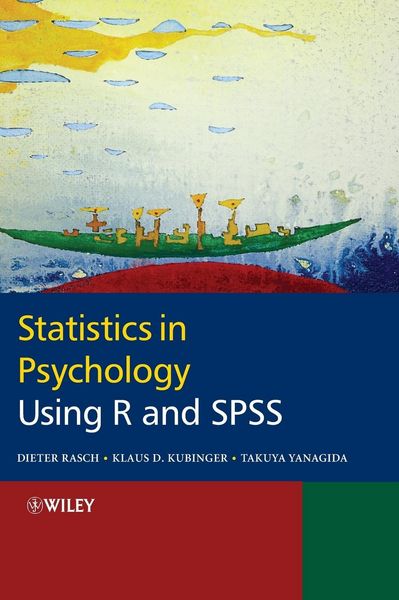
• Produktbild: Statistics in Psychology Using R and SPSS
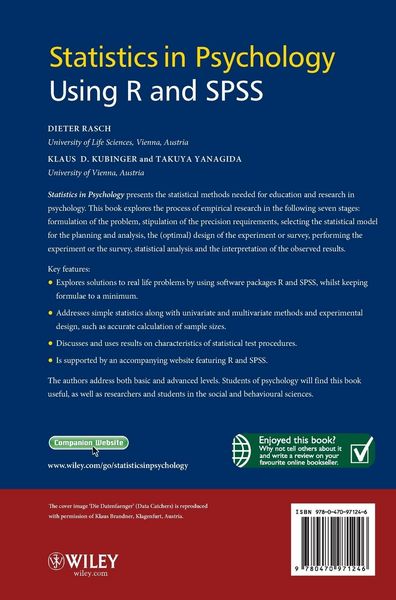
  • Produktbild: Statistics in Psychology Using R and SPSS

Statistics in Psychology Using R and SPSS

119,99 €

inkl. gesetzl. MwSt., Versandkostenfrei


Beschreibung

Produktdetails

Einband

Gebundene Ausgabe

Erscheinungsdatum

12.12.2011

Verlag

John Wiley & Sons

Seitenzahl

564

Maße (L/B/H)

26/18,3/3,5 cm

Gewicht

998 g

Auflage

1. Auflage

Sprache

Englisch

ISBN

978-0-470-97124-6

Beschreibung

Produktdetails

Einband

Gebundene Ausgabe

Erscheinungsdatum

12.12.2011

Verlag

John Wiley & Sons

Seitenzahl

564

Maße (L/B/H)

26/18,3/3,5 cm

Gewicht

998 g

Auflage

1. Auflage

Sprache

Englisch

ISBN

978-0-470-97124-6

Herstelleradresse

Libri GmbH
Europaallee 1
36244 Bad Hersfeld
DE

Email: gpsr@libri.de

Kundinnen und Kunden meinen

0 Bewertungen

Informationen zu Bewertungen

Zur Abgabe einer Bewertung ist eine Anmeldung im Konto notwendig. Die Authentizität der Bewertungen wird von uns nicht überprüft. Wir behalten uns vor, Bewertungstexte, die unseren Richtlinien widersprechen, entsprechend zu kürzen oder zu löschen.

Die Bewertungen sind nach Format, Anzahl Sterne und Datum sortiert.

Verfassen Sie die erste Bewertung zu diesem Artikel

Helfen Sie anderen Kund*innen durch Ihre Meinung

Kundinnen und Kunden meinen

0 Bewertungen filtern

Die Leseprobe wird geladen.
  • Produktbild: Statistics in Psychology Using R and SPSS
  • Produktbild: Statistics in Psychology Using R and SPSS
  • Introduction.

    1 Concept of the Book.

    2 Measuring in Psychology.

    2.1 Types of psychological measurements.

    2.2 Measurement techniques in psychological assessment.

    2.3 Quality criteria in psychometrics.

    2.4 Additional psychological measurement techniques.

    2.5 Statistical models of measurement with psychological roots.

    3 Psychology: An Empirical Science.

    3.1 Gain of insight in psychology.

    3.2 Steps of empirical research.

    4 Definition: Character, Chance, Experiment, and Survey.

    4.1 Nominal scale.

    4.2 Ordinal scale.

    4.3 Interval scale.

    4.4 Ratio scale.

    4.5 Characters and factors.

    II Descriptive Statistics.

    5 Numerical and graphical Data Analysis.

    5.1 Introduction to data analysis.

    5.2 Frequencies and empirical distributions.

    5.3 Statistics.

    5.4 Frequency distribution for several characters.

    III Inferential Statistics for one Character.

    6 Probability and  distribution.

    6.1 Relative frequencies and probabilities.

    6.2 Random variable and theoretical distributions.

    6.3 Quantiles of theoretical distribution functions.

    6.4 Mean and variance of theoretical distributions.

    6.5 Estimation of unknown parameters.

    7 Assumptions: Random Sampling and Randomization.

    7.1 Simple random sampling in surveys.

    7.2 Principles of random sampling and randomization.

    8 One Sample from one Population.

    8.1 Introduction.

    8.2 The Parameter mof acharacter modeled by a normally distributed random variable.

    8.3 Planning a study for hypothesis testing with respect to m.

    8.4 Sequential tests for the unknown parameter m.

    8.5 Estimation, hypothesis testing, planning the study, and sequential testing concerning other parameters.

    9 Two Samples from two Populations.

    9.1 Hypothesis testing, study planning and sequential testing regarding the unknown parameters m1 and m2.

    9.2 Hypothesis testing, study planning and sequential testing for other parameters.

    9.3 Equivalence testing.

    10 Samples from more than two Populations.

    10.1 The various problem situations.

    10.2. Selection procedures.

    10.3 Multiple comparisons of means.

    10.4 Analysis of variance.

    IV Descriptive and Inferential Statistics for two Characters.

    11 Regression and Correlation.

    11.1 Introduction.

    11.2 Regression model.

    11.3 Correlation coefficients and measures of association.

    11.4 Hypothesis testing and planning the study concerning correlation coefficients.

    11.5 Correlation analysis in two samples.

    V Inferential Statistics for more than two Characters.

    12 One Sample from one Population.

    12.1 Association between three or more characters.

    12.2 Hypothesis testing concerning a vector of means m.

    12.3 Comparisons of means and "homological" methods for matched observations.

    13 Samples from more than one Population.

    13.1 General linear model.

    13.2 Analysis of covariance.

    13.3. Multivariate analysis of variance.

    13.4 Discriminant analysis.

    VI Model Generation and Theory-Generating Procedures.

    14 Model Generation.

    14.1 Theoretical basics of model generation.

    14.2 Methods for determining the quality and excellence of a model.

    14.2.1 Goodness of fit tests.

    14.2.2 Coefficients of the goodness of fit.

    14.2.3 Cross-validation.

    14.4 Simulation: Non-analytical solutions to statistical problems.

    15 Theory-Generating Procedures.

    15.1 Descriptive statistics' methods.

    15.2 Methods of inferential statistics.