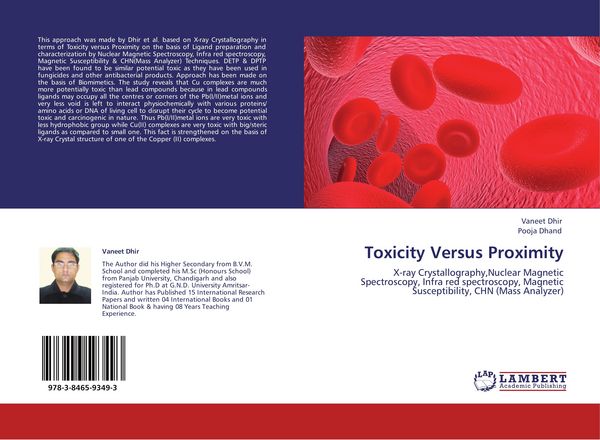
Toxicity Versus Proximity X-ray Crystallography,Nuclear Magnetic Spectroscopy, Infra red spectroscopy, Magnetic Susceptibility, CHN (Mass Analyzer)
-
- Englisch ausgewählt
43,99 €
UVP
49,00 €
inkl. gesetzl. MwSt.,
Beschreibung
Produktdetails
Einband
Taschenbuch
Erscheinungsdatum
23.11.2011
Verlag
LAP LAMBERT Academic PublishingSeitenzahl
64
Maße (L/B/H)
22/15/0,4 cm
Gewicht
113 g
Auflage
1. Auflage
Sprache
Englisch
ISBN
978-3-8465-9349-3
This approach was made by Dhir et al. based on X-ray Crystallography in terms of Toxicity versus Proximity on the basis of Ligand preparation and characterization by Nuclear Magnetic Spectroscopy, Infra red spectroscopy, Magnetic Susceptibility & CHN(Mass Analyzer) Techniques. DETP & DPTP have been found to be similar potential toxic as they have been used in fungicides and other antibacterial products. Approach has been made on the basis of Biomimetics. The study reveals that Cu complexes are much more potentially toxic than lead compounds because in lead compounds ligands may occupy all the centres or corners of the Pb(I/II)metal ions and very less void is left to interact physiochemically with various proteins/ amino acids or DNA of living cell to disrupt their cycle to become potential toxic and carcinogenic in nature. Thus Pb(I/II)metal ions are very toxic with less hydrophobic group while Cu(II) complexes are very toxic with big/steric ligands as compared to small one. This fact is strengthened on the basis of X-ray Crystal structure of one of the Copper (II) complexes.
Kundinnen und Kunden meinen
Verfassen Sie die erste Bewertung zu diesem Artikel
Helfen Sie anderen Kund*innen durch Ihre Meinung
Kurze Frage zu unserer Seite
Vielen Dank für Ihr Feedback
Wir nutzen Ihr Feedback, um unsere Produktseiten zu verbessern. Bitte haben Sie Verständnis, dass wir Ihnen keine Rückmeldung geben können. Falls Sie Kontakt mit uns aufnehmen möchten, können Sie sich aber gerne an unseren Kund*innenservice wenden.
zum Kundenservice