Produktbild: Automata, Languages and Programming
Band 1256

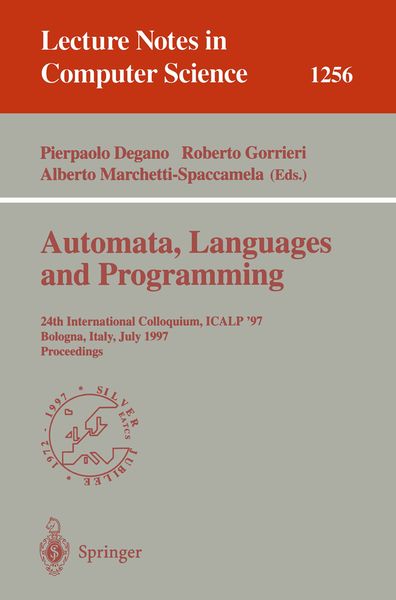
Automata, Languages and Programming 24th International Colloquium, ICALP'97, Bologna, Italy, July 7 - 11, 1997, Proceedings

97,99 €

inkl. gesetzl. MwSt., Versandkostenfrei


Beschreibung

Produktdetails

Einband

Taschenbuch

Erscheinungsdatum

18.06.1997

Herausgeber

Pierpaolo Degano + weitere

Verlag

Springer Berlin

Seitenzahl

864

Maße (L/B/H)

23,6/15,9/5 cm

Gewicht

1322 g

Auflage

1997

Sprache

Englisch

ISBN

978-3-540-63165-1

Beschreibung

Produktdetails

Einband

Taschenbuch

Erscheinungsdatum

18.06.1997

Herausgeber

Verlag

Springer Berlin

Seitenzahl

864

Maße (L/B/H)

23,6/15,9/5 cm

Gewicht

1322 g

Auflage

1997

Sprache

Englisch

ISBN

978-3-540-63165-1

Herstelleradresse

Springer Nature Customer Service Center GmbH
Europaplatz 3
69115 Heidelberg
DE
ProductSafety@springernature.com

Kundinnen und Kunden meinen

0 Bewertungen

Informationen zu Bewertungen

Zur Abgabe einer Bewertung ist eine Anmeldung im Konto notwendig. Die Authentizität der Bewertungen wird von uns nicht überprüft. Wir behalten uns vor, Bewertungstexte, die unseren Richtlinien widersprechen, entsprechend zu kürzen oder zu löschen.

Die Bewertungen sind nach Format, Anzahl Sterne und Datum sortiert.

Verfassen Sie die erste Bewertung zu diesem Artikel

Helfen Sie anderen Kund*innen durch Ihre Meinung

Kundinnen und Kunden meinen

0 Bewertungen filtern

  • Produktbild: Automata, Languages and Programming
  • Graphical calculi for interaction.- NP-completeness: A retrospective.- The LEDA platform for combinatorial and geometric computing.- The Wadge-Wagner hierarchy of ?-rational sets.- From chaotic iteration to constraint propagation.- DNA2DNA computations: A potential “killer app”?.- Tilings and quasiperiodicity.- Enumerative sequences of leaves in rational trees.- A completion algorithm for codes with bounded synchronization delay.- The expressibility of languages and relations by word equations.- Finite loops recognize exactly the regular open languages.- An abstract data type for real numbers.- Recursive computational depth.- Some bounds on the computational power of piecewise constant derivative systems (extended abstract).- Monadic simultaneous rigid E-unification and related problems.- Computability on the probability measures on the Borel sets of the unit interval.- Worst-case hardness suffices for derandomization: A new method for hardness-randomness trade-offs.- Results on resource-bounded measure.- Randomization and nondeterminism are comparable for ordered read-once branching programs.- Checking properties of polynomials.- Exact analysis of Dodgson elections: Lewis Carroll's 1876 voting system is complete for parallel access to NP.- Game theoretic analysis of call-by-value computation.- On modular properties of higher order extensional lambda calculi.- On explicit substitutions and names (extended abstract).- On the dynamics of sharing graphs.- Minimizing diameters of dynamic trees.- Improving spanning trees by upgrading nodes.- Dynamic algorithms for graphs of bounded treewidth.- The name discipline of uniform receptiveness (extended abstract).- On confluence in the ?-calculus.- A proof theoretical approach to communication.- Solving trace equations using lexicographical normal forms.- Star-free picture expressions are strictly weaker than first-order logic.- An algebra-based method to associate rewards with EMPA terms.- A semantics preserving actor translation.- Periodic and non-periodic min-max equations.- Efficient parallel graph algorithms for coarse grained multicomputers and BSP.- Upper bound on the communication complexity of private information retrieval.- Computation paths logic: An expressive, yet elementary, process logic.- Model checking the full modal mu-calculus for infinite sequential processes.- Symbolic model checking for probabilistic processes.- On the concentration of the height of binary search trees.- An improved master theorem for divide-and-conquer recurrences.- Bisimulation for probabilistic transition systems: A coalgebraic approach.- Distributed processes and location failures.- Basic observables for processes.- Constrained bipartite edge coloring with applications to wavelength routing.- Colouring paths in directed symmetric trees with applications to WDM routing.- On-line routing in all-optical networks.- A complete characterization of the path layout construction problem for ATM networks with given hop count and load.- Efficiency of asynchronous systems and read arcs in petri nets.- Bisimulation equivalence is decidable for one-counter processes.- Symbolic reachability analysis of FIFO-channel systems with nonregular sets of configurations.- Axiomatizations for the perpetual loop in process algebra.- Discrete-time control for rectangular hybrid automata.- Maintaining minimum spanning trees in dynamic graphs.- Efficient splitting and merging algorithms for order decomposable problems.- Efficient array partitioning.- Constructive linear time algorithms for branchwidth.- The word matching problem is undecidable for finite special string-rewriting systems that are confluent.- The geometry of orthogonal reduction spaces.- The theory of vaccines.- The equivalence problem for deterministic pushdown automata is decidable.- On recognizable and rational formal power series in partially commuting variables.- On a conjecture of J. Shallit.- On characterizations of escrow encryption schemes.- Randomness-efficient non-interactive zero knowledge.- Approximation results for the optimum cost chromatic partition problem.- The minimum color sum of bipartite graphs.- A primal-dual approach to approximation of node-deletion problems for matroidal properties.- Independent sets in asteroidal triple-free graphs.- Refining and compressing abstract domains.- Labelled reductions, runtime errors, and operational subsumption.- A complete and efficiently computable topological classification of D-dimensional linear cellular automata over Z m .- Recognizability equals definability for partial k-paths.- Molecular computing, bounded nondeterminism, and efficient recursion.- Constructing big trees from short sequences.- Termination of constraint logic programs.- The expressive power of unique total stable model semantics.