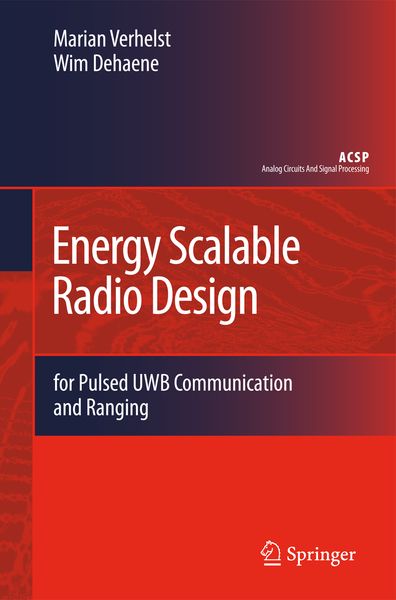
Energy Scalable Radio Design for Pulsed UWB Communication and Ranging
-
- Hardcover
- Taschenbuch ausgewählt
-
Sprache:Englisch
139,99 €
UVP
160,49 €
inkl. gesetzl. MwSt.,
Beschreibung
Produktdetails
Einband
Taschenbuch
Erscheinungsdatum
29.11.2011
Verlag
Springer NetherlandSeitenzahl
243
Maße (L/B/H)
23,5/15,5/1,5 cm
Gewicht
400 g
Auflage
1. Auflage
Sprache
Englisch
ISBN
978-94-007-2610-9
Smart energy management, both at design time and at run time, is indispensable in modern radios. It requires a careful trade-off between the system’s performance, and its power consumption. Moreover, the design has to be dynamically reconfigurable to optimally balance these parameters at run time, depending on the current operating conditions.
Energy Scalable Radio Design describes and applies an energy-driven design strategy to the design of an energy-efficient, highly scalable, pulsed UWB receiver, suitable for low data rate communication and sub-cm ranging. This book meticulously covers the different design steps and the adopted optimizations: System level air interface selection, architectural/algorithmic design space exploration, algorithmic refinement (acquisition, synchronization and ranging algorithms) and circuit level (RTL) implementation based on the FLEXmodule-concept. Measurement results demonstrate the effectiveness and necessity of the energy-driven design strategy.
Noch keine Bewertungen vorhanden
Verfassen Sie die erste Bewertung zu diesem Artikel
Helfen Sie anderen Kundinnen und Kunden durch Ihre Meinung.
Kurze Frage zu unserer Seite
Vielen Dank für Ihr Feedback
Wir nutzen Ihr Feedback, um unsere Produktseiten zu verbessern. Bitte haben Sie Verständnis, dass wir Ihnen keine Rückmeldung geben können. Falls Sie Kontakt mit uns aufnehmen möchten, können Sie sich aber gerne an unseren Kund*innenservice wenden.
zum Kundenservice