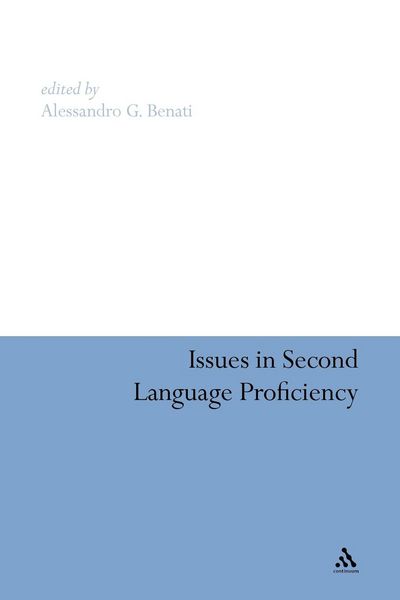
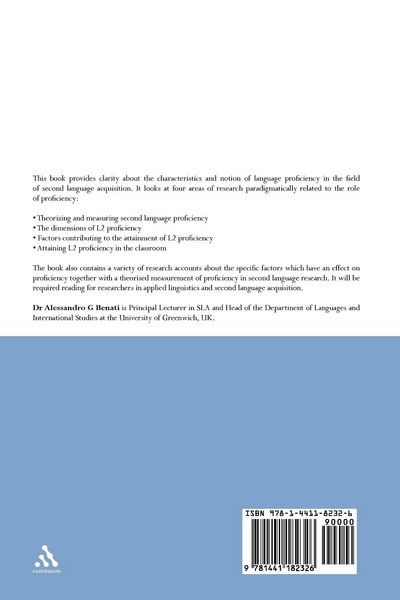
• Produktbild: Issues in Second Language Proficiency
  • Produktbild: Issues in Second Language Proficiency

Issues in Second Language Proficiency

64,99 €

inkl. gesetzl. MwSt., Versandkostenfrei


Beschreibung

Produktdetails

Einband

Taschenbuch

Erscheinungsdatum

27.10.2011

Herausgeber

Alessandro G. Benati

Verlag

Bloomsbury

Seitenzahl

270

Maße (L/B/H)

23,4/15,6/1,5 cm

Gewicht

415 g

Sprache

Englisch

ISBN

978-1-4411-8232-6

Beschreibung

Produktdetails

Einband

Taschenbuch

Erscheinungsdatum

27.10.2011

Herausgeber

Alessandro G. Benati

Verlag

Bloomsbury

Seitenzahl

270

Maße (L/B/H)

23,4/15,6/1,5 cm

Gewicht

415 g

Sprache

Englisch

ISBN

978-1-4411-8232-6

Herstelleradresse

Libri GmbH
Europaallee 1
36244 Bad Hersfeld
DE

Email: gpsr@libri.de

Noch keine Bewertungen vorhanden

Verfassen Sie die erste Bewertung zu diesem Artikel

Helfen Sie anderen Kundinnen und Kunden durch Ihre Meinung.

Kundinnen und Kunden meinen

Bewertungen (0)

Die Leseprobe wird geladen.
  • Produktbild: Issues in Second Language Proficiency
  • Produktbild: Issues in Second Language Proficiency
  • Acknowledgements
    Introduction
    1. Attaining second language proficiency, Alessandro Benati (University of Greenwich, United Kingdom)
    Part I: Theory and dimensions of second language proficiency
    2. What is 'priming', and what might priming techniques be able to tell us about L2 learning and proficiency? Emma Marsden (University of York, United Kingdom)
    3. Cross-linguistic influence in L2 verb frames: the effects of word familiarity and language proficiency, Christopher J Hall (York St John University, United Kingdom) and Areli Reyes (Universidad Autónoma de Tlaxcala, Mexico)
    4. The role of working memory in the development of L2 grammatical proficiency, Clare Wright (Newcastle University, United Kingdom)
    Part II: Factors contributing to the attainment of L2 proficiency
    5. Statistical learning and innate knowledge in the development of second language proficiency: evidence from the acquisition of gender concord, Roger Hawkins (University of Essex, United Kingdom)
    6. Metalinguistic knowledge: A stepping stone towards L2 proficiency? Karen Roehr (University of Essex, United Kingdom) and Gabriela Adela Gánem- Gutiérrez (University of Essex, United Kingdom)
    7. The development of vocabulary proficiency in relation to learning style, Paul Booth (Kingston University, United Kingdom)
    8. Second language reading proficiency and word recognition: The concept of saliency and its application across different scripts, Mick Randall (British University in Dubai, Dubai)
    9. L2 proficiency: measuring the intelligibility of words and extended speech, Sara Kennedy (McGill University, Montréal, Canada)
    10. English with a native-like accent: an empirical study on proficiency, Tanja Angelovska & Angela Hahn (University of Munich, Germany) Part 3: Attaining L2 proficiency in the classroom
    11. Formal intervention and the development of proficiency: the role of explicit Formation, Bill Van Patten (Texas Tech University, United States of America)
    12. Secondary and cumulative effects in attaining L2 proficiency in the classroom. Alessandro Benati (University of Greenwich, United Kingdom), James Lee (University of New South Wales, Australia) and Cecile Laval (University of Greenwich, United Kingdom)
    13. Models of speaking and the assessment of second language proficiency. Peter Skehan (Chinese University of Hong Kong, China)
    14. Researching task difficulty: towards understanding L2 proficiency. Parvaneh Tavakoli (London Metropolitan University, United Kingdom)
    15. On transfer, proficiency and cross-individual/aggregate SLA differences: Examining Adjectival Semantics in L2 Spanish, Pedro Guijarro-Fuentes (University of Plymouth, United Kingdom), Tiffany Judy (University of Iowa, United States of America) and Jason Rothman (University of Plymouth, United Kingdom)

    Index