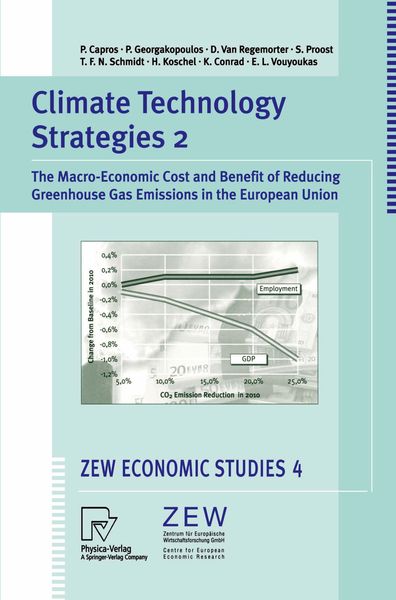
• Produktbild: Climate Technology Strategies 2
  • Produktbild: Climate Technology Strategies 2
Band 4

Climate Technology Strategies 2 The Macro-Economic Cost and Benefit of Reducing Greenhouse Gas Emissions in the European Union

Aus der Reihe ZEW Economic Studies

48,99 €

inkl. gesetzl. MwSt., Versandkostenfrei


Beschreibung

Produktdetails

Einband

Taschenbuch

Erscheinungsdatum

14.10.1999

Verlag

Physica

Seitenzahl

224

Maße (L/B/H)

23,5/15,5/1,3 cm

Gewicht

760 g

Auflage

1. Auflage

Sprache

Englisch

ISBN

978-3-7908-1230-5

Beschreibung

Produktdetails

Einband

Taschenbuch

Erscheinungsdatum

14.10.1999

Verlag

Physica

Seitenzahl

224

Maße (L/B/H)

23,5/15,5/1,3 cm

Gewicht

760 g

Auflage

1. Auflage

Sprache

Englisch

ISBN

978-3-7908-1230-5

Herstelleradresse

Physica Verlag
Tiergartenstr. 17
69121 Heidelberg
DE

Email: ProductSafety@springernature.com

Noch keine Bewertungen vorhanden

Verfassen Sie die erste Bewertung zu diesem Artikel

Helfen Sie anderen Kundinnen und Kunden durch Ihre Meinung.

Kundinnen und Kunden meinen

Bewertungen (0)

  • Produktbild: Climate Technology Strategies 2
  • Produktbild: Climate Technology Strategies 2
  • 1 Introduction.- 1.1 The Economic Cost of CO2 Abatement.- 1.2 Structure of the Volume.- 2 Literature Review.- 2.1 Introduction.- 2.2 Models and Studies for the Cost of Ghg Abatement.- 2.3 Gaps From Previous Studies and Directions of Future Research.- 3 Definition Of Policy Instruments And Criteria For Their Assessment.- 3.1 Introduction.- 3.2 Criteria for the Assessment of Environmental Policy Instruments.- 3.3 Selected Environmental Policy Instruments.- 3.4 Evaluation of Environmental Policy Instruments.- 3.5 Conclusions.- 4 Baseline Scenario for the Eu and Overview of Policy Simulations.- 4.1 Introduction.- 4.2 The Baseline Scenario: The European Economy To 2010.- 4.3 Environmental Constraints in The Gem-E3 Model: An Overview of the Model Mechanisms.- 4.4 Definition of the Policy Scenarios.- 5 The Cost of Meeting Emission Reduction Targets: Pollution Permits.- 6 The Role of Accompanying Policies.- 6.1 Recycling Through the Reduction of Labour Costs.- 6.2 Recycling Through the Reduction Of Investment Costs.- 6.3 No Recycling.- 7 The Role of Energy Saving Investment.- 7.1 Model Specification.- 7.2 Simulation Results.- 8 Internalisation of Externalities.- 8.1 Introduction.- 8.2 Methodology.- 8.3 The Externalities and Their Damage Valuation.- 8.4 The Internalisation Scenario.- 8.5 Simulation Results.- 9 Burden Sharing.- 9.1 Introduction.- 9.2 Equity and Efficiency.- 9.3 Operationalisation of Equity Rules.- 9.4 The Burden Sharing Issue in the Eu Context.- 9.5 Simulation of an Eu Wide Permit Scheme Under Alternative Equity Rules.- 9.6 Conclusion.- 10 Sensitivity Analysis.- 10.1 Labour Market Rigidities and the Double Dividend Issue.- 10.2 World Context.- 11 Conclusions.- 11.1 Emission Abatement and Sustainable Development.- 11.2 Policy Instruments.- 11.3 Policy Evaluation Criteria and Main Results.- 12 Appendix: Brief Description of Models Used in the Study.- 12.1 GEM-E3.- List of Figures.- List of Tables.- References.