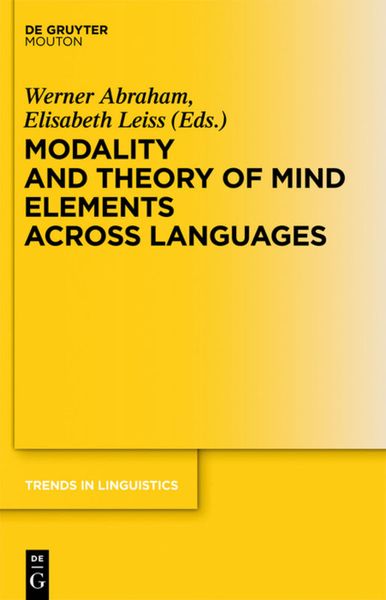
Modality and Theory of Mind Elements across Languages
171,99 €
inkl. gesetzl. MwSt.,
Beschreibung
Produktdetails
Einband
Gebundene Ausgabe
Erscheinungsdatum
18.05.2012
Abbildungen
mit 24 Illustrationen, mit 8 tblättern
Herausgeber
Werner Abraham + weitereVerlag
De Gruyter MoutonSeitenzahl
460
Maße (L/B/H)
23,6/16/3,1 cm
Gewicht
825 g
Auflage
1
Sprache
Englisch
ISBN
978-3-11-027019-8
Modality is the way a speaker modifies her declaratives and other speech acts to optimally assess the common ground of knowledge and belief of the addressee with the aim to optimally achieve understanding and an assessment of relevant information exchange.
In languages such as German (and other Germanic languages outside of English), this may happen in covert terms. Main categories used for this purpose are modal adverbials ("modal particles") and modal verbs. Epistemic uses of modal verbs (like German sollen ) cover evidential (reportative) information simultaneously providing the source of the information.
Methodologically, description and explanation rest on Karl Bühler's concept of Origo as well as Roman Jakobson's concept of shifter. Typologically, East Asian languages such as Japanese pursue these semasiological fundaments far more closely than the European languages. In particular, Japanese has to mark the source of a statement in the declarative mode such that the reliability may be assessed by the hearer.
The contributions in this collection provide insight into these modal techniques.
Kundinnen und Kunden meinen
Verfassen Sie die erste Bewertung zu diesem Artikel
Helfen Sie anderen Kund*innen durch Ihre Meinung
Kurze Frage zu unserer Seite
Vielen Dank für Ihr Feedback
Wir nutzen Ihr Feedback, um unsere Produktseiten zu verbessern. Bitte haben Sie Verständnis, dass wir Ihnen keine Rückmeldung geben können. Falls Sie Kontakt mit uns aufnehmen möchten, können Sie sich aber gerne an unseren Kund*innenservice wenden.
zum Kundenservice